
Laura Bassi
Italian physicist, teacher and philosopher, the first woman to earn a doctorate in science and the first salaried female university lecturer · 1711–1778
- Born
- October 29, 1711
- Died
- February 20, 1778
- Country
- Papal States
- Section
- Physics
Biography
Laura Bassi (Bologna, 1711-1778) was an Italian physicist, teacher and philosopher, regarded as the first woman to earn a doctorate in science and the first to be paid as a university lecturer. She lived in eighteenth-century Italy, when universities were almost closed to women, and her career shows that talent was not tied to sex, even if the rules of the time often held women back.
Born on 29 October 1711 in Bologna, then part of the Papal States, she was the only daughter of a lawyer originally from Modena and of a lower middle-class family. She never attended school. Until the age of thirteen she studied Latin, French and arithmetic with her cousin, Father Lorenzo Stegani. She then worked with Gaetano Tacconi, the family physician and a university professor, who taught her philosophy, mathematics, mechanics, chemistry and natural history. Tacconi also trained her in academic debate and introduced her to the city's intellectual circles.
Among those who took notice of her was Prospero Lambertini, Archbishop of Bologna and future Pope Benedict XIV, who became her patron. On 20 March 1732 she was elected to the Academy of Sciences of the Institute of Bologna, the first woman ever admitted. On 17 April she publicly defended forty-nine philosophical theses, and on 12 May she received a doctorate in philosophy. She was only the second woman to earn such a degree, after Elena Cornaro Piscopia in 1678. Her success earned her the nickname 'Bolognese Minerva'.
That same year she defended twelve more theses, on chemistry, physics, hydraulics and mechanics, as part of her bid for a teaching post. She was appointed professor of natural philosophy. The post was largely honorary, but it made her the first woman paid as a university lecturer. The university, however, barred her from teaching all-male classes, and in 1739 her request to teach the same courses as her male colleagues was refused.
In 1738 she married Giuseppe Veratti, a physician and anatomy lecturer at the university. The marriage gave her more freedom to teach and experiment at home. Sources disagree on how many children they had, either twelve or eight; baptism records list eight. The couple shared the work of raising them, which allowed both to keep working.
Her main interest was Newtonian physics, the study of motion and forces based on the work of Isaac Newton. She built her courses on Newton's Principia, and students came to Bologna from across Europe to hear her. In 1749 she opened a private school of experimental physics in her house, with a laboratory that became known throughout the continent. She gave daily lessons for eight months of the year, mixing theory with experiments on electricity. In the 1760s she and Veratti explored possible medical uses of electricity, though she never published on the subject.
In 1745 the pope created the Benedettini, a group of twenty-four scholars meant to boost science in Bologna. Bassi was not among them, and she asked to be included. Benedict XIV created a twenty-fifth seat so that no existing member had to give up his place, and later settled a dispute over whether she could vote in her favour. From 1746 to 1777 she presented one dissertation a year, on topics such as fluid dynamics, electricity and gases. She was the only woman in the group.
In 1776, after a long debate, the Senate of Bologna gave her the chair of experimental physics, making her the first woman to hold a physics chair at a university. Veratti became her assistant. She died in February 1778. Her legacy is scientific, through her role in spreading Newtonian ideas in Italy, and social too. Her colleagues insisted that science was 'no place for a woman' and treated her as an exception, so that she would not set a precedent. For a long time she was forgotten, but today she is honoured with a crater on Venus, an asteroid, the name of an Italian icebreaker and a Google Doodle in 2025.
Main contributions
- 1732Doctorate in philosophy, after publicly defending forty-nine theses; she was the second woman to hold this degree.
- 1732First woman elected a member of the Academy of Sciences of the Institute of Bologna.
- 1732First woman paid as a university lecturer, appointed professor of natural philosophy.
- 1745Admitted as the twenty-fifth member of the Benedettini, the scientific group set up by the pope.
- 1749Opened a private school of experimental physics with a laboratory in her Bologna home.
- 1776Chair of experimental physics at the University of Bologna, the first held by a woman at a university.
- Spreading Newton's physics in Italy, built on the study of motion and forces.
Teachers and students
Studied under:
Taught:
Trivia and anecdotes
The Bolognese Minerva
The Senate of Bologna struck a medal with her portrait on one side and the goddess Minerva on the other, inscribed 'Only you should see Minerva'.
An asteroid and an icebreaker
An asteroid discovered in 1991 bears her name, '15742 Laurabassi', and in 2019 Italy named its first oceanographic research icebreaker after her.
A Google Doodle in 2025
In May 2025, Google dedicated one of its daily Doodles to her, bringing her story to a wide audience.
Their contemporaries
While Laura Bassi was alive (1711–1778)…
Alive at the same time
Discovered or invented in those years
- 1712Steam engineAn engine that turns the heat energy of water vapour into mechanical motion, using a piston that moves back and forth inside a cylinder.
- 1755MagnesiumMagnesium is a light, shiny gray-white metal with atomic number 12 and symbol Mg, found in many minerals, seawater and living organisms.
- 1766HydrogenThe lightest and most abundant chemical element in the universe, atomic number 1, which under normal conditions is a colourless, odourless and highly flammable gas.
- 1772NitrogenChemical element with atomic number 7, a colourless, odourless gas that makes up about 78% of Earth's air and is an essential part of proteins and nucleic acids.
- 1774OxygenA colorless, odorless gas, symbol O and atomic number 8, that forms the dioxygen in air and is essential for respiration in most living things.
- 1774ChlorineA yellow-green, poisonous and highly reactive gas, element 17, which is part of common salt and is used to disinfect water and make plastics.
 Henry Cavendish1731–1810 · Physics
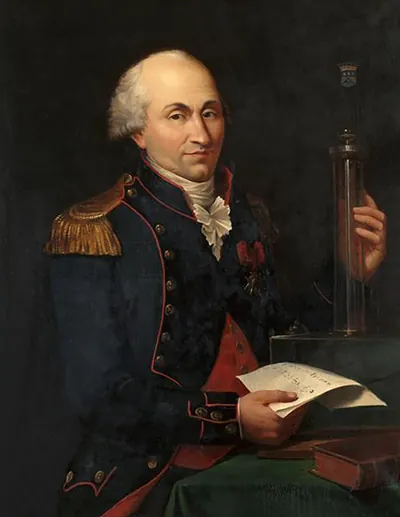 Charles-Augustin de Coulomb1736–1806 · Physics
 Thomas Young1773–1829 · Physics
 André-Marie Ampère1775–1836 · Physics
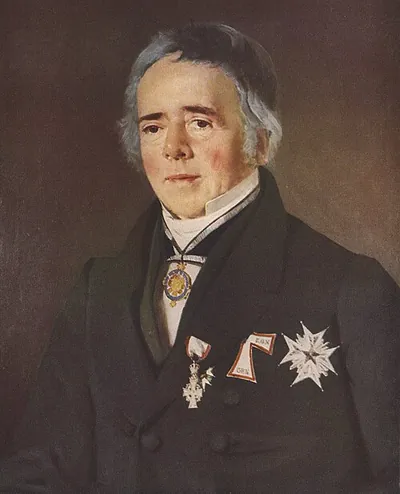 Hans Christian Ørsted1777–1851 · Physics
 Isaac Newton1643–1727 · Physics
