
Laura Ferrarese
Italian-born astrophysicist at the National Research Council of Canada, known for work on supermassive black holes · 1965
- Born
- December 7, 1965
- Country
- Italy
- Section
- Astronomy and space
Biography
Laura Ferrarese is an astrophysicist born in Italy who works at the National Research Council of Canada. Since the 1990s her research has helped explain how supermassive black holes are linked to the galaxies that contain them, and she is now one of the best-known figures in that field.
She was born in Padua, in northern Italy, and studied at the university there before moving to the United States. She received her PhD in physics from Johns Hopkins University in 1996. She then worked as a Hubble Postdoctoral Fellow at the California Institute of Technology, where she began the data-driven work on the Hubble Space Telescope that would shape much of her career.
Sources differ on when she joined Rutgers University in New Jersey: some give 2000 and others 2004, the year she moved to the National Research Council of Canada, where she is now a Principal Research Officer. She has also taught at the University of Victoria and at the University of Padua, where she began her studies.
Her central subject is supermassive black holes, objects with millions or billions of times the mass of the Sun that sit at the centres of most large galaxies. Working with colleagues, she helped establish that the mass of these black holes is closely tied to how fast the stars in the central bulge of their galaxy move, suggesting the two grow together. To measure these quantities she used data from the Hubble Space Telescope, the Chandra X-ray Observatory and the Canada-France-Hawaii Telescope. Her work also covers active galactic nuclei, galaxy dynamics and the rate at which the universe is expanding.
She has led projects using major observatories and served as president of the Canadian Astronomical Society from 2012 to 2014. She is currently a vice president of the International Astronomical Union, and in 2017 she became interim director of the Gemini Observatory for sixteen months. Her honours include the Queen Elizabeth II Diamond Jubilee Medal in 2012 and the Helen Sawyer Hogg Prize in 2014.
Her legacy lies in connecting the growth of galaxies with that of the black holes at their centres, an idea that still guides much research into how cosmic structures form. With more than 170 peer-reviewed papers and over 20,000 citations, her work is a standard reference for anyone studying the distant universe.
Main contributions
- 2000Fundamental relation between supermassive black holes and their host galaxies: the black hole mass is linked to the speed of the galaxy's stars.
- 2001Final results of the Hubble Space Telescope Key Project measuring the Hubble constant, which gives the rate at which the universe expands.
- 2002Study linking supermassive black holes to the dark matter halos around galaxies, matter that is invisible except through its gravity.
- 2004Analysis of the masses of active galactic nuclei using a large reverberation-mapping database, a method that tracks how the light near the centre responds to changes in brightness.
- 2006Analysis of the shape of early-type galaxies in the Virgo Cluster, part of the ACS Virgo Cluster Survey.
Trivia and anecdotes
A television appearance
On 30 November 2000 she was featured in an episode of the British TV series Horizon about supermassive black holes.
A sixteen-month interim post
In July 2017 she accepted a sixteen-month appointment as interim director of the Gemini Observatory.
Their contemporaries
While Laura Ferrarese was alive (1965–)…
Alive at the same time
Discovered or invented in those years
- 1969InternetA global network of interconnected computer networks that communicate using the TCP/IP protocol suite.
- 1971EmailA network service that lets users send and receive digital messages through addressed mailboxes, much like postal mail but electronic.
- 1973Mobile phoneA handheld wireless phone that lets people make and receive calls while moving across a cellular network area.
- 1975Global warmingThe long-term rise in Earth's average surface temperature, driven mainly by greenhouse gases released through human activity.
- 1989World Wide WebA system of linked documents and resources, connected by hyperlinks and accessed over the Internet with web browsers.
- 1990Web browserA program that lets people access the web by fetching a page's files from a server and displaying them on screen as an interactive page.
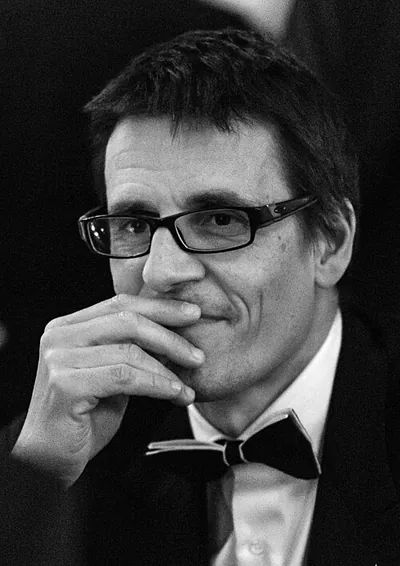 Didier Queloz1966 · Astronomy and space
 Saul Perlmutter1959 · Astronomy and space
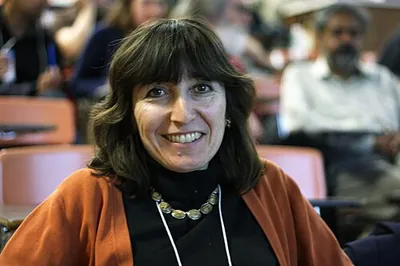 Wendy Freedman1957 · Astronomy and space
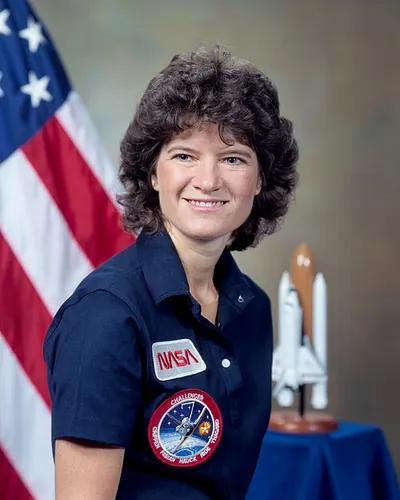 Sally Ride1951–2012 · Astronomy and space
 Russell A. Hulse1950 · Astronomy and space
 Michel Mayor1942 · Astronomy and space
