
Laurel Clark
American naval flight surgeon and NASA astronaut who died in the Space Shuttle Columbia disaster · 1961–2003
- Born
- March 10, 1961
- Died
- February 1, 2003
- Country
- United States
- Section
- Astronomy and space
Biography
Laurel Blair Salton Clark (1961-2003) was an American doctor who served as a United States Navy officer and became a NASA astronaut. She died with her six crewmates when the Space Shuttle Columbia broke apart while returning to the atmosphere in February 2003. Her story matters because it joins military medicine, human spaceflight and a disaster that forced NASA to rethink the safety of the shuttle program.
Clark was born on March 10, 1961, in Ames, Iowa, but she always considered Racine, Wisconsin, her hometown. She graduated from William Horlick High School in Racine in 1979. She studied zoology at the University of Wisconsin-Madison, earning a bachelor's degree in 1983 and a medical degree from the same university in 1987. As a student she belonged to a sorority and held an amateur radio license.
During medical school she trained with the Diving Medicine Department at the Navy's Experimental Diving Unit in March 1987. After graduating she completed postgraduate training in pediatrics from 1987 to 1988 at the National Naval Medical Center in Bethesda, Maryland. The following year she finished undersea medical officer training in Groton, Connecticut, and diving medicine training in Panama City, Florida. She was designated a Radiation Health Officer, responsible for monitoring radiation exposure among personnel.
Her first major posting was Holy Loch, Scotland, where she led the medical department of Submarine Squadron 14. From there she carried out several medical evacuations from American submarines. After two years of operational work she was certified as a submarine and diving medical officer. She then completed six months of aeromedical training in Pensacola, Florida, and became a Naval Flight Surgeon, the physician responsible for the health of aircrew.
At Marine Corps Air Station Yuma, Arizona, she served as flight surgeon for a Marine night-attack squadron flying the AV-8B Harrier jet. She went on several deployments, including one to the Western Pacific, and practiced medicine in austere conditions. Her squadron won an award as the Marine Attack Squadron of the Year. She later became group flight surgeon for Marine Aircraft Group 13 and, before being chosen as an astronaut candidate, worked as a flight surgeon for a training squadron in Pensacola.
NASA selected her in April 1996, and in August of that year she reported to the Johnson Space Center in Houston, Texas. After two years of training and evaluation she was qualified for flight as a mission specialist, the crew member responsible for carrying out scientific work aboard. From 1997 to 2000 she worked in the Astronaut Office, in the branch that handles the experiments carried on missions and the living conditions inside the orbiter.
She flew on STS-107 aboard Columbia, which launched on January 16, 2003, as a dedicated research mission. The crew worked around the clock in two alternating shifts and carried out about 80 experiments. Clark took part in bioscience work, including experiments on growing plants in space, which she discussed in an interview with Milwaukee media only days before her death. During the descent she recorded part of the flight on a small digital camera. In her final email, sent from the orbiter, she described the planet as magnificent and said that whenever she could look out of the window, the view was glorious.
On February 1, 2003, as the shuttle re-entered the atmosphere, Columbia broke apart over the southwestern United States, sixteen minutes before its scheduled landing. The immediate cause was a piece of foam insulation from the external tank that came loose during launch and struck the left wing, knocking off heat-shield tiles. Without them, hot gas entered the internal structure, the vehicle lost stability and disintegrated. All seven crew members died. Her husband, Jonathan Clark, a former Navy captain and NASA flight surgeon, was part of the official panel that prepared the 400-page final report on the disaster.
She was posthumously awarded the Congressional Space Medal of Honor. Her name appears on an asteroid, a hill on Mars, an interior crater of the Apollo lunar crater, an auditorium at Walter Reed National Military Medical Center and a memorial fountain in Racine. She left a son, Ian, born in 1996. Her legacy lies in aerospace medicine and in the memory of a research mission cut short, which pushed NASA to re-examine the safety of its shuttles.
Main contributions
- 1989Completed undersea and diving medical officer training with the Navy, preparing her to treat personnel in extreme underwater settings.
- 1996Selection by NASA as an astronaut candidate, which led to two years of training before she could fly.
- 2003STS-107 mission aboard the Space Shuttle Columbia, a research flight with about 80 experiments carried out in orbit.
Trivia and anecdotes
A recovered CD
Clark took a CD by the Scottish band Runrig into space. After the shuttle broke up, the disc was found among debris that reached the ground, and her family gave it back to the band.
A radio amateur
During her university years she held a technician-class amateur radio license with the call sign KC5ZSU.
An asteroid named for her
Asteroid 51827 Laurelclark was named in her honor, one of several ways her work in space science is remembered.
Their contemporaries
While Laurel Clark was alive (1961–2003)…
Alive at the same time
Discovered or invented in those years
- 1969InternetA global network of interconnected computer networks that communicate using the TCP/IP protocol suite.
- 1971EmailA network service that lets users send and receive digital messages through addressed mailboxes, much like postal mail but electronic.
- 1973Mobile phoneA handheld wireless phone that lets people make and receive calls while moving across a cellular network area.
- 1975Global warmingThe long-term rise in Earth's average surface temperature, driven mainly by greenhouse gases released through human activity.
- 1989World Wide WebA system of linked documents and resources, connected by hyperlinks and accessed over the Internet with web browsers.
- 1990Web browserA program that lets people access the web by fetching a page's files from a server and displaying them on screen as an interactive page.
 Saul Perlmutter1959 · Astronomy and space
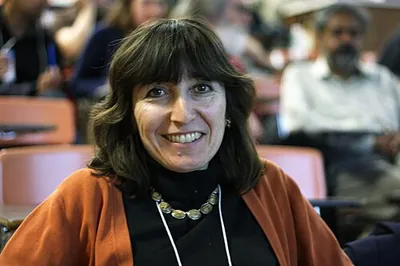 Wendy Freedman1957 · Astronomy and space
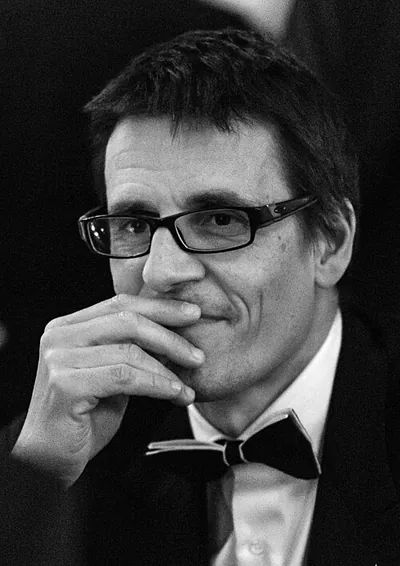 Didier Queloz1966 · Astronomy and space
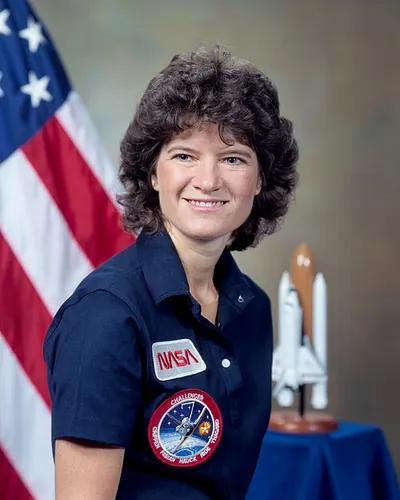 Sally Ride1951–2012 · Astronomy and space
 Russell A. Hulse1950 · Astronomy and space
 Michel Mayor1942 · Astronomy and space
