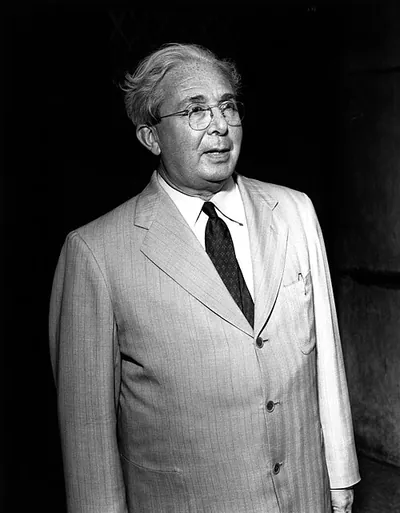
Leó Szilárd
Hungarian-born American physicist who conceived the nuclear chain reaction and helped lay the foundations of information theory · 1898–1964
- Born
- February 11, 1898
- Died
- May 30, 1964
- Country
- Hungary, United States, Germany
- Section
- Physics
Biography
Leó Szilárd (Budapest, 1898 - La Jolla, California, 1964) was a Hungarian-born physicist who became an American citizen and worked across nuclear physics and biology. He lived through the first half of the twentieth century, a period shaped by two world wars and by the birth of nuclear energy. He matters for three reasons: he conceived the nuclear chain reaction, he drove the letter that led to the Manhattan Project, and he tried, without success, to prevent the military use of the atomic bomb.
He was born Leó Spitz into a middle-class Jewish family. His father, Lajos Spitz, was a civil engineer, and in 1900 the family changed its German surname to the Hungarian Szilárd, meaning solid. He attended a secondary school in Budapest and soon stood out in mathematics, winning the Eötvös Prize, a national award, in 1916. World War I interrupted his engineering studies. He served in the Austro-Hungarian army, and an attack of influenza in September 1918 may have saved his life, since his regiment was nearly wiped out soon afterwards. After the war, in the turbulent Hungary of Béla Kun, he and his brother Béla founded a student group for socialists, and in 1919 they found that nationalist students would not let them re-enrol because they were Jewish.
In December 1919 he left for Berlin. He soon grew bored with engineering and switched to physics at Friedrich Wilhelm University, where he attended lectures by Einstein, Planck, Nernst, Franck and von Laue. His doctoral thesis, which earned top honours in 1922, dealt with Maxwell's demon, a thought experiment devised by James Clerk Maxwell in the nineteenth century to challenge the second law of thermodynamics. In this scenario a tiny being sorts fast and slow molecules and so lowers the disorder of a system, which seemed to need no energy. Szilárd showed that the measurements such a being must make have an energy cost, and in doing so he recognised the link between thermodynamics and information theory, the mathematics of how much data a message carries. His 1927 habilitation lecture introduced the Szilárd engine, a simple model of the paradox, and the first equation linking negative entropy and information. He published it only in 1929 and did not develop the idea further. Claude Shannon later took it up as a starting point.
During his Berlin years he also conceived or patented several technical ideas: a linear accelerator in 1928, a cyclotron in 1929, and an electron microscope. He built none of these devices and did not publish the ideas in scientific journals, so others received the credit. The Nobel Prize went to Ernest Lawrence in 1939 for the cyclotron and to Ernst Ruska in 1986 for the electron microscope, but never to Szilárd. Between 1926 and 1930 he also worked with Einstein on a refrigerator with no moving parts.
When Hitler became chancellor of Germany in January 1933, Szilárd urged his family and friends to leave Europe while they could. He settled in England, where he helped found the Academic Assistance Council, which found jobs for refugee scholars. By 1939 it had placed more than 2,500 of them. On 12 September 1933 he read a report in The Times of a speech by Rutherford, who doubted that atomic energy could ever be put to practical use. According to a well-known account, Szilárd conceived of a chain reaction that same day while waiting to cross a street in Bloomsbury, a process in which neutrons would set off further reactions, much as one chemical reaction can trigger another. The street story is a traditional tale and is not documented precisely, but the idea itself is clearly dated to that year. He filed a patent in 1934, which was granted in 1936. To keep it secret, he assigned it to the British Admiralty, which kept it from publication until 1949. In London, together with the physicist Thomas Chalmers, he also discovered a way of separating isotopes, known as the Szilárd-Chalmers effect, which was later used to prepare medical isotopes.
In 1938 he emigrated to the United States and settled in New York, close to Columbia University, where he worked without a formal post. When the chemists Hahn and Strassmann observed uranium fission in December 1938, Szilárd realised that uranium might sustain a chain reaction. Fermi was not convinced, so Szilárd carried out his own experiments at Columbia with Walter Zinn and found that natural uranium multiplied neutrons. With Fermi he then tested water and graphite as moderators, substances that slow neutrons down. He discovered that commercial graphite contained boron, which absorbs neutrons, and had purified graphite produced instead. In August 1939 he drafted a letter to President Roosevelt warning that Germany might develop nuclear weapons, and he persuaded Einstein to sign it. The Einstein-Szilárd letter helped start the American programme that became the Manhattan Project. Szilárd then moved to Chicago, where on 2 December 1942 the first self-sustaining nuclear reaction was achieved in Chicago Pile-1. He clashed repeatedly with General Leslie Groves over who controlled the research.
In 1945 Szilárd drafted a petition, signed by many scientists on the project, asking for a non-lethal demonstration of the bomb before witnesses. He was refused a meeting with Truman, and the Secretary of State, Byrnes, made clear that the bomb would be used. The bombs fell on Hiroshima and Nagasaki and killed about 300,000 Japanese civilians. Szilárd had lived through the hardships of post-war Hungary and always stood for the protection of human life and the freedom to share ideas. After the war he turned to biology. In 1947 he began working in molecular biology with Aaron Novick. In 1960 he was diagnosed with bladder cancer and treated with a cobalt-60 therapy he had designed himself. He spent his last years at the Salk Institute in San Diego, and in 1962 he founded the Council for a Livable World to bring what he called the sweet voice of reason on nuclear weapons to Congress, the White House and the American public. He died of a heart attack in his sleep in 1964.
Colleagues remembered him as an eccentric, quick-thinking man whose odd remarks often turned out to be remarkably perceptive. His legacy lies in physics, in the theory of information and in the responsibility scientists bear for the uses of their work. Today he is commemorated by a lunar crater named after him and by the asteroid (38442) Szilárd.
Main contributions
- 1922Doctoral thesis on Maxwell's demon, linking thermodynamics and information theory.
- 1927Szilárd engine, a thought experiment on Maxwell's demon with the first equation linking negative entropy and information, published in 1929.
- 1928Patent application for a linear particle accelerator.
- 1929Patent application for the cyclotron, a machine later credited to Ernest Lawrence.
- 1934Patent for the neutron-driven nuclear chain reaction, granted in 1936 and kept secret until 1949.
- 1939Einstein-Szilárd letter to Roosevelt, which pushed the American nuclear research programme forward.
- 1942Took part in the first self-sustaining nuclear reaction, in Chicago Pile-1.
- 1945Petition asking for a demonstration of the atomic bomb without using it against civilians, which the government rejected.
Teachers and students
Trivia and anecdotes
From Spitz to Szilárd
In 1900 the family swapped its German surname for a Hungarian one meaning solid.
An idea sparked by a novel
By his own account, H. G. Wells's novel The World Set Free, with its atomic bombs, impressed him deeply well before he conceived the chain reaction.
A very unusual colleague
Colleagues described him as an eccentric, fast thinker whose seemingly odd remarks were often very perceptive.
Related discoveries and inventions
- 1930Einstein refrigeratorAn absorption refrigerator with no moving parts that runs at constant pressure and needs only a heat source.
Their contemporaries
While Leó Szilárd was alive (1898–1964)…
Alive at the same time
Discovered or invented in those years
- 1903AirplaneA fixed-wing aircraft, heavier than air, powered by engines or rockets, that stays aloft because its wings generate lift.
- 1916Black holeA region of space where gravity is so strong that nothing, not even light, can escape once it crosses a certain boundary.
- 1925TelevisionA system that sends moving pictures and sound over distance and shows them on a receiver, the television set.
- 1925Quantum mechanicsPhysical theory describing how matter and light behave at atomic and subatomic scales, where energy is exchanged in minimal packets and results are expressed as probabilities.
- 1931Big BangA cosmological model describing how the universe expanded from an early state of extreme density and temperature, about 13.8 billion years ago.
- 1945ComputerA programmable machine that takes in data, processes it by following stored instructions, and produces results, able to switch tasks simply by running different software.
 Wolfgang Pauli1900–1958 · Physics
 Enrico Fermi1901–1954 · Physics
 Werner Heisenberg1901–1976 · Physics
 Ernest Lawrence1901–1958 · Physics
 Paul Dirac1902–1984 · Physics
 Eugene Paul Wigner1902–1995 · Physics
