
Ludwig Reichenbach
German naturalist, botanist, ornithologist and illustrator, director of the Dresden natural history museum for more than four decades · 1793–1879
- Born
- January 8, 1793
- Died
- March 17, 1879
- Country
- Kingdom of Saxony
- Section
- Biology
Biography
Heinrich Gottlieb Ludwig Reichenbach (1793-1879) was a German naturalist who worked as a botanist, ornithologist and illustrator. He ran the natural history museum in Dresden for more than four decades during the first half of the nineteenth century, a time when museums were becoming places of public teaching. He is remembered for his botanical work and for a commission that led to the famous glass sea creatures made by the Blaschka family.
He was born in Leipzig, the son of Johann Friedrich Jakob Reichenbach, a scholar who published the first Greek-German dictionary in 1818. From 1810 he studied medicine and natural sciences at the University of Leipzig, and in 1818 he became a tutor, a teacher who supervised and guided students. Medicine gave him a solid grounding in animal anatomy, but his attention gradually turned to plants and birds.
In 1820 he was appointed director of the natural history museum in Dresden and professor at the university there, posts he held until 1862. His work involved identifying, naming and ordering specimens. Over his career he identified and classified more than 2,900 new species, a task that meant comparing specimens and grouping them by their similarities. This kind of work is the basis of taxonomy, the science of naming and organising living things.
His books show how he combined writing with drawing. The Iconographia botanica seu Plantae criticae, issued in ten volumes between 1823 and 1832, pairs plant illustrations with descriptions. The Handbuch der speciellen Ornithologie of 1851 to 1854 is a manual on birds, and the Regnum animale of 1834 to 1836 presents animals in engraved plates. These images were more than decoration. They allowed other researchers to recognise and compare species without having the specimen in front of them. Reichenbach was regarded as a capable botanical artist.
He also helped build institutions. When fire at the Zwinger Palace during the constitutional crisis of 1849 almost completely destroyed the zoological collections, he rebuilt them within a few years, and that collection still forms the core of the museum's displays today. He later founded the Dresden Botanical Garden and took part in founding the city's zoo.
His best-known collaboration began in 1863. Marine invertebrates such as sea anemones have no skeleton, and in the nineteenth century they were usually preserved in jars of alcohol, where over time they lost their shape and colour. Reichenbach saw highly detailed glass flowers made by the Bohemian glassworker Leopold Blaschka, shown at an exhibition hosted by Prince Camille de Rohan, who introduced the two men. Reichenbach commissioned a set of glass sea anemones and advised Blaschka to sell such models to museums, universities and collectors rather than continue the family business in decorative glassware. That advice grew into a successful mail-order trade. The first pieces Reichenbach bought, along with the rest of that collection, were destroyed in the bombing of Dresden during the Second World War.
His son, Heinrich Gustav Reichenbach, also became a botanist and a leading specialist in orchids. Reichenbach died in 1879 and was buried in Dresden. His grave was later cleared after the right to use it lapsed, and in 2011, at the initiative of the Senckenberg natural history collections, a stele was unveiled in his memory.
His legacy is twofold. Several plants and animals bear his name, among them the cactus Echinocactus reichenbachii, native to south-central United States and northern Mexico, and Reichenbach's sunbird, Anabathmis reichenbachii. Botanists cite him with the abbreviation Rchb., and his illustrations are still consulted as records of nineteenth-century plants and animals.
Main contributions
- 1823Iconographia botanica seu Plantae criticae: ten volumes of botanical illustrations with descriptions, issued up to 1832.
- 1830Flora germanica excursoria: a guide to German flora designed for fieldwork, in two volumes up to 1832.
- 1834Regnum animale: an illustrated work on the animal kingdom, published between 1834 and 1836.
- 1845Vollständigste Naturgeschichte des In- und Auslandes: a large natural history with more than a thousand plates, published up to 1854.
- 1851Handbuch der speciellen Ornithologie: a systematic ornithology manual on birds, published between 1851 and 1854.
- 1863Commission of the first glass sea anemones from Leopold Blaschka, models true to nature for teaching.
- Identification and classification of more than 2,900 new species of plants and animals, as recorded in his nomenclatural work.
Trivia and anecdotes
Glass sea anemones
A museum commission changed the Blaschka family's trade. Their decorative glassware business gave way to mail-order sales of glass sea creatures to institutions around the world.
A cactus named after him
The cactus Echinocactus reichenbachii, from south-central United States and northern Mexico, carries his name in recognition of his botanical work.
A late memorial
His grave was cleared once the right to use it had lapsed. In 2011 a stele was placed in his memory at the initiative of the Senckenberg collections.
Their contemporaries
While Ludwig Reichenbach was alive (1793–1879)…
Alive at the same time
Discovered or invented in those years
- 1803AtomThe basic unit of a chemical element: a nucleus of protons and usually neutrons surrounded by a cloud of electrons.
- 1846NeptuneThe eighth and most distant planet of the Solar System, an ice giant found through mathematical prediction before any direct sighting.
- 1859EvolutionThe process by which the heritable traits of living populations change over generations, explaining the diversity of life from common ancestors.
- 1869Periodic tableAn arrangement of the chemical elements into rows (periods) and columns (groups), ordered by atomic number, that reveals recurring chemical behaviour and lets scientists predict properties.
- 1869Deoxyribonucleic acidA double-stranded molecule that carries the genetic instructions of nearly all living things and many viruses.
- 1876TelephoneA device that carries the human voice over distance by turning sound into electrical signals and back into sound at the other end of the line.
 Charles Darwin1809–1882 · Biology
 Theodor Schwann1810–1882 · Biology
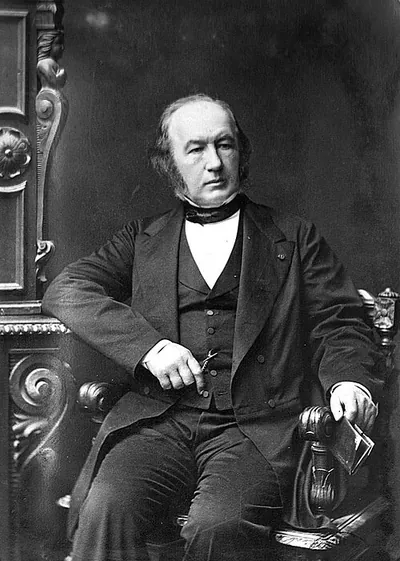 Claude Bernard1813–1878 · Biology
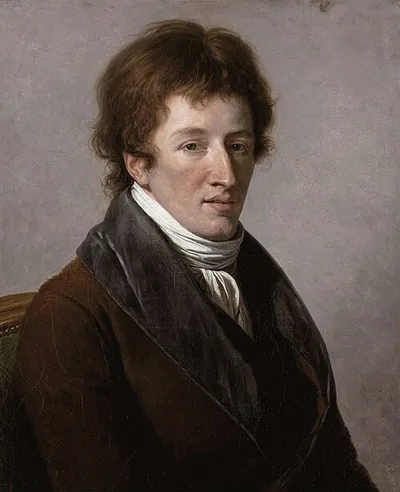 Georges Cuvier1769–1832 · Biology
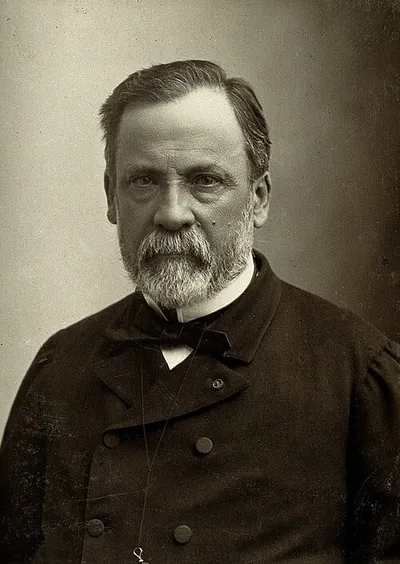 Louis Pasteur1822–1895 · Biology
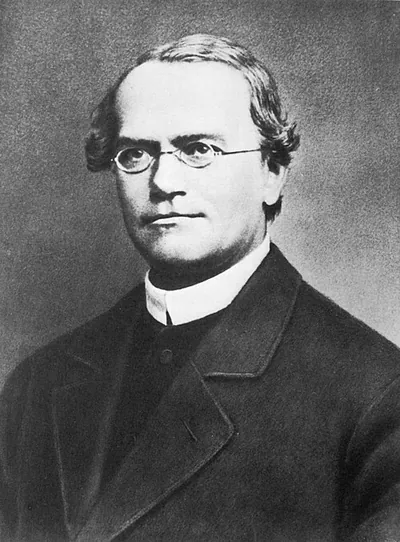 Gregor Mendel1822–1884 · Biology
