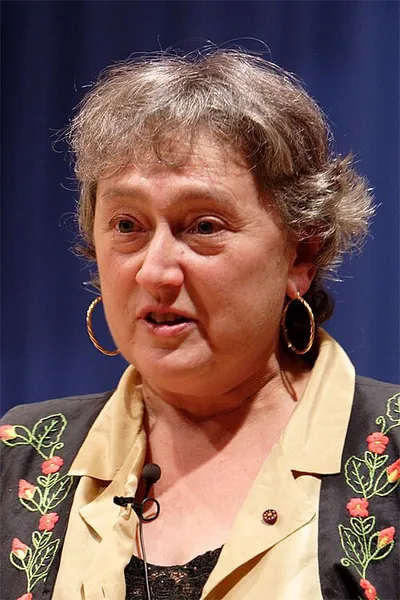
Lynn Margulis
American biologist who championed the symbiotic origin of eukaryotic cells · 1938–2011
- Born
- March 5, 1938
- Died
- November 22, 2011
- Country
- United States
- Section
- Biology
Biography
Lynn Margulis, born Lynn Petra Alexander in Chicago on March 5, 1938, and died in Amherst, Massachusetts, on November 22, 2011, was an American biologist who argued that symbiosis is one of the major forces in evolution. Her work changed how biologists understand the origin of cells with a nucleus, known as eukaryotes. She is also associated with the Gaia hypothesis and with a stubborn defence of ideas that were for years considered marginal.
She was the first of four daughters in a well-off Chicago family. Her father was a lawyer and her mother ran a travel agency. She later described herself as a rebellious and difficult student at high school, but at fifteen she was admitted to an advanced programme at the University of Chicago. There she met Carl Sagan, who later became famous as a popular astronomer, and the two married in 1957, a week after she graduated. That same year she began a master's degree at the University of Wisconsin, where she studied genetics with James F. Crow, who encouraged her to devote herself fully to the field. At Wisconsin she worked with Walter Plaut, and in 1958 they published her first scientific paper, on DNA found in the cytoplasm of an amoeba. They did not yet realise that they had detected mitochondrial DNA, the genetic material of the mitochondria, small structures inside cells that produce energy.
Her interest in microorganisms grew during her doctoral work at the University of California, Berkeley, under Max Alfert, and she received her PhD in 1965. Her marriage to Sagan had ended in 1964, after years of heavy work and the care of two small sons. Margulis read older scientific papers that had been forgotten, including work by E. B. Wilson and Ivan E. Wallin, and these gave her grounds to argue that mitochondria and chloroplasts, the structures in plant cells that carry out photosynthesis, had once been independent bacteria.
In 1967 she published "On the Origin of Mitosing Cells" in the Journal of Theoretical Biology, after about fifteen journals had turned it down. In it she proposed that eukaryotic cells formed when several simpler cells without a nucleus, prokaryotes, came to live inside one another. She developed the idea in the 1970 book Origin of Eukaryotic Cells, and called it serial endosymbiosis theory. She credited Russian researchers such as Konstantin Mereschkowski and Boris Kozo-Polyansky, whose work she had helped bring back into view. The theory challenged neo-Darwinism, which at the time explained evolution mainly as the slow build-up of random mutations sorted by competition between individuals. Margulis argued that cooperation and symbiosis were equally important, and that new forms of life could arise from the merging of different organisms.
In the 1970s she worked with the British chemist James Lovelock on the Gaia hypothesis, which proposes that living things and the physical environment of Earth form a self-regulating system. Margulis contributed the microbiological side, having observed that many bacteria produce gases that affect the atmosphere. Critics saw the idea as implying purpose in nature, and Margulis later said she disliked the image of Earth as a single organism.
In 1978 she proposed, with Robert Whittaker, a classification of life into five kingdoms grouped into two superkingdoms, prokaryotes and eukaryotes, and she remained a leading defender of that scheme against the three-domain system of Carl Woese. Her most widely recognised contribution was confirmed in the late 1970s and 1980s, when molecular biology showed that mitochondria and chloroplasts have their own DNA, different from the nuclear DNA and closer to that of bacteria. She was elected to the US National Academy of Sciences in 1983 and received the National Medal of Science from President Bill Clinton in 1999. She taught at Boston University from 1966 to 1988, and then at the University of Massachusetts Amherst, first in botany and later in geosciences.
Her personal life was turbulent. She married the crystallographer Thomas N. Margulis in 1967, and they divorced in 1980. She had four children in total, and her son Dorion Sagan became her main collaborator on popular books. Her public statements on HIV and on the attacks of September 11, 2001 caused controversy, and several scientists sharply criticised her positions on those subjects.
Her legacy lies in the broad acceptance of endosymbiosis as the explanation for the origin of eukaryotic cells and in the view that microorganisms have a central role in the history of life. Today cooperation and symbiosis are widely seen as an essential part of evolution, although some of her proposals, such as the claim that symbiogenesis matters more than mutation, remain debated among scientists.
Main contributions
- 1958First scientific paper, written with Walter Plaut, on DNA found in the cytoplasm of an amoeba, later identified as mitochondrial DNA.
- 1967"On the Origin of Mitosing Cells", in which she proposes the symbiotic origin of eukaryotic cells.
- 1970Book Origin of Eukaryotic Cells, where she develops the serial endosymbiosis theory.
- 1978Proposal, with Robert Whittaker, to classify life into five kingdoms grouped into two superkingdoms.
- 1979Collaboration with James Lovelock on the Gaia hypothesis, which describes Earth as a self-regulating system shaped by living things.
Trivia and anecdotes
Work in the Ebro Delta
As a visiting professor at the Autonomous University of Barcelona in the 1980s, she took part in field work on microbial mats in the Ebro Delta.
A rejected paper
Her 1967 paper was turned down by about fifteen journals before it was accepted, and the idea took nearly a decade to gain acceptance.
Their contemporaries
While Lynn Margulis was alive (1938–2011)…
Alive at the same time
Discovered or invented in those years
- 1945ComputerA programmable machine that takes in data, processes it by following stored instructions, and produces results, able to switch tasks simply by running different software.
- 1957Artificial satelliteAn artificial satellite is a human-made object placed in orbit around a celestial body, usually Earth, to collect information, relay signals, or carry out a specific task.
- 1969InternetA global network of interconnected computer networks that communicate using the TCP/IP protocol suite.
- 1971EmailA network service that lets users send and receive digital messages through addressed mailboxes, much like postal mail but electronic.
- 1973Mobile phoneA handheld wireless phone that lets people make and receive calls while moving across a cellular network area.
- 1989World Wide WebA system of linked documents and resources, connected by hyperlinks and accessed over the Internet with web browsers.
 Ada Yonath1939–2026 · Biology
 Stephen Jay Gould1941–2002 · Biology
 Christiane Nüsslein-Volhard1942 · Biology
 John Gurdon1933–2025 · Biology
 Kary Mullis1944–2019 · Biology
 Yoshinori Ohsumi1945 · Biology
