
Marc Garneau
Canadian military officer, engineer, astronaut and politician, the first Canadian in space · 1949–2025
- Born
- February 23, 1949
- Died
- June 4, 2025
- Country
- Canada
- Section
- Astronomy and space
Biography
Marc Garneau (born February 23, 1949, in Quebec City; died June 4, 2025, in Montreal) was a Canadian military officer, engineer, astronaut and politician. In 1984 he became the first Canadian to travel into space, and later he led the country's space agency and held senior government posts. His career, which moved between spaceflight and parliamentary politics, makes him a key figure in Canadian space activity from the late twentieth century into the early twenty-first.
He was born into a family of soldiers. His grandfather, Gérard Garneau, was a colonel in the First World War, and his father, André, rose to brigadier general after a long army career. His mother, Jean Richardson, came from Sussex, New Brunswick, and had worked as a nurse during the Second World War. Because his father was regularly posted elsewhere, the family moved often, and Garneau attended schools in Quebec, Saint-Jean-sur-Richelieu and London. He graduated from the Royal Military College of Canada in 1970 with a degree in engineering physics.
He then joined the Canadian naval forces as a combat systems engineer, responsible for the electronic systems aboard warships. Between 1982 and 1983 he trained at the staff college in Toronto. Earlier, in 1973, he had earned a doctorate in electrical engineering at Imperial College London with a thesis called The Perception of Facial Images. For that work he used the Photofit, an analogue computer that helped identify facial features by combining parts. He left the military in 1989.
In December 1983 the National Research Council of Canada announced the country's first group of astronauts: six people chosen from more than 4,300 applicants. Garneau was the only military officer in the group. On October 5, 1984, he flew aboard the space shuttle Challenger on mission STS-41-G as a payload specialist, a role focused on running the mission's experiments rather than flying the vehicle. He later trained as a mission specialist and made two more flights: STS-77 in 1996 and STS-97 in 2000, which travelled to the International Space Station. In total he logged around 677 hours in space.
In 2001 he was named executive vice-president of the Canadian Space Agency and soon after became its president, a post he left in November 2005. Meanwhile, in 2003, he became chancellor of Carleton University in Ottawa. In 2006 he ran for the Liberals in Vaudreuil-Soulanges and lost to the Bloc Québécois candidate Meili Faille by more than 9,000 votes. Two years later he won the Westmount-Ville-Marie riding in central Montreal by a similar margin. He was re-elected in 2011 by a very narrow majority and in 2015 in Notre-Dame-de-Grâce-Westmount.
After the Liberals won the 2015 election, he served as Minister of Transport until January 2021, when he became Minister of Foreign Affairs, a post he held until October 2021. In 2013 he had withdrawn from the Liberal leadership race and backed Justin Trudeau. He retired from politics in 2023.
Garneau is remembered as Canada's first astronaut and as an example of how technical and military training can lead into public service. His career also shows how applied science shaped his country's space policy.
Main contributions
- 1973Doctorate in electrical engineering with a thesis on the perception of facial images, based on the Photofit, an analogue computer for identifying facial features.
- 1984First flight by a Canadian into space, on mission STS-41-G aboard the space shuttle Challenger as a payload specialist.
- 1996Participation in shuttle mission STS-77 as a mission specialist.
- 2000Flight to the International Space Station on mission STS-97, his third trip to space.
- 2001Presidency of the Canadian Space Agency, which he led until 2005.
- 2008Elected federal Member of Parliament for Westmount-Ville-Marie in central Montreal.
- 2015Appointed Minister of Transport in Justin Trudeau's government.
- 2021Minister of Foreign Affairs from January to October.
Trivia and anecdotes
A very demanding selection
Out of more than 4,300 applicants, only six were picked for Canada's first astronaut group, and Garneau was the only military officer among them.
Defeat and victory by a similar margin
He lost by more than 9,000 votes in 2006 and won by a similar figure in 2008, in different ridings.
A thesis on faces
His doctoral thesis examined how people recognise faces, and he used an analogue computer called the Photofit to do it.
Their contemporaries
While Marc Garneau was alive (1949–2025)…
Alive at the same time
Discovered or invented in those years
- 1957Artificial satelliteAn artificial satellite is a human-made object placed in orbit around a celestial body, usually Earth, to collect information, relay signals, or carry out a specific task.
- 1969InternetA global network of interconnected computer networks that communicate using the TCP/IP protocol suite.
- 1971EmailA network service that lets users send and receive digital messages through addressed mailboxes, much like postal mail but electronic.
- 1973Mobile phoneA handheld wireless phone that lets people make and receive calls while moving across a cellular network area.
- 1989World Wide WebA system of linked documents and resources, connected by hyperlinks and accessed over the Internet with web browsers.
- 1990Web browserA program that lets people access the web by fetching a page's files from a server and displaying them on screen as an interactive page.
 Russell A. Hulse1950 · Astronomy and space
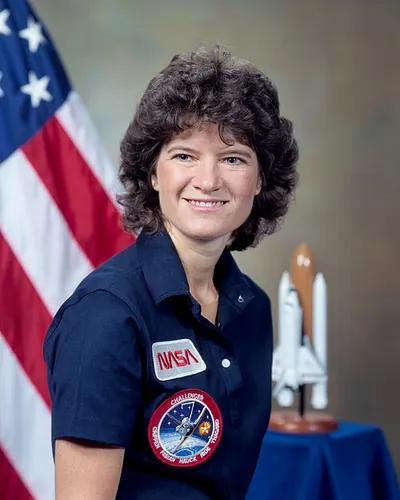 Sally Ride1951–2012 · Astronomy and space
 Michel Mayor1942 · Astronomy and space
 Joseph Hooton Taylor1941 · Astronomy and space
 Wendy Freedman1957 · Astronomy and space
 Saul Perlmutter1959 · Astronomy and space
