
Mária Telkes
Hungarian-American physicist and inventor, a pioneer of solar energy and of materials that store heat · 1900–1995
- Born
- December 12, 1900
- Died
- December 2, 1995
- Country
- Hungary, United States
- Section
- Energy
Biography
Mária Telkes (Budapest, 12 December 1900 – Budapest, 2 December 1995) was a Hungarian-American scientist who spent much of her career finding ways to use sunlight to heat homes, produce drinking water and keep warmth for later. She worked at a time when solar energy was still largely a laboratory curiosity, and her best-known contribution is the idea of storing the heat of the day so it can be used when it is needed, a principle now common in many solar installations.
She was born in Budapest into a family with Jewish roots. Her grandfather came from a Jewish family, and in 1881 her father Magyarized the family name to Telkes; in 1883 he converted to the Unitarian faith, and in 1907 the family was raised to the Hungarian nobility. Interested in chemistry from an early age, she built her own chemistry set at ten, and her father encouraged her experiments. She studied physical chemistry at the University of Budapest, earning her bachelor's degree in 1920. In her first year she read a popular book, «Energy Sources of the Future» by Kornel Zelowitch, which she later said pushed her toward the United States, where most solar energy work was then being done. She completed her doctorate in 1924 and that year became an instructor at the University of Geneva. A visit to a relative who was the Hungarian consul in Cleveland, Ohio, changed her plans, and in 1925 she settled in the United States.
In Cleveland she was hired by the Cleveland Clinic Foundation, founded in 1921 by the biomedical researcher George W. Crile, to study the energy produced by living organisms. Together they developed a photoelectric device that could record brain waves, and they wrote a book, «Phenomenon of Life». In 1937 she became an American citizen and joined the Westinghouse company in Pittsburgh as a research engineer, working on metal alloys for thermocouples, devices that turn heat into electricity by joining two different metals. That same year her interest in the Sun began to take shape, and in 1939 she joined the Solar Energy Conversion Project at the Massachusetts Institute of Technology (MIT), where she investigated thermoelectric devices powered by sunlight.
During the Second World War the US government appointed her a civilian adviser to the Office of Scientific Research and Development (OSRD). There she built a prototype solar desalination unit, finished in 1942, which turned seawater into drinking water using the Sun's heat and the condensation of vapour. It was useful to castaways and downed airmen, though its deployment was held back until the war's end by problems with manufacturing contracts renegotiated by Hoyt C. Hottel. For this work she received a certificate of merit in 1945, and in 1952 the Society of Women Engineers gave her its first Achievement Award. She had hoped to make a simple, cheap version for poor, arid villages.
Her central concern was thermal storage, which she considered the most critical problem for any house heated by the Sun. She worked with phase-change materials, substances that absorb or release heat as they switch between solid and liquid, and favoured Glauber's salt (sodium sulfate). Her relationship with Hottel, who was sceptical about solar power, was strained; in 1946 the team used that salt in its second solar house, and the failure was largely blamed on her, leading to her reassignment to the metallurgy department. In 1948 she began working with the architect Eleanor Raymond on the Dover Sun House in Massachusetts, financed by the philanthropist Amelia Peabody. The salt melted in the sunlight and released its heat as it cooled and hardened. For the first two winters it was a success and drew large crowds, but by the third the salt had separated into layers and its containers were corroding and leaking. The owners eventually replaced the system with an oil furnace.
In 1953 MIT's dean of science called for a review of the solar programme; the report favoured Hottel's views and criticised her, and she was dismissed that year. By then she was at New York University, where she designed a cheap, simple solar oven with four mirrors and a tightly insulated box, meant for cooking in places without other fuel. She later spent years in industry at Curtiss-Wright, Cryo-Therm and Melpar, working on materials for extreme conditions such as space missions and missiles. In 1969 she joined the University of Delaware to study photovoltaic cells, which turn light directly into electricity, and in 1971 she helped build one of the first houses to generate both heat and electricity from the Sun. In the 1970s she moved to Texas and advised pioneering solar companies.
Telkes died in Budapest in 1995. She held more than twenty patents, and her colleagues called her the Sun Queen. She is now regarded as one of the founders of solar thermal storage. Her lasting legacy is the idea that the heat of the day can be kept for the night, a question that remains central to solar energy.
Main contributions
- 1942Solar desalination prototype that makes drinking water from seawater using the heat of the Sun.
- 1947Thermoelectric generator that produces electricity from heat.
- 1948Solar heating system using Glauber's salt for the Dover Sun House, which stores heat during the day.
- 1953Thermoelectric refrigerator that cools using electric current driven by temperature differences, with no moving parts.
- 1953Simple, low-cost solar oven designed for cooking in communities without other energy sources.
- 1971One of the first houses able to generate both heat and electricity from the Sun.
Trivia and anecdotes
The Sun Queen
Her colleagues used this nickname, which has remained one of the best-known ways to remember her.
A youthful book
She said that reading «Energy Sources of the Future» helped convince her to emigrate to the United States.
Their contemporaries
While Mária Telkes was alive (1900–1995)…
Alive at the same time
Discovered or invented in those years
- 1903AirplaneA fixed-wing aircraft, heavier than air, powered by engines or rockets, that stays aloft because its wings generate lift.
- 1925TelevisionA system that sends moving pictures and sound over distance and shows them on a receiver, the television set.
- 1925Quantum mechanicsPhysical theory describing how matter and light behave at atomic and subatomic scales, where energy is exchanged in minimal packets and results are expressed as probabilities.
- 1931Big BangA cosmological model describing how the universe expanded from an early state of extreme density and temperature, about 13.8 billion years ago.
- 1945ComputerA programmable machine that takes in data, processes it by following stored instructions, and produces results, able to switch tasks simply by running different software.
- 1969InternetA global network of interconnected computer networks that communicate using the TCP/IP protocol suite.
 Nikolay Dollezhal1899–2000 · Energy
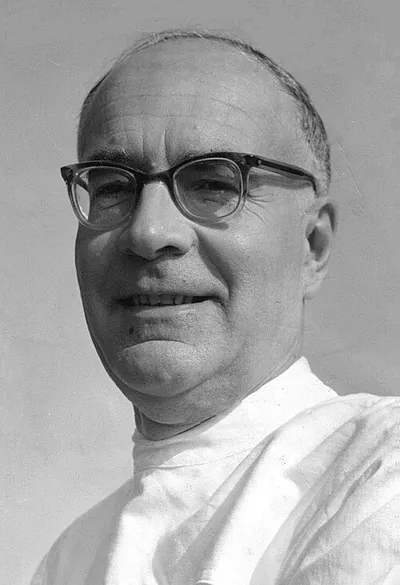 Felix Wankel1902–1988 · Energy
 Igor Kurchatov1903–1960 · Energy
 Walter Zinn1906–2000 · Energy
 John R. Dunning1907–1975 · Energy
 Alvin M. Weinberg1915–2006 · Energy
