
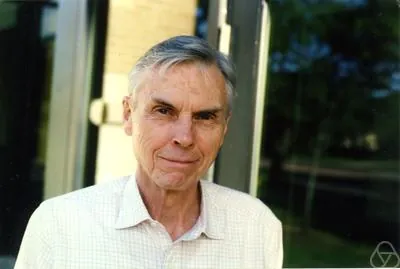
Mark Kac
Polish-American mathematician known for probability theory and for the question 'Can one hear the shape of a drum?' · 1914–1984
- Born
- August 16, 1914
- Died
- October 25, 1984
- Country
- United States, Poland
- Section
- Mathematics
Biography
Mark Kac (Kremenets, 1914 – Los Angeles, 1984) was a Polish-American mathematician whose main field was probability theory, the branch of mathematics that studies chance and the regular patterns hidden within random events. He is remembered for a simple question that opened an entire line of research in spectral geometry: can one hear the shape of a drum? His career spanned two continents during a period shaped by war and persecution, and his work linked statistics with physics and number theory.
Kac was born into a Polish-Jewish family in Kremenets, a town that passed from the Russian Empire to Poland after the Peace of Riga when he was a child. He earned his doctorate in 1937 at the Polish university in Lwów under Hugo Steinhaus, and he belonged to the so-called Lwów School of Mathematics, a group of researchers who worked intensely on analysis and probability and often discussed problems in a café in the city. With a scholarship from the Parnas Foundation he sailed for the United States in 1938, arriving in New York City that November. The outbreak of the Second World War kept him abroad. His parents and brother, who had stayed in Kremenets, were murdered by the Nazis in mass executions in August 1942, a loss that shaped his personal life for good.
From 1939 to 1961 he taught at Cornell University in Ithaca, New York, rising from instructor to full professor in 1947. He became a naturalized American citizen in 1943. During the war he also worked with George Uhlenbeck at the MIT Radiation Laboratory, and in the 1951-1952 academic year he spent a sabbatical at the Institute for Advanced Study. In those years he moved toward statistical physics, the study of how large collections of particles behave. In 1952, with Theodore H. Berlin, he introduced the spherical model of a ferromagnet, a simplified picture of how tiny magnets in a material align, and with J. C. Ward he found an exact solution of the Ising model by a counting method. In 1956 he proposed the Kac ring, a simple model in which particles obeying laws that work equally well forwards and backwards in time produce behaviour that runs in one direction on a large scale. Using it as an analogy for molecular motion, he offered an explanation of Loschmidt's paradox, a classic objection to the second law of thermodynamics.
In 1961 he moved to Rockefeller University in New York, where he worked with Uhlenbeck and P. C. Hemmer on the mathematics of van der Waals gases, real gases whose molecules attract one another. After twenty years there he joined the University of Southern California, where he spent the rest of his career. In 1966 he published the article 'Can one hear the shape of a drum?', asking whether the geometric shape of a drum is fixed by the set of tones it can produce. The answer turned out to be no: two different shapes can share exactly the same resonant frequencies. Still, some shapes, such as a circular drum, can be deduced from their spectrum.
Kac also took part in the defence of human rights. He co-chaired the Committee of Concerned Scientists and co-signed letters that brought to light the cases of the scientist Vladimir Samuilovich Kislik and the applied mathematician Yosif Begun, both persecuted in the Soviet Union. He received the Chauvenet Prize in 1950 and again in 1968, became a member of the US National Academy of Sciences in 1965 and of the American Philosophical Society in 1969, and gave prestigious lectures in Brussels and Pisa. His legacy endures in probability theory, statistical physics and spectral geometry, a field that still explores the link between an object's shape and the vibrations it produces. His autobiography, 'Enigmas of Chance', appeared posthumously in 1985.
Main contributions
- 1943Spherical model of a ferromagnet: a simplified picture of how microscopic magnets in a material align, presented with Berlin in 1952.
- 1952Exact solution of the Ising model: a mathematical solution of a classic statistical physics model using a counting method, with J. C. Ward.
- 1956Kac ring: a simplified model showing how large-scale irreversibility can emerge from laws that are reversible in time.
- 1966'Can one hear the shape of a drum?': article asking whether a shape is determined by its resonant frequencies, with a negative answer in general.
Teachers and students
Studied under:
Taught:
Trivia and anecdotes
A question that named a problem
His 1966 article asking whether one can hear the shape of a drum became a famous problem that drove decades of research.
Their contemporaries
While Mark Kac was alive (1914–1984)…
Alive at the same time
Discovered or invented in those years
- 1916Black holeA region of space where gravity is so strong that nothing, not even light, can escape once it crosses a certain boundary.
- 1925TelevisionA system that sends moving pictures and sound over distance and shows them on a receiver, the television set.
- 1925Quantum mechanicsPhysical theory describing how matter and light behave at atomic and subatomic scales, where energy is exchanged in minimal packets and results are expressed as probabilities.
- 1931Big BangA cosmological model describing how the universe expanded from an early state of extreme density and temperature, about 13.8 billion years ago.
- 1945ComputerA programmable machine that takes in data, processes it by following stored instructions, and produces results, able to switch tasks simply by running different software.
- 1969InternetA global network of interconnected computer networks that communicate using the TCP/IP protocol suite.
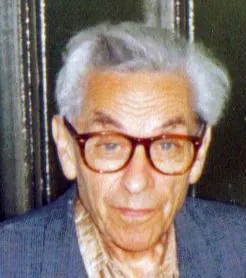 Paul Erdős1913–1996 · Mathematics
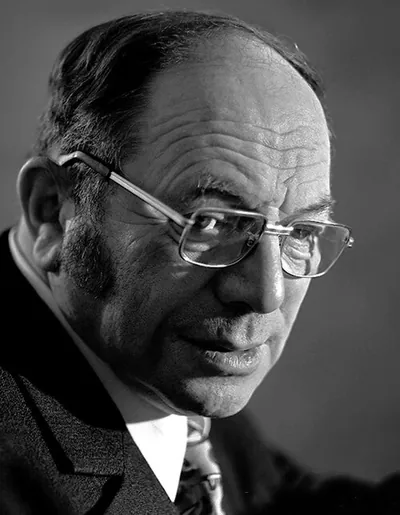 Leonid Kantorovich1912–1986 · Mathematics
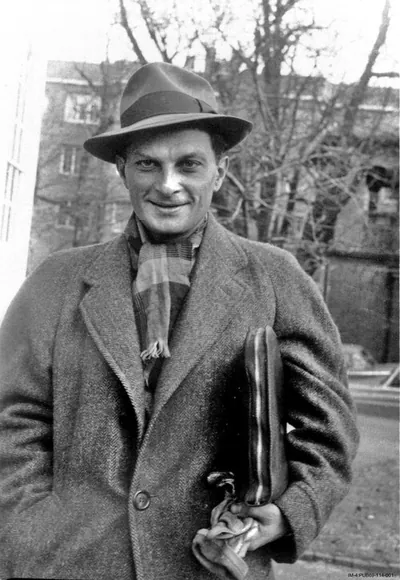 Stanisław Ulam1909–1984 · Mathematics
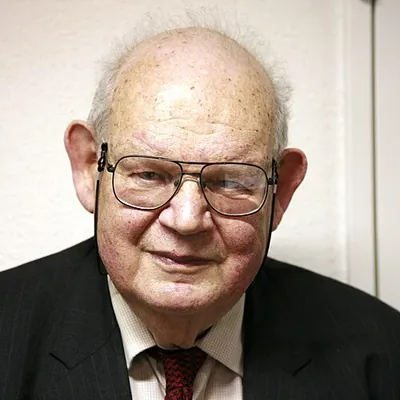 Benoit Mandelbrot1924–2010 · Mathematics
 Andrey Kolmogorov1903–1987 · Mathematics
 John Tate1925–2019 · Mathematics
