Martín Cárdenas
Bolivian naturalist, botanist and agronomist who compiled the most extensive inventory of his country's flora · 1899–1973
- Born
- November 12, 1899
- Died
- February 14, 1973
- Country
- Bolivia
- Section
- Biology
Biography
Martín Cárdenas Hermosa (Cochabamba, 1899 - Cochabamba, 1973) was a Bolivian naturalist, botanist and agronomist, widely regarded as the most important botanist in his country's history. He worked in the first half of the twentieth century, when scientific research in Bolivia depended almost entirely on individual effort. His significance lies in cataloguing Bolivia's native plants and in showing that serious science could be done from the country with very limited resources.
He received his early schooling at the Seminario Conciliar and the Escuela Municipal Bolívar, and completed secondary education at the state colleges Nacional Bolívar and Sucre in Cochabamba. In 1918 he graduated in Sciences and Letters and won a scholarship to the Instituto Normal Superior "Simón Bolívar" in La Paz, where he specialised in natural sciences and chemistry, qualifying in 1922.
During holidays in Cochabamba he walked the surrounding countryside collecting plants, then searched the books and journals of La Paz's Municipal Library to identify them. There he met the Swedish botanist Erik Asplund, who had spent years travelling through Bolivia gathering plants for his herbarium. Cárdenas joined him on several expeditions and learned a great deal from him, and Asplund is generally regarded as his first major mentor in botany.
By May 1922 he was already teaching natural sciences and chemistry at the Instituto Normal Superior in La Paz, first as an assistant and later as a full professor. With little funding, he travelled the country at his own expense, often staying in the homes of former students who remained his friends. These journeys earned him a reputation as an eccentric, and some people even said he was mad.
The results were remarkable. He gathered around 6,500 plant specimens from Bolivia's flora and described 180 new cactus species, with 16 varieties, and recorded 26 types of wild potato with six varieties. His identifications and naming of new species are listed 893 times in the international IPNI database. He is also recognised as a promoter of new farming methods and of introducing additional crops to Bolivia.
His reputation reached well beyond the country. He received the IICA International Agricultural Medal, became a corresponding member of the Botanical Society of America and a foreign member of the Linnean Society of London, and in 1951 was awarded the Mary Soper Pope Memorial Award in botany. His legacy lives on in the botanical garden of Cochabamba, which bears his name, in the house where he lived, now a museum, and in the genus Cardenasia, named in his honour by the American botanist Rusby.
Main contributions
- 1918Graduation in Sciences and Letters, which opened the way to a scholarship for study in La Paz.
- 1922Qualification in natural sciences and chemistry at the Instituto Normal Superior in La Paz.
- 1951Mary Soper Pope Memorial Award in botany, one of his international honours.
- A herbarium of about 6,500 specimens of Bolivian flora, gathered on his expeditions across the country.
- Description of 180 new cactus species, with 16 varieties.
- Record of 26 types of wild potato, with six varieties, contributing to knowledge of Andean crops.
Trivia and anecdotes
A reputation for eccentricity
According to the sources, his many field trips earned him a reputation for madness among acquaintances, yet he paid for them himself.
A house turned museum
The house where he lived in Cochabamba is now a museum. His name also appears on schools in Cochabamba and La Paz.
Their contemporaries
While Martín Cárdenas was alive (1899–1973)…
Alive at the same time
Discovered or invented in those years
- 1903AirplaneA fixed-wing aircraft, heavier than air, powered by engines or rockets, that stays aloft because its wings generate lift.
- 1925TelevisionA system that sends moving pictures and sound over distance and shows them on a receiver, the television set.
- 1925Quantum mechanicsPhysical theory describing how matter and light behave at atomic and subatomic scales, where energy is exchanged in minimal packets and results are expressed as probabilities.
- 1931Big BangA cosmological model describing how the universe expanded from an early state of extreme density and temperature, about 13.8 billion years ago.
- 1945ComputerA programmable machine that takes in data, processes it by following stored instructions, and produces results, able to switch tasks simply by running different software.
- 1969InternetA global network of interconnected computer networks that communicate using the TCP/IP protocol suite.
 Hans Krebs1900–1981 · Biology
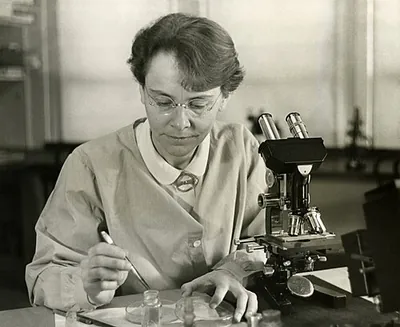 Barbara McClintock1902–1992 · Biology
 Gerty Cori1896–1957 · Biology
 Konrad Lorenz1903–1989 · Biology
 Ernst Mayr1904–2005 · Biology
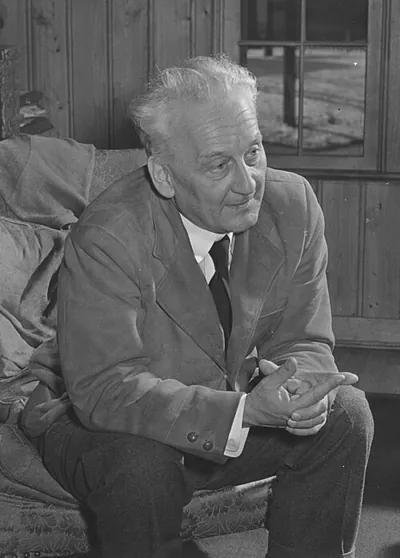 Albert Szent-Györgyi1893–1986 · Biology