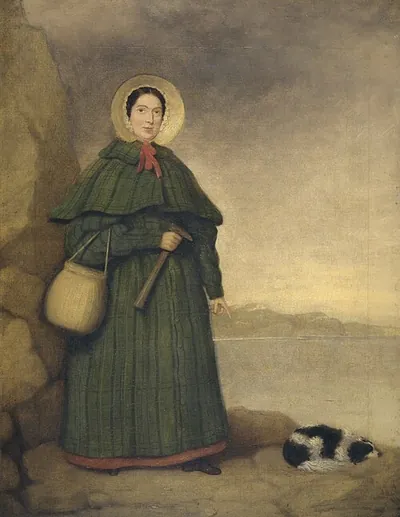
Mary Anning
Fossil collector, dealer and palaeontologist from England, often regarded as the first recognised palaeontologist · 1799–1847
- Born
- May 21, 1799
- Died
- March 9, 1847
- Country
- United Kingdom of Great Britain and Ireland
- Section
- Earth sciences
Biography
Mary Anning was an English fossil collector and dealer, and is often described as the first recognised palaeontologist. She lived on the Dorset coast in the first half of the nineteenth century, when geology was beginning to show that the Earth was far older than traditional chronologies suggested and that the animals of the past had been very different from those alive today. Her finds in the Jurassic cliffs at Lyme Regis helped change those ideas, although for most of her life she received little public recognition for them.
She was born on 21 May 1799 in Lyme Regis, a coastal town in Dorset. Her father, Richard, was a cabinetmaker who supplemented his income by searching the nearby cliffs for fossils and selling them to tourists. Her mother, Molly Moore, had married him in 1793. The family were Dissenters, Protestants who did not belong to the Church of England, and they attended a Congregationalist chapel. That status brought legal and social discrimination in a town with a conservative outlook. Of the ten children the couple had, only Mary and her brother Joseph survived. An older daughter, also named Mary, died in 1798 after her clothes caught fire at home, and the baby born the following year was given her sister's name. A local story holds that at fifteen months old she survived a lightning strike on an elm tree under which she had been held by a neighbour; the three women beneath the tree were killed. The details are uncertain, but the community later credited the event with her liveliness and curiosity.
Her formal schooling was very limited. She learned to read at the Sunday school attached to the chapel, and most of what she read in childhood was religious. On her own, she read whatever scientific material she could find and laboriously copied out articles lent to her by others. To understand the anatomy of the fossils she collected, she dissected fish and cuttlefish. This self-taught training allowed her in time to speak on equal terms with geologists and naturalists.
Richard Anning died in 1810, leaving debts and no savings. He had been ill with tuberculosis and had suffered injuries from a fall on the cliffs. The family had to seek parish relief, and Mary and Joseph, who had already accompanied their father on his expeditions, turned fossil hunting into their main livelihood, working alongside their mother. The cliffs around the town belong to a rock layer called the Blue Lias, made of thin alternating bands of limestone and shale laid down on a shallow sea floor early in the Jurassic period, roughly 200 million years ago. It is one of the richest fossil sites in Britain, but it is also hazardous. In winter, rain triggers landslides that expose new fossils, which is why collectors went to the shore at that time of year, despite the risk.
Her breakthrough came around 1811 and 1812. Joseph uncovered the skull of an ichthyosaur, a large marine reptile, and shortly afterwards Mary found the rest of the skeleton. It was the first ichthyosaur to be correctly identified. Sold to a collector and shown in London, the specimen attracted interest at a time when the public was beginning to grasp how long life had existed on Earth. In 1820 Lieutenant-Colonel Thomas Birch, a wealthy collector, learned that the family was about to sell its furniture to pay the rent. He auctioned the fossils he had bought from them, and the roughly 400 pounds raised gave the Annings some financial relief and enhanced their standing among geologists.
Day-to-day sales depended on the tourist season. Invertebrate fossils such as ammonite and belemnite shells were common and sold for a few shillings. Vertebrate fossils were much rarer and fetched several pounds. In 1826, using savings built up over years, she bought a house with a large shop window and opened Anning's Fossil Depot. The local newspaper reported the move. Visitors came from across Europe and America. The geologist George William Featherstonhaugh bought specimens for the New York Lyceum of Natural History, and in 1844 King Frederick Augustus II of Saxony bought an ichthyosaur skeleton. Carl Gustav Carus, the king's physician and adviser, recorded the richness of the shop in his diary. The dangers of her trade were also painfully clear in 1833, when a landslide nearly killed her and instead killed Tray, her terrier and regular companion on collecting trips.
Anning corresponded with leading geologists. Charles Lyell asked her opinion on how the sea was eroding the cliffs at Lyme, and Adam Sedgwick, who taught geology at Cambridge, was among her earliest customers. Henry De la Beche, who later became one of Britain's leading geologists, went fossil hunting with her as a teenager. William Buckland, a lecturer at Oxford, visited Lyme during vacations and searched for fossils at her side. It was through this exchange that she made a suggestion of real scientific value: that the strange cone-shaped objects known as bezoar stones were actually fossilised faeces of marine reptiles. Buckland gave them the name coprolites. Her observations also helped show that belemnite fossils preserved fossilised ink sacs, like those of modern cephalopods. The Swiss palaeontologist Louis Agassiz worked with her and her friend Elizabeth Philpot on fossil fish, and he thanked them both for their help in his book on the subject. Charlotte Murchison, the wife of the geologist Roderick Murchison, became a lifelong friend, and the two women exchanged many letters.
The scientific establishment, however, was largely closed to her. In Britain at the time women could not vote, hold public office or attend university. The Geological Society of London did not even allow women to attend its meetings as guests. Specimens she found were often described by gentlemen who had paid for them, and her name was frequently left out of what was published. A young woman who sometimes accompanied her wrote that Anning felt these men of learning had profited from her knowledge. Anning was also critical of Thomas Hawkins, who had inserted false bones into his ichthyosaur skeletons, and she said plainly that he made fossils look as he imagined they ought to be. Her only scientific writing published in her lifetime was a letter printed in 1839 in the Magazine of Natural History. In it she challenged the claim that a recently found fossil shark represented a new genus, pointing out that she had long ago documented sharks with both straight and hooked teeth.
Money was a constant worry. In 1830 an economic slump in Britain reduced demand for fossils. De la Beche commissioned Georg Scharf to make a lithograph of his watercolour Duria Antiquior, a scene of prehistoric Dorset based largely on fossils Anning had found. He sold copies among his wealthy colleagues and friends and gave the proceeds to her, making it one of the first widely circulated images of deep time. That same year she found the skeleton of a new type of plesiosaur, which sold for 200 pounds. In 1835 she lost most of her lifelong savings in a poor investment. Buckland then persuaded the British Association for the Advancement of Science and the government to grant her an annual pension of 25 pounds, known as a Civil List pension. Around this time she also switched from the Congregational chapel to the Church of England, partly because the chapel had lost members and partly because of the social standing of the established church.
She died on 9 March 1847, aged 47, of breast cancer. Her last years were marked by illness, and the laudanum she took for pain gave rise to baseless rumours in the town that she drank heavily. After her death, De la Beche, then president of the Geological Society, wrote a memoir published in the society's proceedings. It was the first such tribute the society had paid to someone who was not a member, and the first to a woman. The society did not admit women as fellows until 1904. A stained-glass window in her memory, paid for by the vicar and by members of the society, was placed in St Michael the Archangel church in Lyme Regis. She is now remembered as a central figure in early palaeontology, whose work was vital to understanding Jurassic marine reptiles, and whose life shows clearly the barriers that women and people of modest origins faced in science at the time.
Main contributions
- 1811First correctly identified ichthyosaur skeleton, found with her brother Joseph in the Lyme cliffs; a large Jurassic marine reptile.
- 1823The first nearly complete plesiosaur skeleton, a long-necked marine reptile, found on 10 December.
- 1828The first pterosaur found outside Germany, a flying reptile of the age of dinosaurs.
- 1829A Squaloraja fish skeleton, a fossil fish with features between sharks and rays.
- 1830Her fossils formed the basis of Henry De la Beche's lithograph Duria Antiquior, one of the first widely circulated scenes of deep time.
- 1839A letter to the Magazine of Natural History on fossil sharks, her only scientific writing published during her lifetime.
- Identifying coprolites as fossilised faeces, a suggestion made to William Buckland that was important for studying the diet of marine reptiles.
Trivia and anecdotes
The lightning strike of 1800
A local story says she survived a lightning strike at fifteen months old while three women under the elm died. It is a popular tale whose details are uncertain.
A line in a notebook
When the physician of the King of Saxony asked her to write her name in his notebook, she added that she was famous throughout Europe.
A dog called Tray
In 1833 a landslide killed Tray, her usual companion, and nearly killed her too. She wrote about the episode to Charlotte Murchison.
Their contemporaries
While Mary Anning was alive (1799–1847)…
Alive at the same time
Discovered or invented in those years
- 1803AtomThe basic unit of a chemical element: a nucleus of protons and usually neutrons surrounded by a cloud of electrons.
- 1811MoleculeAn electrically neutral group of at least two atoms held together by chemical bonds in a defined arrangement.
- 1821ElectricityThe set of physical phenomena linked to the presence and movement of electric charge, and one of the most versatile forms of energy in modern life.
- 1838ProteinLarge biomolecules made of chains of amino acids that carry out structural, catalytic, transport, defensive and regulatory functions in living things.
- 1839PhotographyA technique for creating lasting images by recording light, either on a light-sensitive material or with an electronic sensor.
- 1846NeptuneThe eighth and most distant planet of the Solar System, an ice giant found through mathematical prediction before any direct sighting.
 Charles Lyell1797–1875 · Earth sciences
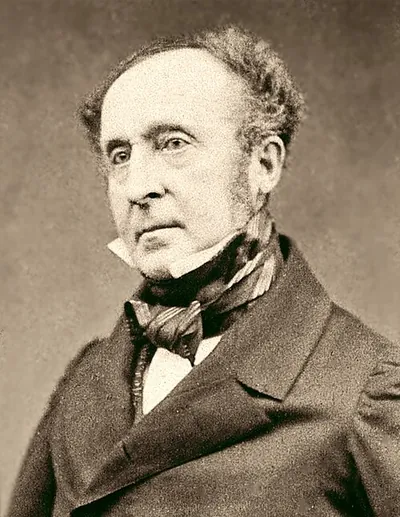 Roderick Murchison, 1st Baronet1792–1871 · Earth sciences
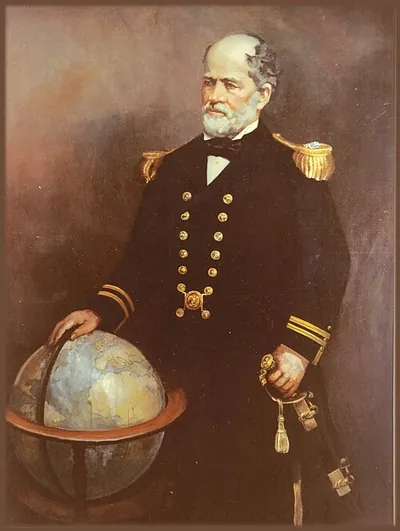 Matthew Fontaine Maury1806–1873 · Earth sciences
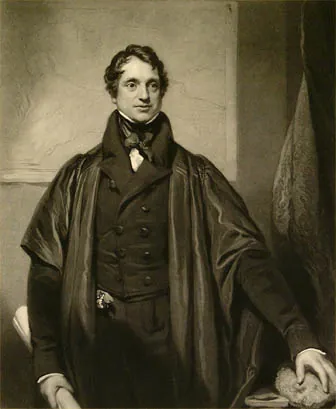 Adam Sedgwick1785–1873 · Earth sciences
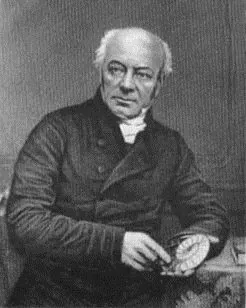 William Buckland1784–1856 · Earth sciences
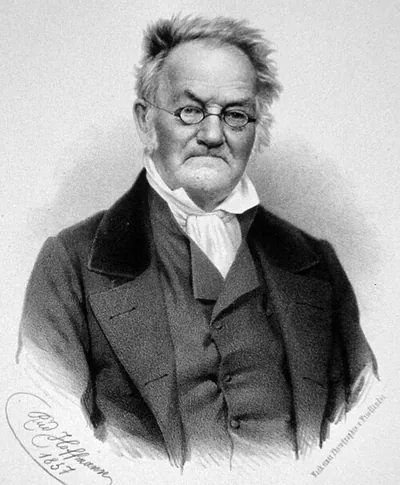 Carl Ritter1779–1859 · Earth sciences
