
Mary Kenneth Keller
American Catholic religious sister and computer science pioneer, the first woman to earn a doctorate in computer science in the United States · 1913–1985
- Born
- December 17, 1913
- Died
- January 10, 1985
- Country
- United States
- Section
- Computing
Biography
Mary Kenneth Keller was an American Catholic religious sister, educator and pioneer of computer science. Born in 1913 and died in 1985, she is remembered as the first woman in the United States to earn a doctorate in computer science, a degree still rare in the 1960s, when the discipline was only beginning to establish itself as an academic field in its own right.
She was born Evelyn Marie Keller in Cleveland, Ohio. In 1932 she joined the Sisters of Charity of the Blessed Virgin Mary, a congregation founded a century earlier by an Irish nun, and in 1940 she took her vows under the religious name Sister Mary Kenneth. She studied mathematics at DePaul University in Chicago, earning a bachelor's degree in 1943 and later a master's in mathematics and physics. She also attended or was affiliated with the universities of Wisconsin-Madison, Purdue and Michigan, and with Dartmouth College, where in 1958 she joined a computing laboratory that had until then been reserved for men. She was the first woman admitted there, at an institution that had gone nearly two centuries without accepting women.
In the summer of 1961 she took part in a programme for high school teachers at Dartmouth, where she worked with Thomas Kurtz, one of the creators of BASIC, a simple programming language designed so that beginners could write their own programs. Keller contributed to its development and became a skilled teacher of the language, co-writing a widely used textbook on it in 1973.
Her doctoral dissertation, completed in 1965 at the University of Wisconsin-Madison, dealt with inductive inference, the ability to reach general rules from examples. Specifically, it described algorithms that could automatically carry out the differentiation of algebraic expressions. Irving Tang received his doctorate on the same day, so the two are usually named as the first computer science doctorates in the country. For years Keller was regarded as the very first, and later research qualified that claim, though her status as the first woman to earn the degree in the field is not disputed.
After graduating, Keller accepted a post at Clarke College in Dubuque, Iowa, a Catholic women's college run by her own congregation. There she founded the computer science department, which she led for about twenty years. She championed an open approach to education: she allowed student mothers to attend class with their babies and encouraged women and newcomers to take up computing. A grant from the National Science Foundation allowed her to equip a small college with technology it could otherwise not have afforded, turning the department into a leading educational centre in the American Midwest.
Keller also helped found the Association of Small Computer Users in Education (ASCUE), devoted to the use of computers in small educational institutions. For her, faith and science were never opposed: she saw computing as a tool for human and social development. In 1975 she observed that we had still not fully used the computer as the great interdisciplinary tool it is.
She died in Dubuque in 1985, at the age of 71. Her legacy lives on in the Keller Computer Center at Clarke, named after her, and in a computer science scholarship that also bears her name. She is today regarded as one of the pioneers of computing and an early example of women's participation in the field.
Main contributions
- 1961Contribution to the development of the BASIC programming language, designed so that beginners could write their own programs.
- 1965First doctoral dissertation in computer science by a woman in the United States, on algorithms that automatically differentiate algebraic expressions.
- 1965Founding of the computer science department at Clarke College, which she led for about twenty years.
- 1973Co-authorship of a textbook on BASIC, widely used to teach programming.
- Co-founding of the Association of Small Computer Users in Education (ASCUE), devoted to the use of computers in education at small institutions.
Teachers and students
Trivia and anecdotes
First woman admitted to Dartmouth
She joined a computing laboratory at Dartmouth that had until then been reserved for men, at a university that had never admitted a woman in nearly two centuries.
A shared doctorate
Keller and Irving Tang received their doctorates on the same day, 7 June 1965, so for years she was considered the first person to hold that degree in the country.
Their contemporaries
While Mary Kenneth Keller was alive (1913–1985)…
Alive at the same time
Discovered or invented in those years
- 1916Black holeA region of space where gravity is so strong that nothing, not even light, can escape once it crosses a certain boundary.
- 1925TelevisionA system that sends moving pictures and sound over distance and shows them on a receiver, the television set.
- 1925Quantum mechanicsPhysical theory describing how matter and light behave at atomic and subatomic scales, where energy is exchanged in minimal packets and results are expressed as probabilities.
- 1931Big BangA cosmological model describing how the universe expanded from an early state of extreme density and temperature, about 13.8 billion years ago.
- 1945ComputerA programmable machine that takes in data, processes it by following stored instructions, and produces results, able to switch tasks simply by running different software.
- 1969InternetA global network of interconnected computer networks that communicate using the TCP/IP protocol suite.
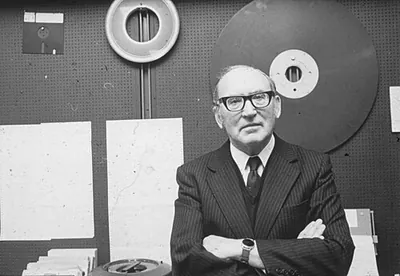 Maurice Wilkes1913–2010 · Computing
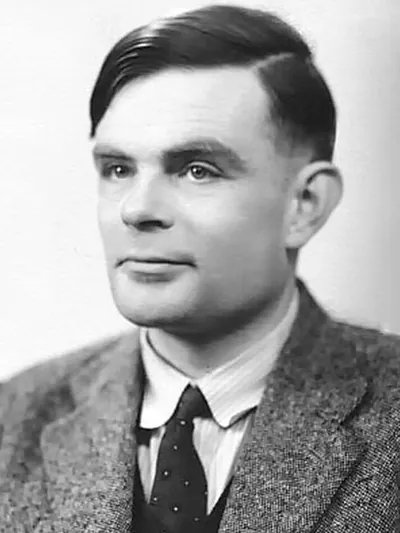 Alan Turing1912–1954 · Computing
 Claude Shannon1916–2001 · Computing
 Konrad Zuse1910–1995 · Computing
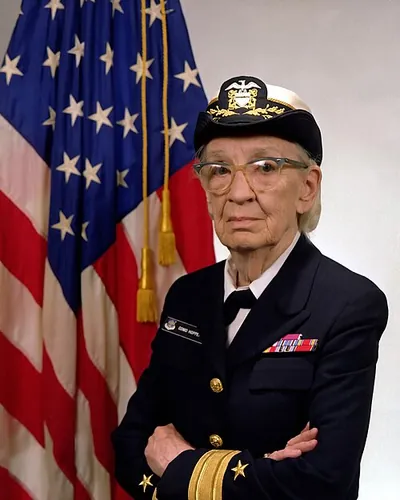 Grace Hopper1906–1992 · Computing
 Kenneth E. Iverson1920–2004 · Computing
