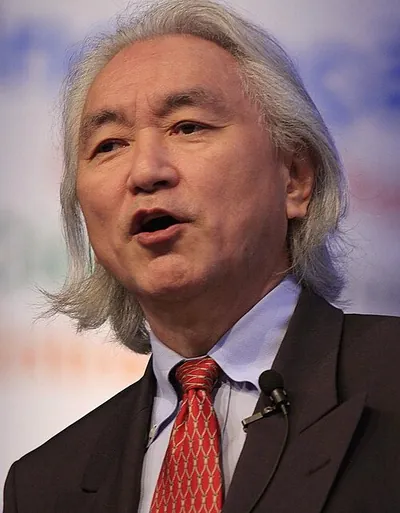
Michio Kaku
American theoretical physicist, science communicator and futurologist · 1947
- Born
- January 24, 1947
- Country
- United States
- Section
- Physics
Biography
Michio Kaku is an American theoretical physicist of Japanese descent, known for his work on string theory, a framework that describes particles and forces as vibrations of one-dimensional objects called strings. He is also one of the best-known science communicators of his time, with a career in books, radio and television that has made him a familiar figure to general audiences. He came of age during the late twentieth century, when physics was moving toward ambitious unified theories and when popular science was reaching large audiences, and his importance lies in bridging abstract research and public understanding.
He was born on January 24, 1947, in San Jose, California. His parents were second-generation Japanese Americans, and both were held in the Tule Lake War Relocation Center during the Second World War, where they met. At home Kaku was raised in the teachings of Buddhism, while at school he received Christian instruction. He has said that this double upbringing shaped his views of the universe: Buddhism pictures a cosmos with no beginning and no end, while Christianity describes a linear history with a start and an end. In his own account, his theories try to reconcile these two images.
His scientific vocation, he has recalled, began with a photograph of Albert Einstein's desk taken after Einstein's death. Kaku was struck by the fact that Einstein had never finished his unified field theory, an attempt to describe all the fundamental forces of nature within one framework, and he resolved to devote his life to that problem. As a high school student he built a small 2.3 MeV particle accelerator in his parents' garage, using scrap metal and wire. The device was strong enough to produce antimatter, particles with the opposite charge to ordinary matter. He presented it at a national science fair in Albuquerque, New Mexico, where the physicist Edward Teller, one of the figures behind the hydrogen bomb, noticed him, took him on as a protégé and awarded him the Hertz Engineering Scholarship.
With Teller's backing he studied at Harvard, graduating in 1968 summa cum laude and first in his physics class. He then went to the University of California, Berkeley, where he earned his doctorate in 1972 at the Radiation Laboratory. Around the same time he held a lectureship at Princeton University. His research focused on string theory, on quantum field theory, which describes how particles and forces behave at very small scales, and on supergravity, an extension of general relativity that builds in symmetries linking matter and force particles. In 1974 he and Keiji Kikkawa of Osaka University published the first papers describing string theory in field form, a step that helped its later development.
Kaku also lived through the Vietnam War. In 1968, as he was about to be drafted, he joined the United States Army and served until 1970. He completed basic training at Fort Benning in Georgia and advanced infantry training at Fort Lewis in Washington, but he was never sent to Vietnam. He later explained that, as a student in California, he listened to programs on the Pacifica radio network that made him reconsider nuclear weapons. That shift led him to turn away from developing a new generation of nuclear arms, a path his mentor Teller had offered him, and toward research, teaching, writing and public education.
His academic base has been the City College of New York, where he holds the Henry Semat Chair in theoretical physics. He has also been a visiting member at the Institute for Advanced Study in Princeton. His public work became central from the 1980s, when he wrote about nuclear energy and the arms race. His best-known books for general readers combine physics with speculation about the future, among them Hyperspace, Parallel Worlds, Physics of the Impossible and Physics of the Future. From 2006 he presented the radio show Science Fantastic on commercial stations in the United States, and for years he has hosted the weekly program Exploration, produced by WBAI in New York, which covers science, war, peace and the environment. On television he has presented series for the BBC, the Discovery Channel, the History Channel and the Science Channel, including Time, about the nature of time, and Sci Fi Science: Physics of the Impossible, which examined the scientific basis of ideas such as time travel and warp drive.
As a futurologist, Kaku has made predictions for the year 2100: that people will be able to move objects with their minds, control computers through tiny brain sensors, design bodies to order and extend life. He expects these advances to lead to a planetary civilization, which he calls Type I on the Kardashev scale, a way of ranking civilizations by the energy they command. He has also argued why many predictions from the information age, such as the paperless office or the videophone, did not come true. He attributes this to what he calls the caveman principle: when modern technology collides with the older desires of humans, the older desires tend to win. Half-jokingly, he suggests that to predict future social life one need only imagine life a hundred thousand years ago and multiply it by a billion.
Kaku is married for a second time, to Shizue Kaku, and has two daughters. He has said that figure skating is a recreational pastime. As a public voice he has spoken against denial of the human cause of global warming, against nuclear proliferation and against what he sees as the misuse of science. He criticized the Cassini-Huygens probe over the plutonium it carried to power its thermoelectric generator, and he questioned NASA's risk assessment, while remaining a strong supporter of space exploration. He has served on the boards of Peace Action and of the New York station WBAI-FM.
His legacy lies mainly in bringing theoretical physics to a general audience. His academic work on string theory and quantum field theory contributed to the effort to unify the forces of nature, a goal that remains unfinished. His popular books, several of them bestsellers, have made him one of the most recognizable science voices in the United States and beyond.
Quotes
“On countless occasions it has been claimed that something is impossible, but one or several decades later its feasibility has been demonstrated.”
“Remarkably, only a handful of fundamental physical principles are sufficient to summarize most of modern physics.”
“Mathematics... is the set of all possible self-consistent structures, and there are vastly more logical structures than physical principles.”
“We actually have a candidate for the mind of God. The mind of God we believe is cosmic music, the music of strings resonating through 11 dimensional hyperspace. That is the mind of God.”
Main contributions
- 1974First papers describing string theory in field form, written with Keiji Kikkawa.
- 1987Beyond Einstein, a book on superstrings and the search for a final theory, written with Jennifer Trainer.
- 1994Hyperspace, a popular book on parallel universes, extra dimensions and warps of time.
- 2008Physics of the Impossible, on the scientific basis of ideas such as invisibility, time travel and warp drive.
- 2011Physics of the Future, a book of technological forecasts for the year 2100.
- 2021The God Equation, a book on the search for a theory of everything.
Teachers and students
Trivia and anecdotes
An accelerator in the garage
For a school science fair he built a 2.3 MeV particle accelerator in his parents' garage, powerful enough to produce antimatter.
A photograph that changed his course
According to his own account, a picture of Einstein's desk after the physicist's death led him to study physics.
A war without combat
He was drafted during the Vietnam War but was never sent to fight there.
Their contemporaries
While Michio Kaku was alive (1947–)…
Alive at the same time
Discovered or invented in those years
- 1947TransistorA semiconductor component that amplifies or switches electrical current between two terminals, depending on a signal applied to a third.
- 1957Artificial satelliteAn artificial satellite is a human-made object placed in orbit around a celestial body, usually Earth, to collect information, relay signals, or carry out a specific task.
- 1969InternetA global network of interconnected computer networks that communicate using the TCP/IP protocol suite.
- 1971EmailA network service that lets users send and receive digital messages through addressed mailboxes, much like postal mail but electronic.
- 1973Mobile phoneA handheld wireless phone that lets people make and receive calls while moving across a cellular network area.
- 1989World Wide WebA system of linked documents and resources, connected by hyperlinks and accessed over the Internet with web browsers.
 Stephen Hawking1942–2018 · Physics
 Donna Strickland1959 · Physics
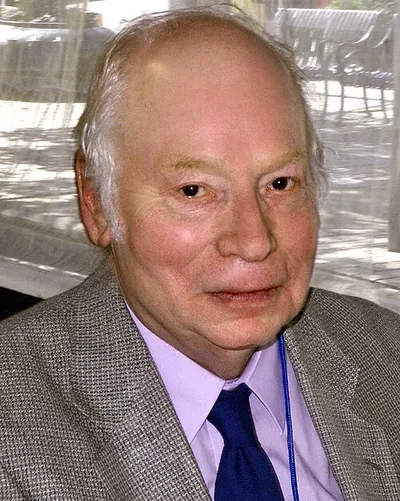 Steven Weinberg1933–2021 · Physics
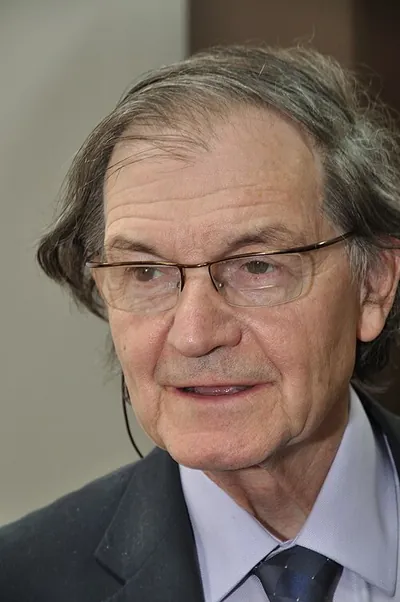 Roger Penrose1931 · Physics
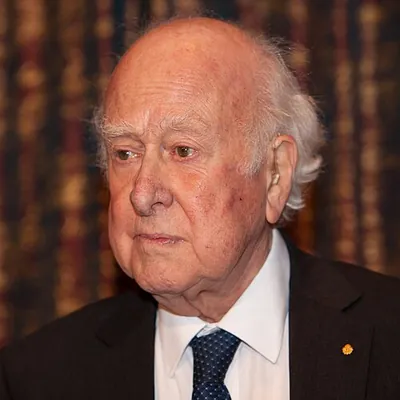 Peter Higgs1929–2024 · Physics
 Murray Gell-Mann1929–2019 · Physics
