
Mikhail Lavrentyev
Soviet mathematician and hydrodynamicist, founder of the Akademgorodok science town in Novosibirsk · 1900–1980
- Born
- November 19, 1900
- Died
- October 15, 1980
- Country
- Soviet Union, Russian Empire
- Section
- Mathematics
- Awards
- Abel Prize
Biography
Mikhail Alekseyevich Lavrentyev (1900-1980) was a Soviet mathematician and hydrodynamicist, a specialist in the motion of fluids. His work covered conformal mappings and partial differential equations, as well as the physics of explosions, but he is best remembered for creating Akademgorodok, the scientific town near Novosibirsk that became one of the Soviet Union's most ambitious research projects.
Lavrentyev was born in Kazan, where his father worked as an instructor and later became a professor at the university there and then at Moscow. He studied at Kazan University until his family moved to Moscow in 1921, when he transferred to the physics and mathematics department of Moscow State University, graduating in 1922. From 1923 to 1926 he was a graduate student of Nikolai Luzin, a leading figure of the Moscow school of mathematics. In 1936 some of Luzin's own students accused him of plagiarism and anti-Soviet activity, triggering a political case against him. Lavrentyev took no part in this persecution, known as the Luzin case, and in any case Luzin was a friend of his father.
In 1927 he spent half a year in France, working with French mathematicians. On returning to the Soviet Union he joined Moscow University and later the Steklov Institute of Mathematics. One of his students was Mstislav Keldysh. In 1939 the president of the Ukrainian Academy of Sciences asked him to direct the Institute of Mathematics in Kyiv. During the Second World War he worked on defence projects, which drew him into the study of explosive processes. A better grasp of these physics made controlled explosions usable in construction, most notably for the Medeu dam near Almaty in Kazakhstan.
From 1957 to 1975 he was one of the main organizers and the first chairman of the Siberian Division of the Academy of Sciences of the USSR. His most widely known achievement is the founding of Akademgorodok, now a district of Novosibirsk. Shortly after the decision to create the Siberian Division, Novosibirsk State University was established, and he was a professor there from 1959 to 1966. He also helped found the Institute of Hydrodynamics of the Siberian Division, which was named after him in 1980.
His son, Mikhail Mikhailovich Lavrentyev (1930-2010), also became a mathematician and served in the leadership of Akademgorodok. Lavrentyev received many honours, including the title Hero of Socialist Labour, a Lenin Prize and a USSR State Prize, and he was made an honorary citizen of Novosibirsk. His legacy lives on in the Lavrentyev Institute of Hydrodynamics, the research vessel Akademik Lavrentyev, and streets in Kazan, Dolgoprudny and Novosibirsk.
Main contributions
- 1957Founding of the Siberian Division of the USSR Academy of Sciences, whose first director he was until 1975, boosting research in Siberia.
- 1957Foundation of Akademgorodok, the Academic Town, now a district of Novosibirsk and his best-known achievement.
- Work on conformal mappings, which preserve angles when a shape is transferred from one surface to another, and on partial differential equations.
- Studies of the physics of explosive processes, which made controlled blasts usable in works such as the Medeu dam in Kazakhstan.
Teachers and students
Studied under:
Taught:
Trivia and anecdotes
A political case he stayed out of
In 1936 some of Luzin's students accused their teacher of plagiarism and anti-Soviet activity. Lavrentyev took no part in the persecution, perhaps because Luzin was a friend of his father.
Their contemporaries
While Mikhail Lavrentyev was alive (1900–1980)…
Alive at the same time
Discovered or invented in those years
- 1903AirplaneA fixed-wing aircraft, heavier than air, powered by engines or rockets, that stays aloft because its wings generate lift.
- 1925TelevisionA system that sends moving pictures and sound over distance and shows them on a receiver, the television set.
- 1925Quantum mechanicsPhysical theory describing how matter and light behave at atomic and subatomic scales, where energy is exchanged in minimal packets and results are expressed as probabilities.
- 1931Big BangA cosmological model describing how the universe expanded from an early state of extreme density and temperature, about 13.8 billion years ago.
- 1945ComputerA programmable machine that takes in data, processes it by following stored instructions, and produces results, able to switch tasks simply by running different software.
- 1969InternetA global network of interconnected computer networks that communicate using the TCP/IP protocol suite.
 Andrey Kolmogorov1903–1987 · Mathematics
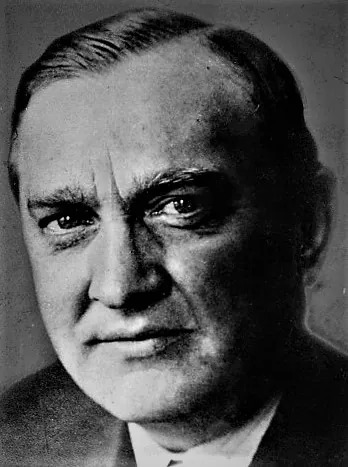 Stefan Banach1892–1945 · Mathematics
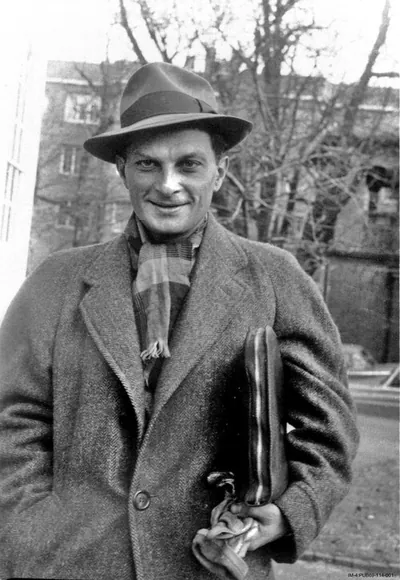 Stanisław Ulam1909–1984 · Mathematics
 Ronald Fisher1890–1962 · Mathematics
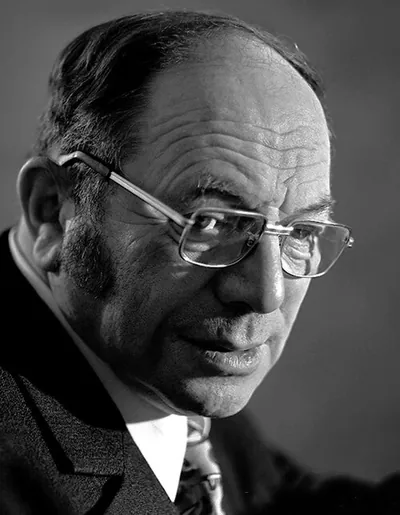 Leonid Kantorovich1912–1986 · Mathematics
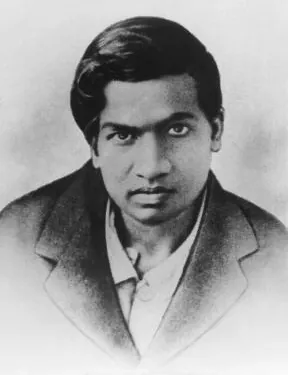 Srinivasa Ramanujan1887–1920 · Mathematics
