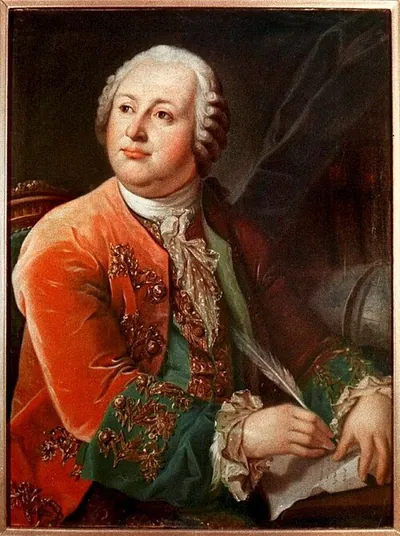
Mikhail Lomonosov
Russian polymath, scientist, geographer and poet, founder of Moscow University · 1711–1765
- Born
- November 19, 1711
- Died
- April 15, 1765
- Country
- Russian Empire
- Section
- Physics
Extended biography
Childhood and early learning
Mikhail Vasilyevich Lomonosov was born in 1711 in Mishaninskaya, a village on an island in the Northern Dvina, not far from Kholmogory, in the far north of Russia. The village was later renamed Lomonosovo in his honour. His father was a peasant fisherman who had grown into a ship owner, carrying goods along the White Sea coast to places such as Solovki, Kola and Lapland. The business gave the family some comfort, but the father expected his son to follow him into trade.
His mother, the daughter of a deacon, was the first wife of his father and died when Lomonosov was still a child. The usual account says that a neighbour, Ivan Shubny, taught him to read, and that he later studied with the village deacon. For years the only books within reach were religious ones, and he read them eagerly. At fourteen he was given a Church Slavonic grammar and an arithmetic textbook, which opened a much wider world. Even when his father took him on trading trips, he used every free moment to read.
Relations with his stepmother were strained, and his wish for a proper education grew stronger. He was sure that his village could not offer the schooling he needed. At nineteen he made a drastic decision: in the winter of 1730 he joined a caravan of fish merchants and walked all the way to Moscow. He arrived with little money and an uneven education, so he had to begin in a school for small children before he could enter higher study.
Moscow, Marburg and Freiberg
In Moscow he gained a place at the Slavic Greek Latin Academy, helped by teachers who were impressed by his stamina and ability. Accounts of the period describe a very frugal life, spent largely in study. He completed in five years a course designed for eight, which earned him a scholarship at the Academy of Sciences in St Petersburg. In 1736 he set off for Germany to study metallurgy and chemistry.
At the University of Marburg he attended lectures by the philosopher Christian Wolff, a leading figure of the German Enlightenment. Most biographers regard this link as the most influential of his life, both in his philosophical outlook and in his sense of science as an organised enterprise. In his final year he moved to the mining academy at Freiberg, where he studied mineralogy, mining and metallurgy. Relations there soured over the quality of teaching and the meagre money provided to the Russian students, and he left without permission.
During these years he learned German quickly, read Robert Boyle and began to take chemistry seriously. He also started writing poetry. His Ode on the Taking of Khotin from the Turks, composed in 1739, drew attention in St Petersburg. Money troubles were constant. He had married Elisabeth Christine Zilch, the daughter of the widow who rented him rooms in Marburg, in June 1740. Supporting a family on the Academy's small and irregular allowance proved almost impossible, and he eventually returned to Russia.
Back in St Petersburg
He came back in 1741 and became an adjunct in the physics department of the Academy. His manner was blunt, he quarrelled often with colleagues, and he had a reputation for heavy drinking. In 1743 he was arrested after being accused of insulting people connected with the Academy, and he spent around eight months under house arrest. He was released in early 1744 after apologising to those involved. A year later he became a full member of the Academy and professor of chemistry, the first Russian to hold that post there, and he set up the institution's first chemistry laboratory.
His literary rivalries were fierce, especially with Sumarokov and Trediakovsky, yet Empress Elizabeth protected him and granted him estates. That support let him pursue large projects. From the mid-1750s he worked in the geography department of the Academy, and in 1755, with the backing of Count Ivan Shuvalov, he helped found Moscow University, the first Russian university, which now bears his name.
His life combined laboratory discipline with a passion for teaching and cultural policy. He believed that Russia needed its own scientists and teachers, and he devoted much of his energy to training them. Writing reports, organising courses and defending budgets took up much of his time, alongside his poetry and experimental work.
Chemistry and the conservation of mass
Combustion and the changes that metals undergo when heated were among his chief concerns. At the time many chemists accepted the phlogiston theory, which held that burning bodies released an invisible substance called phlogiston. In 1756 Lomonosov repeated an experiment of Robert Boyle in sealed glass vessels and weighed the metals carefully before and after heating. He concluded that the phlogiston theory could not be sustained in the form then offered.
His best-known contribution is the principle that matter is neither created nor destroyed in a chemical reaction: the total mass before a reaction equals the total mass after it. He stated this in several letters, including one to Leonhard Euler dated 5 July 1748, and developed it in later writings on the solidity and fluidity of bodies. Antoine Lavoisier reached a similar conclusion by other routes several decades later, which is why the law is sometimes called the Lomonosov-Lavoisier law. Priority is debated, partly because Lomonosov's work circulated very little outside Russia for a long time.
He also argued for a corpuscular view of matter. He distinguished elements, which he took to be simple parts of bodies, from corpuscles, which were groups of such parts. He treated heat as a form of motion, suggested that light behaves as a wave and contributed to ideas that later became the kinetic theory of gases. Many of these views ran ahead of his time, and some were not fully understood until the following century.
Astronomy, optics and the transit of Venus
In 1761 Lomonosov watched the transit of Venus across the face of the Sun from a small observatory near his house in St Petersburg. As the planet entered and left the solar disc, he saw a thin arc of light around the dark part of Venus. He interpreted it as sunlight bent by refraction in a dense atmosphere surrounding the planet. Refraction is the bending of light when it passes from one medium to another. The effect became known in the literature as Lomonosov's arc.
The interpretation was not accepted at once. Some doubted that eighteenth-century telescopes were precise enough to show such a feature, and others disputed the explanation. Later observers, during several transits, reported the arc, and an experiment in 2012 with antique refracting telescopes reproduced the conditions he had described and supported his account. It is now counted among his most solid findings.
In 1762 he also designed an unusual reflecting telescope. In most reflectors the main mirror sends light to a focus in front of the tube, where the observer's head can block the image. Lomonosov tilted the primary mirror by one to three degrees, so that the image formed to the side of the tube and could be viewed without obstruction. The design was not published until 1827, by which time similar instruments by William Herschel were known, so this type is usually linked to Herschel's name.
Geography, geology and the Arctic ice
Geography was perhaps the field where Lomonosov left the most lasting mark in Russia. His studies of how icebergs form led him to think about the dynamics of sea ice and the shape of the Arctic coast. He explained that icebergs break away from ice sheets on land, and from this he reasoned that the ocean surrounding Antarctica must be bordered by frozen land. This was a theoretical prediction of an Antarctic continent that no one had yet seen.
In his 1763 work on northern sea routes he outlined the essential features of Arctic marine dynamics, drew a hydrographic chart marking possible routes for ships and described a general law governing the movement of ice. For this work he is often regarded as a forerunner of glaciology, the study of ice and glaciers. He also trained geographers who later joined Academy expeditions. Around 1764 he helped organise an expedition, led by Admiral Vasily Chichagov, to search for a northeast passage between the Atlantic and Pacific by sailing along the northern coast of Siberia.
In geology he held that nature changes steadily and continuously, so the Earth's past should be explained through processes still visible today. He showed that soil, peat, coal, petroleum and amber had an organic origin, and in 1745 he published a catalogue of more than three thousand minerals. In 1763 he presented his work on the strata of the Earth, his most important geological text. Some historians place it as a precursor to the ideas of James Hutton, who is traditionally named as a founder of modern geology.
Language, verse and mosaics
Lomonosov was also an innovator in Russian language and literature. With his contemporaries Sumarokov and Trediakovsky he sought to establish rules of grammar, syntax and versification that would let a native literary tradition grow from Western European genres. His Epistle on the Rules of Russian Versification of 1739 set out his ideas and championed syllabo-tonic verse, based on alternating stressed and unstressed syllables, in place of the older syllabic system. He is therefore seen as the advocate of this form in Russian poetry, although statistical studies suggest that the shift was already underway.
In his grammar of 1755, published in 1757, he separated the forms of Old Church Slavonic from those of spoken Russian, and proposed a literary language that could combine both registers for lofty and everyday subjects. His rhetoric of 1748 was among the first of its kind in Russian, and his preface on the usefulness of church books is regarded as one of the earliest stylistic studies in the language. He wrote solemn odes, religious odes and poems about nature. His Meditations on the Greatness of God, one for morning and one for evening, are among the first Russian poems to express awe before the natural world. He also wrote two verse tragedies, which did not enjoy great success.
He was proud of reviving the ancient craft of mosaic. After years of experiments on how minerals colour glass, he set up a glass works in 1763 that produced enamelled mosaics, rare outside Italy at the time. About forty mosaics are attributed to him, and twenty-four are known to survive. Among them are a portrait of Peter the Great and a large Battle of Poltava. His most ambitious historical project, an epic about Peter the Great, remained unfinished.
Final years and legacy
In 1764 he was appointed a State Councillor, a senior rank in the imperial administration. He died in St Petersburg on 15 April 1765, at the age of fifty-three, and was buried in the city where most of his professional life had unfolded. Official tributes and memories from his students stressed his educational work and his insistence on doing science in Russian.
His reputation grew slowly outside Russia, partly because many of his studies were written in Latin, German or Russian and did not circulate widely in the major journals of western Europe. It increased through the nineteenth century and especially in the twentieth, when Soviet historians presented him as the father of Russian science. Some of those claims were exaggerated, but specialists now recognise the originality of his work in chemistry, astronomy, geography and language.
His name appears in many places: the Lomonosov crater on the Moon, a crater on Mars, the asteroid 1379 Lomonosowa, the town of Lomonosov, an underwater ridge in the Arctic Ocean, a university that still carries his name and a gold medal of the Russian Academy of Sciences, awarded since 1959. What is most often praised is the combination of curiosity, rigour and the wish to explain science in the Russian language, which made him a central figure in his country's culture.
Main contributions
- 1739Rules of Russian versification: he proposed accentual-syllabic verse, which transformed the country's poetry.
- 1748Law of conservation of mass: in a chemical reaction the total mass stays the same, as he set out in a letter to Euler.
- 1754Mosaic portrait of Peter I: one of the surviving works from his mosaic workshop.
- 1755Russian grammar: a work that blended Church Slavonic forms with spoken Russian.
- 1756Refutation of phlogiston theory: he repeated Boyle's experiment in sealed vessels and concluded that the hypothesis was false.
- 1761Atmosphere of Venus: during the 1761 transit of Venus he saw a luminous arc around the planet and attributed it to refraction of sunlight.
- 1762Off-axis reflecting telescope: its tilted primary mirror let the observer look without blocking the image.
- 1763Study of ice and northern routes: he described the movement of sea ice and drew a hydrographic chart for Arctic navigation.
Teachers and students
Studied under:
Taught:
Trivia and anecdotes
An invented identity
To enter the Slavic-Greek-Latin Academy he gave false information about his family, a lie that nearly got him expelled.
A legendary robbery
He is said to have beaten three robbers and left one of them naked, but this story is unconfirmed.
A Google tribute
On 19 November 2011 Google marked his 300th birthday with a Google Doodle.
Their contemporaries
While Mikhail Lomonosov was alive (1711–1765)…
Alive at the same time
Discovered or invented in those years
- 1712Steam engineAn engine that turns the heat energy of water vapour into mechanical motion, using a piston that moves back and forth inside a cylinder.
- 1735CobaltA bluish-white metal with atomic number 27 and symbol Co, known for its deep blue pigments and its role in modern batteries.
- 1736Graph theoryA branch of mathematics that studies networks of points joined by lines, used to model routes, connections and relationships.
- 1745CapacitorAn electronic component that stores electric charge and energy between two conductors separated by an insulator.
- 1751NickelA silvery-white, corrosion-resistant metal with atomic number 28 and symbol Ni, mostly used today in stainless steel.
- 1755MagnesiumMagnesium is a light, shiny gray-white metal with atomic number 12 and symbol Mg, found in many minerals, seawater and living organisms.
 Henry Cavendish1731–1810 · Physics
 Charles-Augustin de Coulomb1736–1806 · Physics
 Thomas Young1773–1829 · Physics
 André-Marie Ampère1775–1836 · Physics
 Hans Christian Ørsted1777–1851 · Physics
 Isaac Newton1643–1727 · Physics
