
Miron Nicolescu
Romanian mathematician known for real analysis and differential equations, president of the Romanian Academy · 1903–1975
- Born
- August 27, 1903
- Died
- June 30, 1975
- Country
- Romania
- Section
- Mathematics
- Awards
- Abel Prize
Biography
Miron Nicolescu (Giurgiu, 27 August 1903 – Bucharest, 30 June 1975) was a Romanian mathematician best known for his work in real analysis and differential equations. He led the Romanian Academy and served as vice-president of the International Mathematical Union, placing him at the centre of his country's scientific life in the second half of the twentieth century.
He was born in Giurgiu, a town on the Danube, the son of a teacher. He attended the Matei Basarab High School in Bucharest and then studied mathematics at the University of Bucharest, graduating in 1924. That same year he went to Paris, enrolling at the École Normale Supérieure and the Sorbonne. Under Paul Montel, an expert in functions of a complex variable, he completed his doctoral thesis in 1928, titled Fonctions complexes dans le plan et dans l'espace.
Back in Romania, he taught at the University of Cernăuți until 1940, when he became a professor at the University of Bucharest. His academic rise ran alongside his institutional career: he was elected an associate member of the Romanian Academy in 1936 and a full member in 1953. After King Michael's coup of 23 August 1944 he joined the Social Democratic Party and later the Romanian Communist Party, a path shared by many intellectuals of the time that shaped his public role under the postwar regime.
In 1963 he became director of the Institute of Mathematics of the Romanian Academy, a post he held until 1973. From 1966 until his death he presided over the Academy. Internationally, he was elected in 1972 to the German National Academy of Sciences Leopoldina and, at the International Congress of Mathematicians in Vancouver in 1974, vice-president of the International Mathematical Union. He held that office from 1975, the year of his death, and his term was completed by Gheorghe Vrănceanu. The physicist Peter Freund, who met him at a lecture in Timișoara, remembered him as an affable and debonair man.
His name lives on in his country: a technical high school in Sector 4 of Bucharest and a boulevard in Giurgiu carry it. His legacy lies mainly in spreading modern mathematical analysis in Romania and in training a generation of researchers.
Main contributions
- 1928Doctoral thesis Fonctions complexes dans le plan et dans l'espace, supervised by Paul Montel, on functions of a complex variable.
- 1936Election as associate member of the Romanian Academy, recognising his research work.
- 1963Directorship of the Institute of Mathematics of the Romanian Academy, held until 1973.
- 1966Presidency of the Romanian Academy, held until his death.
- 1974Election as vice-president of the International Mathematical Union at the Vancouver congress.
Teachers and students
Studied under:
Taught:
Trivia and anecdotes
A personal testimony
The physicist Peter Freund, who met him at a lecture in Timișoara, described him as an affable and very handsome man.
Tributes in Romania
A technical high school in Sector 4 of Bucharest and a boulevard in Giurgiu bear his name.
Their contemporaries
While Miron Nicolescu was alive (1903–1975)…
Alive at the same time
Discovered or invented in those years
- 1903AirplaneA fixed-wing aircraft, heavier than air, powered by engines or rockets, that stays aloft because its wings generate lift.
- 1925TelevisionA system that sends moving pictures and sound over distance and shows them on a receiver, the television set.
- 1925Quantum mechanicsPhysical theory describing how matter and light behave at atomic and subatomic scales, where energy is exchanged in minimal packets and results are expressed as probabilities.
- 1931Big BangA cosmological model describing how the universe expanded from an early state of extreme density and temperature, about 13.8 billion years ago.
- 1945ComputerA programmable machine that takes in data, processes it by following stored instructions, and produces results, able to switch tasks simply by running different software.
- 1969InternetA global network of interconnected computer networks that communicate using the TCP/IP protocol suite.
 Andrey Kolmogorov1903–1987 · Mathematics
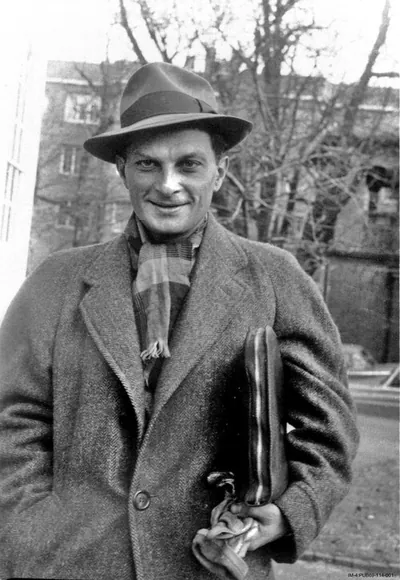 Stanisław Ulam1909–1984 · Mathematics
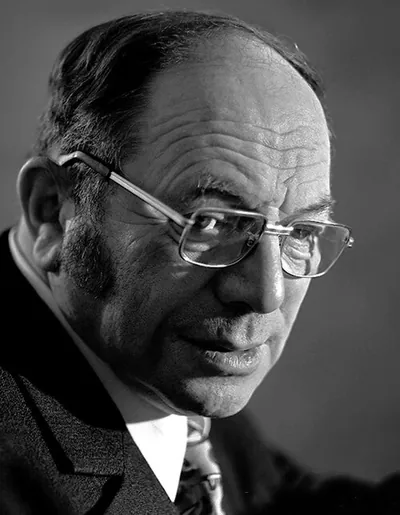 Leonid Kantorovich1912–1986 · Mathematics
 Paul Erdős1913–1996 · Mathematics
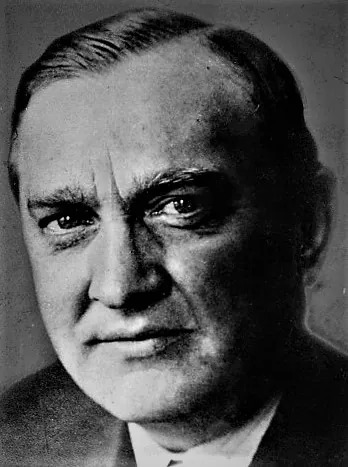 Stefan Banach1892–1945 · Mathematics
 Ronald Fisher1890–1962 · Mathematics
