
Mykhailo Maksymovych
Ukrainian botanist, historian and writer of Cossack origin who worked in the Russian Empire · 1804–1873
- Born
- September 15, 1804
- Died
- November 22, 1873
- Country
- Russian Empire
- Section
- Biology
Biography
Myjailo Maksymóvych (Mykhailo Maksymovych, 1804-1873) was a Ukrainian botanist, historian and writer who worked within the Russian Empire. Of Cossack descent, he moved between the natural sciences and the humanities at a time when both were still taking shape, and he is remembered for linking the study of plants with the study of language, folk song and the history of Ukraine.
He was born into an old Cossack family that owned a small estate near Myjailova Hora in the Poltava region. After school at the Novhorod-Siverskyi gymnasium he studied natural science and philology at Moscow University, then medicine, graduating in 1823 and 1827. He stayed on to research botany, took his doctorate in 1833, and ended up teaching the subject and running the university's botanical garden.
In Moscow he got to know writers such as Pushkin and Gogol, with whom he shared a growing interest in Cossack history. In 1834 he was appointed professor of Russian literature at the newly founded St Volodymyr University in Kyiv, and became its first rector. The university was part of the Russian government's effort to weaken Polish influence in Ukraine, and Maksymovych was partly an instrument of that policy, though he also tried to bring Ukrainian and Russian intellectuals such as Kostomarov and Shevchenko onto the faculty.
He wrote textbooks and popular books on botany, and carried the same accessible style into other fields. In 1833 he published The Book of Naum About God's Great World, a guide to geology and astronomy framed in religious terms, which reached eleven editions. His 1827 collection of Little Russian folk songs, containing 127 songs, was among the first of its kind in eastern Europe. In it he tried a Ukrainian spelling based on etymology, an early step toward the phonetic spelling later proposed by Panteleimon Kulish.
The arrest and exile in 1847 of members of the Brotherhood of Saints Cyril and Methodius, many of them his friends or students, hit him hard, and he turned more fully to research. He married in 1853 and, facing serious money problems, moved to Moscow in 1857 to look for work. Shevchenko visited him after returning from exile and painted portraits of him and his wife.
In his last years he focused on history and debated with Pogodin and Kostomarov. He argued that the lands around Kyiv were never fully depopulated and that their inhabitants were direct ancestors of the Ruthenians, and he criticised the Normanist theory that traced Kyivan Rus' to Scandinavian origins. In Slavic linguistics he split the eastern Slavs into a southern and a northern Russian language. His legacy lies in treating science, history and folklore as parts of one effort to understand the roots of his people, and in helping to launch the university in Kyiv.
Main contributions
- 1823On the System of the Flowering Kingdom: his first scholarly book on botany, classifying flowering plants.
- 1827Little Russian Folksongs: a collection of 127 songs, one of the first of its kind in eastern Europe.
- 1833The Book of Naum About God's Great World: a popular religious-toned guide to geology and astronomy that went through eleven editions.
- 1834First rector of St Volodymyr University in Kyiv, a post he held until 1835.
- 1839History of Old Russian Literature, arguing for continuity between the language and literature of Kievan Rus' and the Cossack period.
- 1856Days and Months of the Ukrainian Villager: the first part of a work on peasant customs across the calendar year.
Trivia and anecdotes
Portraits by Shevchenko
During his visit to Moscow in 1858, Taras Shevchenko painted portraits of Maksymovych and his wife, Maria.
A bestseller
The Book of Naum About God's Great World sold so well that it brought him royalties for many years.
A banned work
His first work on the Haidamaks, the Cossack rebels, was banned by the Russian censor.
Their contemporaries
While Mykhailo Maksymovych was alive (1804–1873)…
Alive at the same time
Discovered or invented in those years
- 1821ElectricityThe set of physical phenomena linked to the presence and movement of electric charge, and one of the most versatile forms of energy in modern life.
- 1839PhotographyA technique for creating lasting images by recording light, either on a light-sensitive material or with an electronic sensor.
- 1846NeptuneThe eighth and most distant planet of the Solar System, an ice giant found through mathematical prediction before any direct sighting.
- 1859EvolutionThe process by which the heritable traits of living populations change over generations, explaining the diversity of life from common ancestors.
- 1869Periodic tableAn arrangement of the chemical elements into rows (periods) and columns (groups), ordered by atomic number, that reveals recurring chemical behaviour and lets scientists predict properties.
- 1869Deoxyribonucleic acidA double-stranded molecule that carries the genetic instructions of nearly all living things and many viruses.
 Charles Darwin1809–1882 · Biology
 Theodor Schwann1810–1882 · Biology
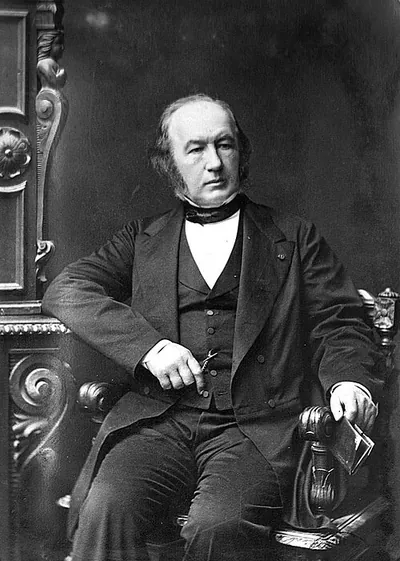 Claude Bernard1813–1878 · Biology
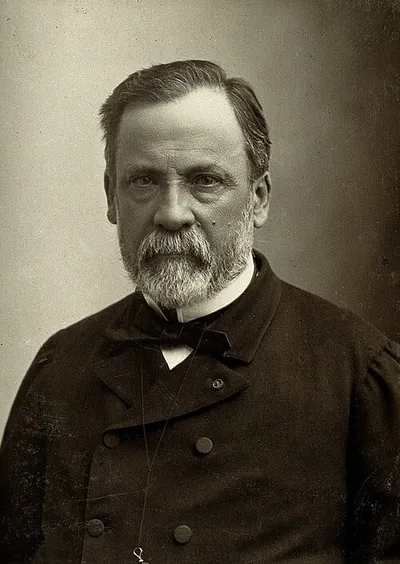 Louis Pasteur1822–1895 · Biology
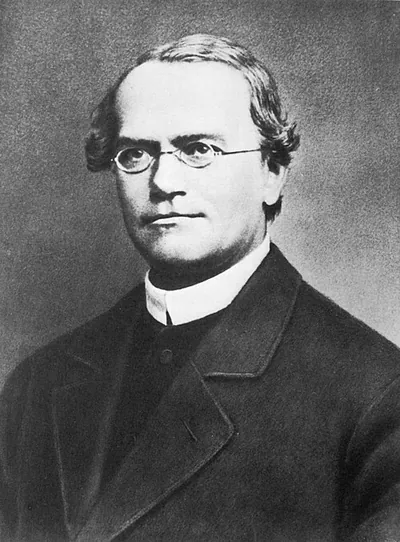 Gregor Mendel1822–1884 · Biology
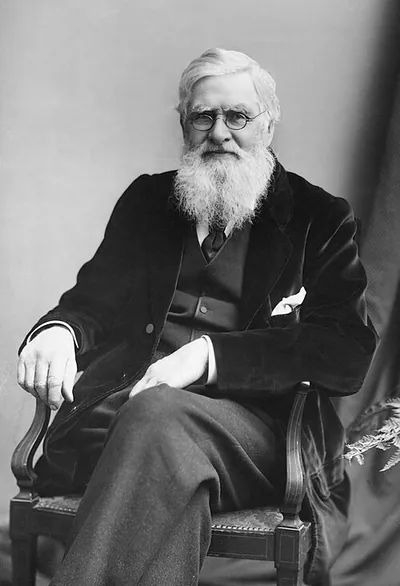 Alfred Russel Wallace1823–1913 · Biology
