
Nicole-Reine Lepaute
French astronomer and human computer of the 18th century, known for calculations on Halley's Comet and astronomical ephemerides · 1723–1788
- Born
- January 5, 1723
- Died
- December 6, 1788
- Country
- Kingdom of France
- Section
- Astronomy and space
Biography
Nicole-Reine Lepaute (Paris, 1723-1788) was a French astronomer and mathematician of the eighteenth century, one of the skilled calculators who supported the astronomy of her time without receiving credit for much of her work. Her name is linked to the prediction of Halley's Comet's return, to the exact timing of a solar eclipse, and to astronomical tables used for decades. Her story matters because it shows how science worked in the Enlightenment: long calculations, shared among several people, often published under other names.
She was born on 5 January 1723 in the Luxembourg Palace in Paris, the daughter of Jean Étable, a servant of Louise Élisabeth d’Orléans, a widowed duchess who lived in the palace. She was the sixth of nine children. Largely self-taught, she read late into the night as a child, and Jérôme Lalande later remarked that she had too much spirit not to be curious. A story says her interest in astronomy began when she saw a comet in the sky, but this is an origin tale that no document confirms.
In August 1748 she married Jean-André Lepaute, a royal clockmaker at the Luxembourg Palace, who designed, built and repaired the clocks of the court of Louis XV. The marriage gave her room to pursue science. While she kept the household accounts, she studied astronomy and mathematics, and she observed, calculated and described her husband's inventions.
Clockmaking was her first route into research. The couple built a clock with an astronomical function, at her suggestion, and she worked out how a pendulum, a weight that swings back and forth, changes its rate of swing with its length. Her tables linked pendulum length to the number of swings per hour. They appeared in the Traité d’horlogerie of 1755, published under her husband's name alone. That same period she met Lalande, sent by the Academy of Sciences to inspect a new type of pendulum. They would work together for about thirty years.
Her best-known achievement concerns Halley's Comet. Edmond Halley had suggested the comet would return around 1758, but he could not give a precise date, because the gravitational pull of Jupiter and Saturn made the calculation a three-body problem that was hard to solve at the time. Alexis Clairaut took on the comet's orbit, while Lepaute and Lalande studied the effect of the two giant planets. They worked for more than six months, barely stopping to eat. In November 1758 they proposed a window running from 15 March to 15 May 1759, centred on 13 April. The comet arrived on 13 March. The error of a few days drew mockery from Jean le Rond d’Alembert, who called the work “more laborious than deep”. Clairaut left her name out of his 1760 book, supposedly to please another woman, though that detail is uncertain.
In 1759 Lalande became director of the Connaissance des Temps, an astronomical almanac issued by the Academy of Sciences, and hired her as his assistant. For years she carried out calculations from his plans and contributed tables of her own. She then prepared the ephemerides, annual guides listing the daily positions of celestial bodies for astronomers and navigators: Saturn's positions for 1775 to 1784, and the Sun, Moon and planets for a later volume. In 1762 she calculated the exact timing of the solar eclipse of 1 April 1764 and published two maps under her own name: one of Europe, showing the eclipse at fifteen-minute intervals, and one of its phases over Paris. In 1761 she was named a member of the Academy of Béziers.
She had no children of her own, but in 1768 she adopted her husband's nephew, Joseph Lepaute Dagelet, and trained him in astronomy and advanced mathematics. Dagelet sailed to Terra Australis in 1773, became a professor at the Paris Military School and joined the Academy of Sciences in 1785. He most likely died in the shipwreck of La Pérouse's expedition in 1788. The strain of decades of calculation damaged her eyesight, and in 1783 she had to stop working. For her husband's last years of terminal illness, which lasted about seven years, she was his carer. She died in the parish of Saint-Roch in Paris on 6 December 1788, a few months before him.
Lalande always acknowledged her work, and after her death he wrote a short biography of her in his astronomical bibliography. Today her memory survives mainly on the Moon, in the Lepaute crater, and in the asteroid 7720 Lepaute.
Main contributions
- 1755Pendulum tables in the Traité d’horlogerie: they link a pendulum's length to its swings per hour, published under her husband's name.
- 1759Prediction of Halley's Comet's return: with Lalande and Clairaut she calculated a window of dates that was only a few days off.
- 1759Work for the Connaissance des Temps: calculations and tables for the Academy of Sciences' astronomical almanac, up to 1774.
- 1762Calculation and maps of the solar eclipse of 1 April 1764: she determined its exact timing and mapped it over Europe and Paris.
- 1774Ephemerides of Saturn and the celestial bodies for 1775-1784: daily planetary positions for use by astronomers and navigators.
Teachers and students
Trivia and anecdotes
A woman without a byline
Her name was left out of several works she had helped produce. Lalande acknowledged her help, while Clairaut omitted her from his 1760 book.
A nephew turned astronomer
In 1768 she adopted her husband's nephew, Joseph Lepaute Dagelet, and trained him in astronomy. He went on to sail to Terra Australis in 1773.
Remembered on the Moon
The lunar crater Lepaute and the asteroid 7720 Lepaute commemorate her name.
Their contemporaries
While Nicole-Reine Lepaute was alive (1723–1788)…
Alive at the same time
Discovered or invented in those years
- 1755MagnesiumMagnesium is a light, shiny gray-white metal with atomic number 12 and symbol Mg, found in many minerals, seawater and living organisms.
- 1766HydrogenThe lightest and most abundant chemical element in the universe, atomic number 1, which under normal conditions is a colourless, odourless and highly flammable gas.
- 1772NitrogenChemical element with atomic number 7, a colourless, odourless gas that makes up about 78% of Earth's air and is an essential part of proteins and nucleic acids.
- 1774OxygenA colorless, odorless gas, symbol O and atomic number 8, that forms the dioxygen in air and is essential for respiration in most living things.
- 1774ChlorineA yellow-green, poisonous and highly reactive gas, element 17, which is part of common salt and is used to disinfect water and make plastics.
- 1781UranusThe seventh planet from the Sun, an ice giant discovered by William Herschel in 1781, the first planet found with a telescope.
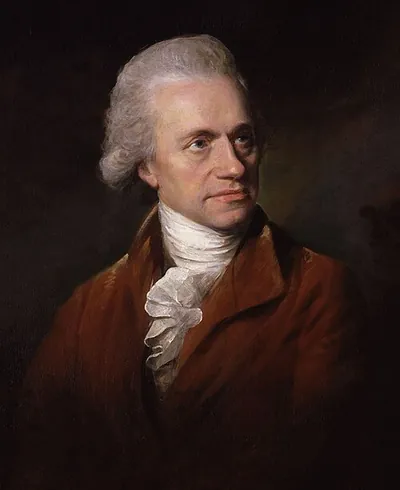 William Herschel1738–1822 · Astronomy and space
 James Bradley1693–1762 · Astronomy and space
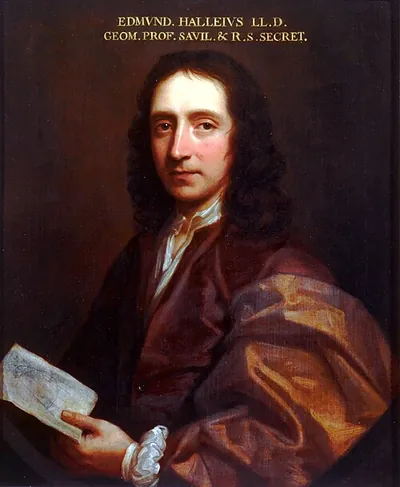 Edmond Halley1656–1742 · Astronomy and space
 John Frederick William Herschel1792–1871 · Astronomy and space
 John Flamsteed1646–1720 · Astronomy and space
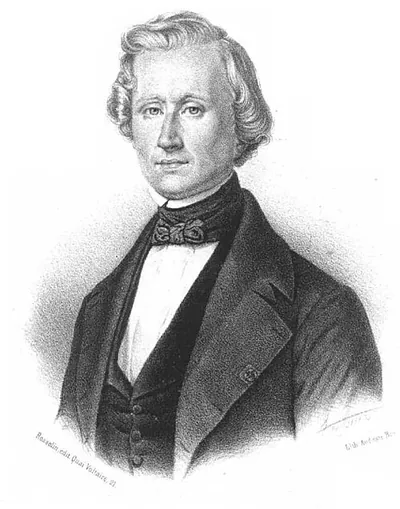 Urbain Le Verrier1811–1877 · Astronomy and space
