
Oliver Lodge
British physicist and engineer, pioneer of radio telegraphy and advocate of spiritualism · 1851–1940
- Born
- June 12, 1851
- Died
- August 22, 1940
- Country
- United Kingdom, United Kingdom of Great Britain and Ireland
- Section
- Technology and communications
Biography
Oliver Joseph Lodge (Penkhull, 1851 – Wiltshire, 1940) was a British physicist and engineer whose experiments with electromagnetic waves helped lay the groundwork for radio in the late nineteenth century. He worked in the years when James Clerk Maxwell's theory of electricity and magnetism was moving from the page into the laboratory, and his work shows how scientists went from proving that such waves existed to using them to send messages. He is remembered both for those technical advances and for his controversial interest in spiritualism.
Born on 12 June 1851 at Penkhull, near Stoke-on-Trent, he was the eldest of eight brothers in a family of clay merchants. At fourteen he joined his father's business, working as a sales agent until he was twenty-two, while attending physics classes in London and at the local Wedgwood institute. He earned his bachelor's degree in science from the University of London in 1875 and a doctorate in 1877. In 1881 he became professor of physics and mathematics at University College Liverpool, and in 1900 he became the first principal of the new University of Birmingham, a post he held until retiring in 1919.
His starting point was Maxwell's 1873 treatise on electricity and magnetism, which he studied closely even though he felt his skills in advanced mathematics were limited. His first papers therefore used mechanical models, built from beaded strings and pulleys, to illustrate phenomena such as electrical conduction. For much of his career he defended the aether, a hypothetical substance thought to fill all space and carry waves. That idea is now abandoned, and the experiment he devised in 1893 to detect the dragging of the aether found no evidence for it.
In 1879 he became interested in producing and detecting electromagnetic waves, something Maxwell had not considered. His progress was slowed by two factors. He was thinking of light waves, which have very high frequencies, rather than the much slower radio waves, and his friend George FitzGerald wrongly assured him that such waves could not be generated electromagnetically. After taking up his post in Liverpool, his research advanced slowly. In 1887, while preparing lectures on lightning, he discharged Leyden jars through long copper wires and saw sparks and regular glows along a wire, which he read as proof that he was generating and detecting Maxwell's waves. Shortly afterwards he learned from a German journal that Heinrich Hertz had already demonstrated their existence. Lodge acknowledged this in his 1888 report at Bath, and in 1894 he gave a memorial lecture on Hertz at the Royal Institution.
In that lecture and in later experiments, Lodge used a detector called a coherer, developed by Édouard Branly: a glass tube of metal filings between two electrodes that conducts current when a wave reaches it. With it he managed to transmit signals over 55 metres. That same year Marconi was working on his own system, which he demonstrated in 1895 with similar elements, and this sparked a long dispute over who had priority in radio telegraphy. Lodge later worked with Alexander Muirhead on devices built specifically for wireless telegraphy, and in 1898 he patented a tuner that let users select particular frequencies. Marconi eventually bought that patent in 1912, and Lodge became his scientific adviser in an honorary role.
Lodge also contributed to other fields. He studied electrolysis, the source of the electromotive force in the voltaic cell, and the use of electricity to disperse fog and smoke. He patented an electric spark ignition system for combustion engines, which his sons later developed through the company Lodge Plugs. He was also very active in public life: he was a member of the Fabian Society, served as president of the British Association in 1912 and 1913, and was knighted in 1902. He married Mary Marshall in 1877 and they had twelve children. After his son Raymond was killed in the First World War in 1915, he turned strongly to spiritualism and wrote books such as Raymond, or Life and Death (1916), in which he claimed to have received messages from his son through mediums. Scientists criticised these claims harshly and never accepted his evidence.
His legacy is twofold. His wave experiments and the coherer are part of the history of radio, although his exact role in its invention is still debated. His work on the aether and his defence of spiritualism show how a respected scientist could hold ideas that later science rejected.
Main contributions
- 1886Moving boundary method for measuring in solution the ion transport number, the fraction of electric current carried by a given ionic species.
- 1888Demonstration of electromagnetic waves travelling along wires, presented at Bath, which supported Maxwell's ideas.
- 1894Transmission of radio signals over 55 metres using a coherer detector, in experiments following his memorial lecture on Hertz.
- 1898Patent for a tuner that allowed specific frequencies to be selected in wireless communication.
- 1898Patent for a moving-coil loudspeaker, with a coil attached to a diaphragm suspended in a strong magnetic field.
- 1916Publication of Raymond, or Life and Death, a book recounting messages he said he had received from his dead son.
Teachers and students
Trivia and anecdotes
A lecture with consequences
His 1894 lecture on Hertz led to the priority dispute with Marconi, since Fleming argued it was a physics experiment rather than a demonstration of telegraphic signalling.
A mistaken warning
FitzGerald wrongly told him that ether waves could not be generated electromagnetically, which delayed his research.
Related discoveries and inventions
- 1893Electromagnetic waveguideA hollow, usually metal, pipe that carries very high frequency radio waves from one point to another with little loss.
Their contemporaries
While Oliver Lodge was alive (1851–1940)…
Alive at the same time
Discovered or invented in those years
- 1859EvolutionThe process by which the heritable traits of living populations change over generations, explaining the diversity of life from common ancestors.
- 1869Periodic tableAn arrangement of the chemical elements into rows (periods) and columns (groups), ordered by atomic number, that reveals recurring chemical behaviour and lets scientists predict properties.
- 1876TelephoneA device that carries the human voice over distance by turning sound into electrical signals and back into sound at the other end of the line.
- 1884CarA road vehicle with four wheels and its own engine, mainly built to carry people.
- 1903AirplaneA fixed-wing aircraft, heavier than air, powered by engines or rockets, that stays aloft because its wings generate lift.
- 1925TelevisionA system that sends moving pictures and sound over distance and shows them on a receiver, the television set.
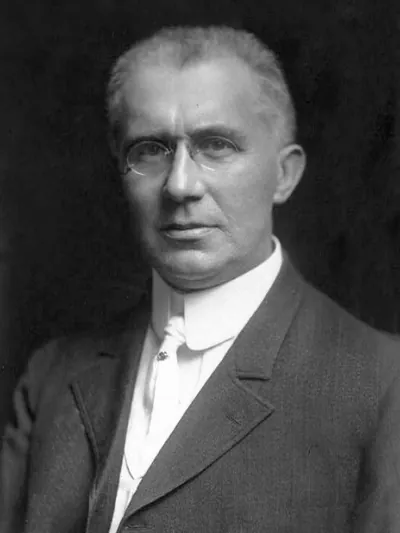 Emile Berliner1851–1929 · Technology and communications
 Karl Ferdinand Braun1850–1918 · Technology and communications
 John Ambrose Fleming1849–1945 · Technology and communications
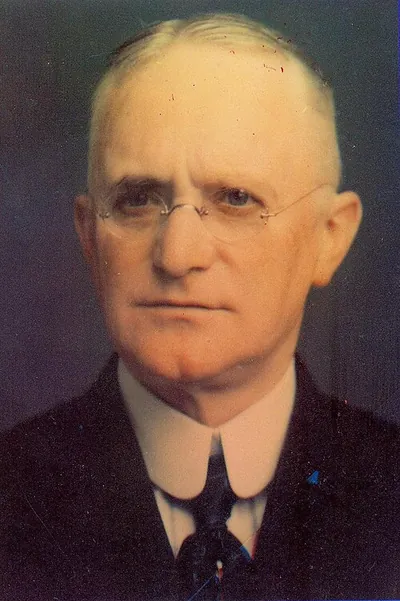 George Eastman1854–1932 · Technology and communications
 Thomas Edison1847–1931 · Technology and communications
 Alexander Graham Bell1847–1922 · Technology and communications
