
Pablo Echenique
Argentine-born Spanish theoretical physicist and politician, a leading figure in Podemos · 1978
- Born
- August 28, 1978
- Country
- Spain, Argentina
- Section
- Physics
Biography
Pablo Echenique Robba (born in Rosario, Argentina, in 1978) is a theoretical physicist who became better known as a leading figure in the Spanish party Podemos. Since 2014 his career has combined physics research, writing about disability and institutional politics, which makes him an unusual figure in Spanish public life.
He was born on 28 August 1978 in Rosario, in Santa Fe province. At thirteen he moved with his mother and sister to Zaragoza, in northeast Spain. He has spinal muscular atrophy, an inherited degenerative condition that appeared in early infancy. He has a recognised disability rating of 88% and uses a wheelchair.
He graduated in physics from the University of Zaragoza in 2002 and earned his doctorate four years later. His thesis took a bottom-up approach, starting from small peptides, short chains of amino acids, to explain how larger proteins behave. He then held a postdoctoral fellowship at the university's Institute of Biocomputation and Complex Systems Physics. In 2008 he received the Romper Barreras award for adapting his university office to his needs.
From December 2012 he wrote, with the journalist Raúl Gay, the blog De retrones y hombres on the eldiario.es site, aiming to challenge stereotypes about disability. Together they coined the word retrón for disabled people. In 2014 one of his posts won the Tiflos Prize for digital journalism, awarded by the Spanish National Organisation of the Blind (ONCE).
He joined Podemos in January 2014, shortly after it was founded, having briefly been a member of Ciudadanos. He finished fifth on the European list because of the party's gender-parity rules and took a seat when Podemos won five. In 2015 he became secretary general of Podemos Aragon and sat in the regional parliament until 2017. From 2016 to 2019 he led the party's national organisation. He was elected to the Congress of Deputies for Zaragoza in 2019 and took part in the talks that produced Spain's first progressive coalition government since the return of democracy.
He has also faced court cases. He was fined for keeping his personal assistant working without Social Security registration, and in 2020 he was ordered to pay €80,000 for saying that a man murdered in 1985 had been a rapist. The Supreme Court later annulled that conviction, finding he had expressed solidarity with a political colleague rather than making a direct accusation against the plaintiff's brother. His legacy mixes science popularisation, advocacy for disability rights and a controversial political career.
Main contributions
- 2006Doctoral thesis on peptides and proteins: a study applying physical methods to understand how the molecules of life behave, starting from their smallest building blocks.
- 2012The blog De retrones y hombres and the coinage of retrón: a way of naming disabled people that challenges common stereotypes.
- 2014Tiflos Prize for digital journalism for a blog post on disability and the prejudices surrounding it.
Trivia and anecdotes
A personal nickname
Besides retrón, Echenique often uses the word cascao when talking about himself and other disabled people.
Married to a university colleague
On 9 August 2012 he married María Alejandra Nelo Bazán, a Venezuelan whom he had met at university while she was doing her doctorate.
Their contemporaries
While Pablo Echenique was alive (1978–)…
Alive at the same time
Discovered or invented in those years
- 1989World Wide WebA system of linked documents and resources, connected by hyperlinks and accessed over the Internet with web browsers.
- 1990Web browserA program that lets people access the web by fetching a page's files from a server and displaying them on screen as an interactive page.
- 1991HTMLThe markup language used to structure web page content so that a browser can display it.
- 1994SmartphoneA mobile phone that combines the functions of a telephone with those of a small pocket computer, featuring a touchscreen, internet access and installable apps.
- 1998International Space StationA permanently crewed research laboratory in low Earth orbit, about 400 kilometres up, built and operated by five space agencies from different countries.
- 2007IPhoneA line of premium smartphones designed and sold by Apple since 2007, built around a touchscreen and the iOS operating system.
 Donna Strickland1959 · Physics
 Stephen Hawking1942–2018 · Physics
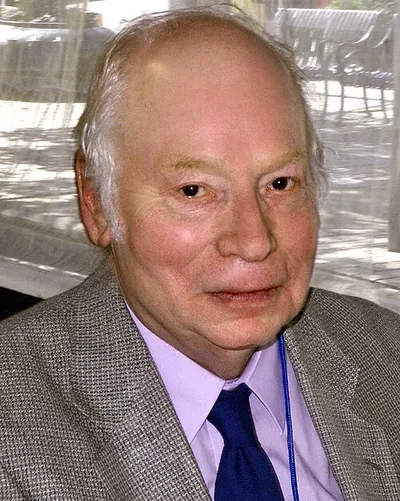 Steven Weinberg1933–2021 · Physics
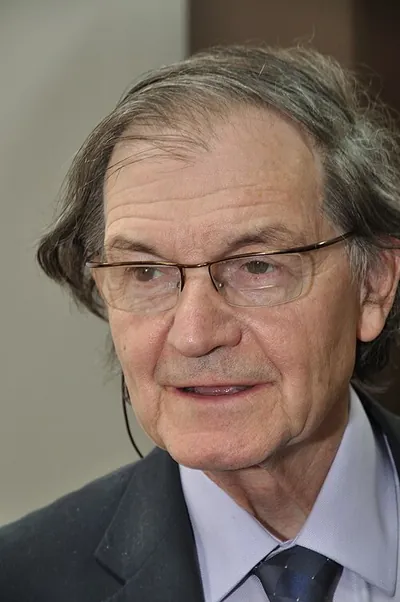 Roger Penrose1931 · Physics
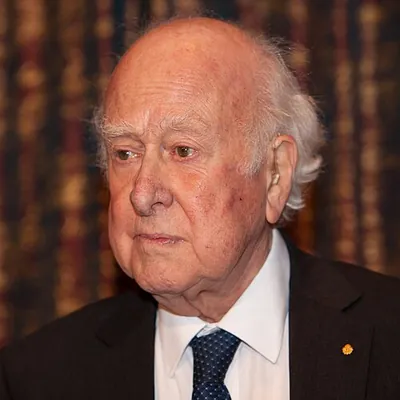 Peter Higgs1929–2024 · Physics
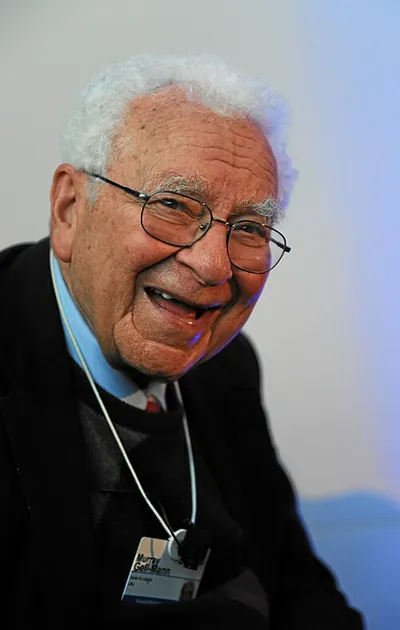 Murray Gell-Mann1929–2019 · Physics
