
Pierre Fatou
French mathematician and astronomer, pioneer of complex dynamics · 1878–1929
- Born
- February 28, 1878
- Died
- August 9, 1929
- Country
- France
- Section
- Mathematics
Biography
Pierre Fatou (Lorient, 1878 - Pornichet, 1929) was a French mathematician and astronomer whose work spans several branches of analysis, the field that studies functions, limits and repeated processes. He lived at the turn from the nineteenth to the twentieth century, when analysis was being transformed by new tools. His name survives in two basic concepts of modern mathematics, the Fatou lemma and the Fatou set, which makes him an essential figure for anyone trying to understand complex dynamics.
He was born in Lorient, on the Breton coast, into a family with military ties: his father, Prosper Ernest Fatou, and his mother, Louise Eulalie Courbet, both belonged to the military world. His family would have liked him to follow a military career too, but his health was not strong enough for that path, and he turned toward science instead. In 1898 he entered the Ecole Normale Superieure in Paris to study mathematics, graduating in 1901. That same year he was appointed an intern at the Paris Observatory, where he became assistant astronomer in 1904 and full astronomer in 1928, a post he held until his death.
His doctoral thesis, Trigonometric series and Taylor series, was the first application of the Lebesgue integral to concrete problems in analysis. The Lebesgue integral, introduced by Henri Lebesgue in 1901, is a more general way of measuring areas and adding up continuously varying quantities than the methods used before. Fatou used it to study analytic and harmonic functions on the unit disc, and in this work he examined for the first time the Poisson integral of an arbitrary measure on the unit circle. From this came the theorem that bears his name, published in 1906, which states that a bounded analytic function on the disc has radial limits almost everywhere on the circle. The result launched a large body of research on so-called bounded analytic functions.
Between 1917 and 1920 he created the area now known as holomorphic dynamics, which looks at the overall behaviour of a function applied again and again to complex numbers. To picture it, imagine repeating an operation on its own result and watching whether the values settle down, scatter, or form intricate shapes. He was the first to introduce and study the set now called the Julia set, whose complement is known as the Fatou set. In those same years Gaston Julia and Samuel Lattes arrived independently at some of the basic results of the field. In 1926 he pioneered the study of transcendental entire functions. As a by-product of this work he found what are now called Fatou-Bieberbach domains, proper subregions of complex space of dimension n that are biholomorphically equivalent to the whole space; such domains cannot exist in dimension one.
He also contributed to celestial mechanics, the branch that studies how bodies in space move. He was the first to prove rigorously a theorem, conjectured by Gauss, about averaging the effect of a perturbation produced by a periodic force with a short period. This work was continued by Leonid Mandelstam, Nikolay Bogolyubov and their students, and grew into a broad area of modern applied mathematics. He also studied the motion of a planet moving through a resisting medium. Decades later, Benoit Mandelbrot used computers to draw the behaviour of one of the iterations Fatou had studied, giving rise to what is now called the Mandelbrot set.
Fatou enjoyed friendly relations with several of his French contemporaries, especially Maurice Rene Frechet and Paul Montel. He received the Becquerel prize in 1918, became a knight of the Legion of Honour in 1923, and served as president of the French Mathematical Society in 1927. In the summer of 1929 he took a holiday in Pornichet, a seaside town west of Nantes, and he died there in August in his room at the villa where he was staying. The death certificate gave no cause; a later interpretation suggests a burst stomach ulcer, though this is not confirmed. His legacy endures in twentieth-century analysis and in today's complex dynamics.
Main contributions
- 1906Fatou theorem: a bounded analytic function on the disc has radial limits almost everywhere on the circle.
- 1917Creation of holomorphic dynamics and study of the Julia set, whose complement is called the Fatou set.
- 1926First studies of the dynamics of transcendental entire functions.
- Doctoral thesis on trigonometric and Taylor series, the first use of the Lebesgue integral on concrete problems in analysis.
- Fatou-Bieberbach domains, subregions of complex space equivalent to the whole space, which cannot exist in dimension one.
- Rigorous proof of a theorem of Gauss on averaging perturbations caused by short-period periodic forces.
Teachers and students
Trivia and anecdotes
A health setback that changed his path
His military family expected him to follow that career, but his fragile health steered him toward mathematics.
Parallel discoveries
Gaston Julia and Samuel Lattes independently reached basic results of holomorphic dynamics in 1918.
A death during a holiday
He died in 1929 in Pornichet while on holiday. The death certificate gave no cause; a perforated stomach ulcer has been suggested, though this is unconfirmed.
Their contemporaries
While Pierre Fatou was alive (1878–1929)…
Alive at the same time
Discovered or invented in those years
- 1884CarA road vehicle with four wheels and its own engine, mainly built to carry people.
- 1885BicycleA two-wheeled vehicle, with the wheels in line, that a person drives with pedals using leg power, and that stays upright through its own motion.
- 1897ElectronA negatively charged subatomic particle found in every atom, and key to electricity and chemical bonding.
- 1903AirplaneA fixed-wing aircraft, heavier than air, powered by engines or rockets, that stays aloft because its wings generate lift.
- 1925TelevisionA system that sends moving pictures and sound over distance and shows them on a receiver, the television set.
- 1925Quantum mechanicsPhysical theory describing how matter and light behave at atomic and subatomic scales, where energy is exchanged in minimal packets and results are expressed as probabilities.
 G.H. Hardy1877–1947 · Mathematics
 Henri Lebesgue1875–1941 · Mathematics
 Emmy Noether1882–1935 · Mathematics
 Bertrand Russell1872–1970 · Mathematics
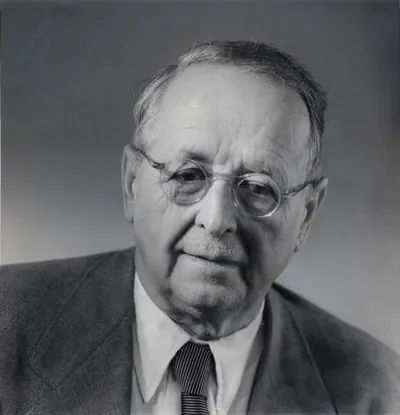 Hermann Weyl1885–1955 · Mathematics
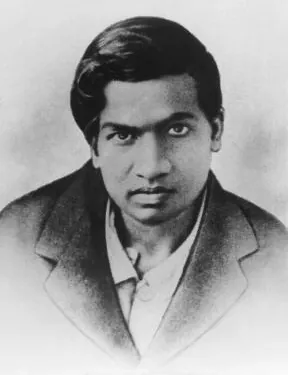 Srinivasa Ramanujan1887–1920 · Mathematics
