
G.H. Hardy
British mathematician known for number theory and mathematical analysis, and mentor of Srinivasa Ramanujan · 1877–1947
- Born
- February 7, 1877
- Died
- December 1, 1947
- Country
- United Kingdom
- Section
- Mathematics
Extended biography
Childhood and early years
Godfrey Harold Hardy was born on 7 February 1877 in Cranleigh, Surrey, England, into a family of teachers. His father worked as bursar and art master at Cranleigh School, and his mother had been a senior mistress at a training college for teachers. Both parents were drawn to mathematics, although neither had attended university.
His gift for numbers showed early. According to family tradition, at the age of two he could write numbers into the millions, and in church he amused himself by splitting the numbers of hymns into their factors. These stories come from family memory, so they should be taken with some caution, but they all describe a child who enjoyed numbers for their own sake.
After schooling at Cranleigh he won a scholarship to Winchester College for his mathematical ability. In 1896 he entered Trinity College, Cambridge. His first tutor did not satisfy him, and he briefly considered switching to history. The turning point came with Augustus Love, who recommended Camille Jordan's Cours d'analyse. By his own account, this book taught him for the first time what mathematics really meant.
Trinity, Cambridge and the demand for rigour
At Cambridge, British mathematics was still closely tied to physics and fluid mechanics, a tradition shaped by the long shadow of Isaac Newton. Much of this work aimed to describe the physical world rather than to build reasoning that was fully precise. Hardy felt that such methods left too many logical gaps. For him, a proof had to stand on its own, without leaning on physical intuition.
Rigour, in this sense, means that every step of an argument must be justified and every concept defined with care. This standard was common in France, Switzerland and Germany, but it had lost ground in Britain. Hardy used his academic position to argue firmly for a conception of pure mathematics in which the goal is demonstrated truth rather than immediate usefulness.
In 1900 he passed the second part of the Mathematics Tripos, Cambridge's demanding examination, and that same year he was elected to a research fellowship at Trinity. In 1903 he took his M.A., then the highest academic degree at English universities. When his fellowship ended in 1906 he became a lecturer in mathematics at Trinity, with a teaching load that left him time for research. Later he came to criticise the Tripos itself, believing that it had become an end in itself rather than a means of learning mathematics.
The discovery of Ramanujan
On 16 January 1913 the Indian mathematician Srinivasa Ramanujan wrote to Hardy. Ramanujan, born in 1887, had taught himself largely without institutional support, and his letter contained results on series, integrals and numbers that did not follow familiar paths. Hardy read it in the morning and suspected a crank or a prank. By evening he had changed his mind: he judged that the letter was probably genuine, because, as he later wrote, great mathematicians are more common than impostors of such remarkable skill.
Hardy invited Ramanujan to Cambridge, and from 1914 he became his mentor. He recognised at once an extraordinary, if untrained, brilliance. The two worked together for several years and published joint results of lasting importance. Ramanujan had a remarkable intuition for formulas, and Hardy supplied the rigorous proofs that many of these intuitions needed before they could be accepted.
Hardy later named his association with Ramanujan as his greatest contribution to mathematics. In a lecture about him he said that this association was the one romantic incident of his life. Ramanujan died in 1920 at the age of thirty-three. Hardy later gave a series of lectures about his life and work, published as a book, in which he reflected on the man and his mathematics. This memory of Ramanujan is central to Hardy's own story as much as to the history of the subject.
Littlewood and number theory
From 1911 Hardy collaborated with John Edensor Littlewood for decades. The partnership produced a large body of work in mathematical analysis and analytic number theory. Number theory studies the properties of whole numbers, such as the primes. Analytic number theory uses tools from analysis, the branch of mathematics dealing with limits and functions, to answer questions about integers.
One central problem was Waring's problem, which asks whether every whole number can be written as a sum of a fixed number of powers, such as squares or cubes. Hardy and Littlewood developed a method, known as the Hardy-Littlewood circle method, which made quantitative progress on this question. The method studies certain complex sums over a circle to estimate how many solutions the equations have.
In the theory of primes the two mathematicians proved important results and also some notable conditional results, meaning results that hold only if an extra assumption is accepted. Their work helped turn number theory into a system of conjectures, plausible statements that mathematicians try to prove. Among them are the first and second Hardy-Littlewood conjectures, which remain subjects of research.
The partnership was so productive that it is now counted among the most famous collaborations in the history of mathematics. In a 1947 lecture, the Danish mathematician Harald Bohr reported a colleague's remark, half joking, that there were only three really great English mathematicians: Hardy, Littlewood and Hardy-Littlewood.
A principle of genetics and an offhand result
Hardy is also known for the Hardy-Weinberg principle, a basic principle of population genetics. This branch studies how the frequencies of different versions of a gene, called alleles, change across generations in a group of individuals. The principle describes which proportions of genotypes remain stable in a large population where selection, migration and mutation do not change those frequencies.
Hardy reached this result in 1908, independently of the German physician and statistician Wilhelm Weinberg, who obtained it in the same year. The origin of the finding was an informal conversation. Hardy played cricket with the geneticist Reginald Punnett, who put the problem to him in purely mathematical terms. Hardy solved the argument in a simple way, and he described it as very simple.
Hardy had no interest in genetics and probably never fully appreciated how important his result would become for biology. As on other occasions, an argument he considered elementary turned out to be fundamental in another discipline. His work on integer partitions had a similar fate, as the next section explains.
A Mathematician's Apology
In 1940 Hardy published A Mathematician's Apology, a short essay in which he reflects on his craft. His aim was to explain to non-specialists what it means to devote one's life to creating mathematics. For its clarity and frankness the book has become one of the most cited readings on the mind of a working mathematician. The novelist Graham Greene ranked it with the notebooks of Henry James as the best account of what it was like to be a creative artist.
Hardy preferred that his work be considered pure mathematics, perhaps because he detested war and the military uses to which mathematics had been put. He argued that the difference between pure and applied mathematics had nothing to do with usefulness, which he considered a delusion as a criterion. For him, pure mathematics is that which is independent of the physical world. Yet he counted among the real mathematicians figures who worked with physics, such as Maxwell and Einstein, because their work had lasting aesthetic value.
The essay contains a paradox that he pointed out himself. His famous work on partitions, the ways of splitting a whole number into a sum of other whole numbers, done together with Ramanujan, is known as the Hardy-Ramanujan asymptotic formula. The formula has been widely applied in physics, for example to find the quantum partition functions of atomic nuclei, a use first made by Niels Bohr, and to derive thermodynamic functions of certain systems of particles. His work in number theory is also important in cryptography. Much of what he thought of as pure therefore found applications.
Hardy also argued that mathematicians should not boast about the uselessness of their work. Since science can serve evil as well as good ends, he thought mathematicians might be glad that there was at least one science whose remoteness from ordinary life would keep it, in his view, gentle and clean. He warned that in his time only the elementary and dull parts of mathematics could, in his view, work for good or for ill.
Character, friendships and private life
Hardy was an extremely shy child, and throughout his life he was described as socially awkward, cold and eccentric. At school he was top of his class in most subjects and won many prizes, but he hated having to receive them in front of the whole school. He found it hard to be introduced to new people and, it is said, could not bear to look at his own reflection; he is also reported to have covered the mirrors with towels when staying in hotels. These details come from the accounts of friends and biographers and are best read as descriptions of his character rather than as individually verified facts.
Socially he was associated with the Bloomsbury Group and the Cambridge Apostles, an elite intellectual society. His friends included G. E. Moore, Bertrand Russell and John Maynard Keynes. Keynes joked that if Hardy had followed the stock exchange for half an hour a day with the same attention he gave to the cricket scores, he would have become a rich man.
Cricket was a great passion. Hardy liked to say that he devoted about four hours a day to mathematics and spent the rest talking, playing cricket and pursuing other gentlemanly activities. He had close friendships and a few platonic relationships with younger men who shared his sensibilities and often his love of cricket. A common interest in the sport led him to befriend the young C. P. Snow.
He never married. Around the age of twenty he decided that he did not believe in God, and from then on he refused to attend college chapel, even for the rituals that were compulsory at Cambridge. He was politically engaged in his own manner. He took part in the Union of Democratic Control during the First World War and in the organisation For Intellectual Liberty in the late 1930s.
His lectures were known for their precision and clarity. A former student, the physicist Freeman Dyson, recalled that he lectured with great precision and total lucidity, carefully prepared like a work of art, with the intellectual conclusion seeming to arise spontaneously in the last few minutes of each hour.
Final years and legacy
In 1919 Hardy left Cambridge to take the Savilian Chair of Geometry at Oxford, where he became a fellow of New College. In the academic year 1928-1929 he spent a year at Princeton University in an exchange with Oswald Veblen. He later returned to Cambridge in 1931, again becoming a fellow of Trinity, and held the Sadleirian Professorship until 1942. It is believed that he moved to avoid compulsory retirement at sixty-five, although this is an interpretation rather than a documented fact.
In 1939 he suffered a coronary thrombosis, a blockage of blood flow to the heart, which prevented him from playing tennis, squash and other sports. He also felt that he had lost much of his creative power in mathematics, and this caused him deep distress. He wrote a memoir about the Bertrand Russell affair, which was privately circulated.
In the early summer of 1947 he attempted suicide with a barbiturate overdose. Afterwards he resolved simply to wait for death. He died suddenly one early morning in December 1947, while his sister read to him from a book about the history of Cambridge University cricket. He had been born in 1877 and died on 1 December 1947.
Hardy's legacy is many-sided. He helped bring into British mathematics a demand for rigour that had previously been more typical of the French, Swiss and German traditions. His partnership with Littlewood left a set of methods and conjectures that are still studied. His mentorship of Ramanujan is one of the best-known episodes in the history of mathematics. His principle in genetics is still taught, and his essay is still read as a defence of mathematics for its own sake. His collected papers were published in seven volumes by Oxford University Press, and an asteroid, (24935) Godfreyhardy, was named in his honour.
Quotes
“A mathematician, like a painter or a poet, is a maker of patterns. If his patterns are more permanent than theirs, it is because they are made with ideas.”
“Beauty is the first test: there is no permanent place in the world for ugly mathematics.”
“I am interested in mathematics only as a creative art.”
“If a man has any genuine talent, he should be ready to make almost any sacrifice in order to cultivate it to the full.”
“No discovery of mine has made, or is likely to make, directly or indirectly, for good or ill, the least difference to the amenity of the world.”
Main contributions
- 1908Hardy-Weinberg principle: formulated independently of Wilhelm Weinberg, it describes how gene frequencies stay stable in a large population without migration, mutation or selection.
- 1911Collaboration with Littlewood in mathematical analysis and analytic number theory, which led to the Hardy-Littlewood circle method, applied to Waring's problem.
- 1938An Introduction to the Theory of Numbers, a book written with E. M. Wright, introducing the theory of numbers.
- 1940A Mathematician's Apology, an essay defending the aesthetic value of pure mathematics and reflecting on the work of mathematicians.
- 1940Ramanujan: Twelve Lectures on Subjects Suggested by His Life and Work, twelve lectures on themes inspired by Ramanujan's life and work.
- Hardy-Ramanujan asymptotic formula: a result on partitions of whole numbers, obtained with Ramanujan and later applied in quantum physics and thermodynamics.
- Hardy's inequality, the mathematical inequality that bears his name.
Teachers and students
Studied under:
Taught:
Trivia and anecdotes
The covered mirrors
It is said that when he stayed in hotels he covered every mirror with towels, as he could not bear to see his own reflection. The detail is often repeated, though it comes from accounts by others.
New Year's resolutions
On a postcard to a friend he listed six resolutions, ranging from proving the Riemann hypothesis to becoming the first president of the USSR, or murdering Mussolini. The list is playful, and not all of its items were meant seriously.
Three great English mathematicians
In a 1947 lecture, the Danish mathematician Harald Bohr reported a colleague as saying that there were only three great English mathematicians: Hardy, Littlewood and Hardy-Littlewood.
Their contemporaries
While G.H. Hardy was alive (1877–1947)…
Alive at the same time
Discovered or invented in those years
- 1884CarA road vehicle with four wheels and its own engine, mainly built to carry people.
- 1903AirplaneA fixed-wing aircraft, heavier than air, powered by engines or rockets, that stays aloft because its wings generate lift.
- 1925TelevisionA system that sends moving pictures and sound over distance and shows them on a receiver, the television set.
- 1925Quantum mechanicsPhysical theory describing how matter and light behave at atomic and subatomic scales, where energy is exchanged in minimal packets and results are expressed as probabilities.
- 1931Big BangA cosmological model describing how the universe expanded from an early state of extreme density and temperature, about 13.8 billion years ago.
- 1945ComputerA programmable machine that takes in data, processes it by following stored instructions, and produces results, able to switch tasks simply by running different software.
 Henri Lebesgue1875–1941 · Mathematics
 Emmy Noether1882–1935 · Mathematics
 Bertrand Russell1872–1970 · Mathematics
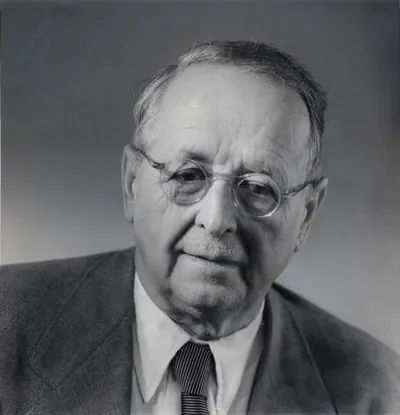 Hermann Weyl1885–1955 · Mathematics
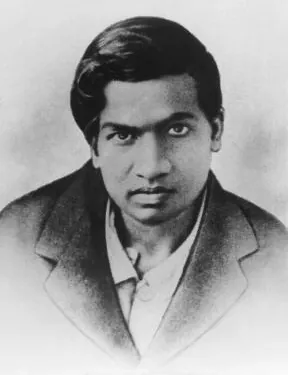 Srinivasa Ramanujan1887–1920 · Mathematics
 Hermann Minkowski1864–1909 · Mathematics
