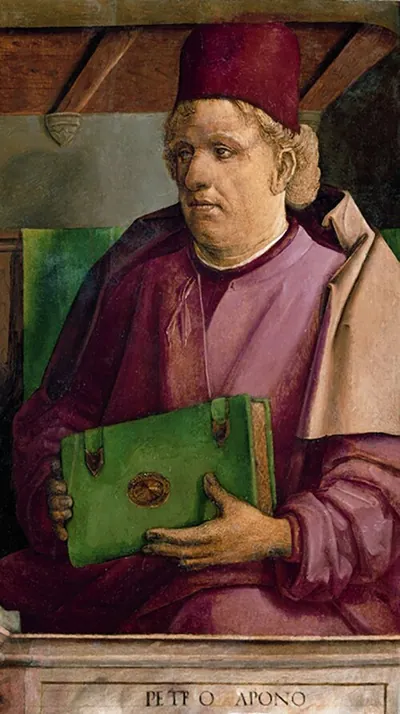
Pietro d'Abano
Italian physician, philosopher and astrologer, professor at the University of Padua · 1250–1316
- Born
- 1250
- Died
- 1316
- Country
- Republic of Venice
- Section
- Physics
Biography
Pietro d'Abano (c. 1250-1316) was an Italian physician, philosopher and astrologer who taught at the University of Padua at the turn of the thirteenth and fourteenth centuries. He matters because he tried to reconcile Arabic medicine with the natural philosophy of Aristotle, and because he helped make Padua the leading centre for medical study in the region.
He was born in Abano, a town near Padua now called Abano Terme, which gave him his name; he is also known as Petrus de Apono. Little is recorded about his youth. He is said to have spent time in Greece and to have studied for a long period in Constantinople, roughly between 1270 and 1290, where he learned Greek. Around 1300 he moved to Paris, where he earned doctorates in philosophy and medicine and built a successful practice, though his fees were notoriously high. There he became known as the Great Lombard.
His writings expound and defend the medical and philosophical systems of Averroes, Avicenna and other Islamic authors. His best-known book, the Conciliator differentiarum quae inter philosophos et medicos versantur, tried to resolve apparent contradictions between medical theory and Aristotle's natural philosophy, and it remained authoritative into the sixteenth century. He is credited with bringing the ideas of Averroes to the West. On the senses, he held that touch depends on the nerves but that the heart also takes part, which allowed him to fit Aristotle's view of the heart as the central organ into his account. On smell, he rejected the common belief that Aristotle explained it through evaporation, pointing out that the philosopher asked whether fish smell in water, something that does not fit vapours drifting through air.
His studies centred on medicine and the superstitions surrounding it. He held that only matter can act on a material body, so he rejected any direct role for God, angels, demons or charms in healing. Even so, he tried to explain why prayers and amulets seemed to work: he attributed their effect to a bond of trust between the person speaking or using the charm and the person being cured. He also believed in astral magic, linking the stars to medical practice. The Heptameron, an anonymous grimoire of magical rites, has traditionally been attributed to him.
In Padua he became friends with the older astrologer Paolo Tosetti. His opponents accused him of practising magic, and rumours said he owned the philosopher's stone and could magically recover the money he spent. In 1314 the papal Inquisition charged him with heresy. He was investigated three times. The first inquiry was closed early by the pope, and in the other two he died before a verdict was reached. He was nonetheless found guilty, and an order was issued to exhume and burn his body, but friends secretly moved it and it ended up in the church of St Augustine, unburied. The Inquisition had to content itself with burning his effigy. It is paradoxical that he was condemned for denying the influence of spirits rather than for magic, since many regarded him as a great magician. How he died is not known for certain; it is believed to have been in 1315, though other sources give 1316. His will shows that he had children, about whom little is known.
His work shaped European medicine for centuries, and his effort to reconcile Arabic, Greek and Christian learning set the tone for how Padua taught medicine.
Main contributions
- Conciliator differentiarum: an attempt to reconcile Arabic medical theory with Aristotle's natural philosophy, highly influential until the sixteenth century.
- Introduction to the West of Averroes's ideas, which he expounded and defended alongside other Islamic writers.
- De venenis eorumque remediis: a treatise on poisons, contagion and their remedies, based on Arabic theories.
- Theory of touch: he explained that the nerves carry sensation, but that the heart also takes part in it.
- Critique of the evaporation theory of smell, based on Aristotle's question about whether fish smell in water.
- Trust-based explanation of healing: he attributed the effect of prayers and charms to a bond between healer and patient, not to supernatural forces.
- Boost to medical teaching at the University of Padua, which became the region's main centre for medical study.
Teachers and students
Trivia and anecdotes
The Great Lombard
In Paris he was known by the nickname the Great Lombard, a reference to his Italian origin.
The purse that refilled itself
Rumours claimed he owned the philosopher's stone and could magically recover the money he spent. These were accusations from his enemies, not verified facts.
A body moved in secret
After he was condemned and ordered to be burned, friends secretly moved his body from place to place until it rested unburied in St Augustine's church.
Their contemporaries
While Pietro d'Abano was alive (1250–1316)…
Alive at the same time
Discovered or invented in those years
- 1250Hand cannonAn early firearm: a metal tube closed at one end, loaded with gunpowder and a projectile and lit by hand through a small side hole.
- 1270GlassesAn optical device of two lenses held in a frame that rests on the nose and ears, used mainly to correct vision.
- 1275EscapementA mechanical linkage in clocks and watches that releases the gear train in small, regular steps while giving impulses to the oscillating timekeeper.
- 1288FirearmA device that fires one or more projectiles driven by high-pressure gas from the rapid burning of a chemical propellant.
- 1300ArsenicA toxic metalloid element, symbol As and atomic number 33, used in semiconductors and alloys.
- 1300Blast furnaceA tall vertical furnace that melts iron ore with coke and limestone to produce pig iron, the raw material for steel.
 Evangelista Torricelli1608–1647 · Physics
 Christiaan Huygens1629–1695 · Physics
 Isaac Newton1643–1727 · Physics
 Henry Cavendish1731–1810 · Physics
 Charles-Augustin de Coulomb1736–1806 · Physics
 Thomas Young1773–1829 · Physics
