
Ramon Margalef
Spanish limnologist, oceanographer and ecologist, Spain's first professor of ecology · 1919–2004
- Born
- May 16, 1919
- Died
- May 23, 2004
- Country
- Spain
- Section
- Earth sciences
Biography
Ramon Margalef López (Barcelona, 1919 – Barcelona, 2004) was a Spanish limnologist, oceanographer and ecologist, and one of the most prominent scientists his country has produced. He is regarded as Spain's first professor of ecology and, together with Bernáldez, as the person who re-founded the discipline there. His work joined the field observation of lakes, ponds and seas with mathematical models, an unusual combination in biology in the mid-twentieth century.
He was born in Barcelona on 16 May 1919. His interest started at home: the garden of the family house contained a pond teeming with aquatic life, and in 1935 he began to study it. That hobby led him to work with the Botanical Institute and the Zoology Museum of Barcelona, the Catalan Institution of Natural History and several hiking groups. Between 1935 and 1937 he attended the School of Advanced Business Studies and qualified as a commercial teacher, but he still lacked a university degree when he wanted to devote himself fully to science.
The Spanish Civil War interrupted his work. Afterwards, following a long and unlucky spell of military service, he returned to limnology, the study of lakes and inland waters. He was already known abroad for his research on freshwater algae and on eutrophication, the process by which water becomes overloaded with nutrients and plant growth until it runs short of oxygen. In 1945 he won a grant from the Spanish National Research Council to finish his degree in Barcelona. He completed a degree in Natural Sciences in 1949, and in December 1951 presented his doctoral thesis, titled Temperature and Morphology of Living Beings.
He held a fellowship at the Institute of Applied Biology from 1945 to 1951 and then worked as a researcher at the Fisheries Research Institute of the CSIC from 1952 to 1975, directing it in 1965–1967. In 1967 he founded the Department of Ecology at the University of Barcelona, where he worked until 1993 and trained many ecologists, limnologists and oceanographers. His ideas also travelled: for years he contributed to the New York magazine Ibérica, and in 1958 he taught marine ecology at the University of Puerto Rico in Mayagüez.
His most important contribution was applying information theory to ecology. This theory, developed in mathematics and engineering, measures how much information a system contains. Margalef showed that it could be applied to communities of plants and animals, and concluded that the information content of a community is roughly equal to its diversity. Sampling methods could then be compared by the amount of information each one yielded. In 1963 he published Some Unifying Principles in Ecology, a paper that brought together theories that had until then developed largely apart. In it he defined an ecosystem's structure as its material components and the interactions among them, and introduced the idea of maturity: a mature ecosystem has a complex structure and uses energy with little loss. For Margalef, ecological succession was a kind of maturation, though one shaped by uncertainty and disturbance.
His contribution to modern limnology was equally important. He began with an inventory of the main aquatic systems of the Iberian Peninsula and then focused on plankton, the microscopic organisms that drift in water, studied from an ecological point of view. At the University of Barcelona he built a school of limnology that later helped create similar groups in several Spanish universities. In 1983 he summarised his work in the book Limnology.
Margalef was also concerned with the role of humans in the biosphere, the layer of the Earth where life exists. He believed that scientific work had to be understood within its social and political context. In 1987, receiving an honorary doctorate from Laval University in Quebec, he stressed the unequal distribution of energy between northern and southern countries.
His legacy is twofold. He founded and consolidated academic ecology in Spain, and he left a theoretical framework that is still used to think about the structure and development of ecosystems. In 2004, the year of his death, the Government of Catalonia created the Ramon Margalef Prize in Ecology, and in 2011 the Spanish Institute of Oceanography launched an oceanographic vessel bearing his name.
Main contributions
- 1957Information theory in ecology: application of a mathematical theory that measures the information in a system to the study of living communities.
- 1963Some Unifying Principles in Ecology: a paper that brings scattered theories together and defines the structure and maturity of ecosystems.
- 1968Perspectives in Ecological Theory: a book based on his lectures at the University of Chicago that consolidated his standing as a leading modern ecologist.
- 1980The Biosphere: a book on all living things on the planet and their relationship with their environment.
- 1983Limnology: a summary of his work on freshwater systems, written to synthesise the discipline.
Teachers and students
Taught:
Trivia and anecdotes
A pond in the garden
His first hydrobiology research was carried out in a pond in the garden of his Barcelona home, full of aquatic life.
A path without a university degree
Before becoming a researcher he qualified as a commercial teacher, as he still had no university studies when he began his research.
Their contemporaries
While Ramon Margalef was alive (1919–2004)…
Alive at the same time
Discovered or invented in those years
- 1925TelevisionA system that sends moving pictures and sound over distance and shows them on a receiver, the television set.
- 1925Quantum mechanicsPhysical theory describing how matter and light behave at atomic and subatomic scales, where energy is exchanged in minimal packets and results are expressed as probabilities.
- 1931Big BangA cosmological model describing how the universe expanded from an early state of extreme density and temperature, about 13.8 billion years ago.
- 1945ComputerA programmable machine that takes in data, processes it by following stored instructions, and produces results, able to switch tasks simply by running different software.
- 1969InternetA global network of interconnected computer networks that communicate using the TCP/IP protocol suite.
- 1989World Wide WebA system of linked documents and resources, connected by hyperlinks and accessed over the Internet with web browsers.
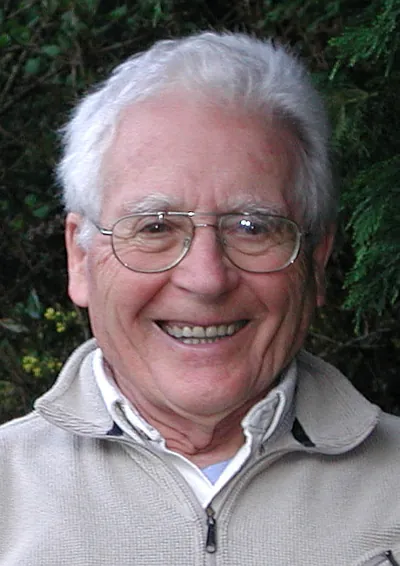 James Lovelock1919–2022 · Earth sciences
 Ted Fujita1920–1998 · Earth sciences
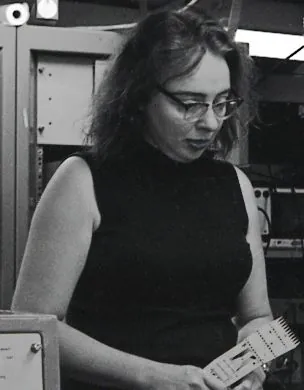 Marie Tharp1920–2006 · Earth sciences
 Edward Norton Lorenz1917–2008 · Earth sciences
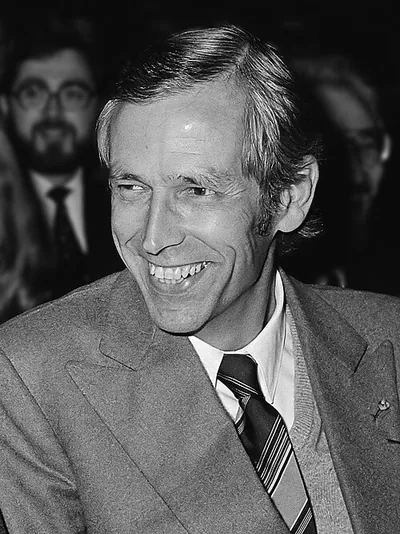 Jacques Piccard1922–2008 · Earth sciences
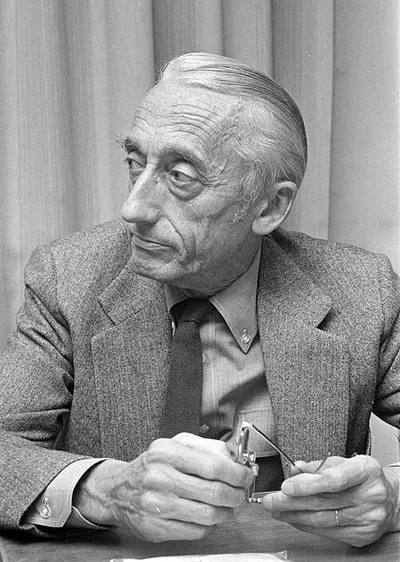 Jacques Cousteau1910–1997 · Earth sciences
