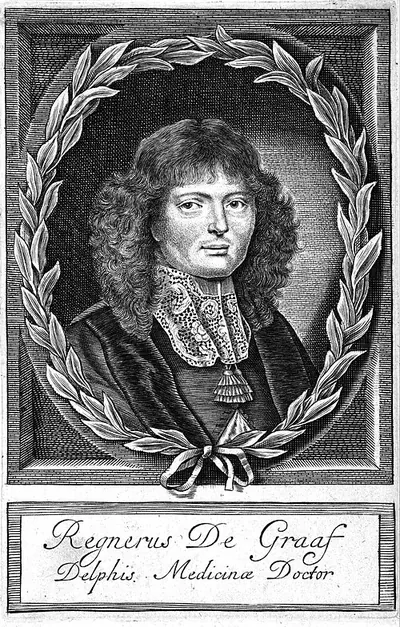
Regnier de Graaf
Dutch physician and anatomist, a pioneer in the study of the reproductive organs · 1641–1673
- Born
- July 30, 1641
- Died
- August 17, 1673
- Country
- Dutch Republic
- Section
- Biology
Biography
Regnier de Graaf was a Dutch physician and anatomist born in Schoonhoven in 1641 and died in Delft in 1673, at the age of 32. He worked when anatomy and experimental medicine were beginning to explain the body with greater precision, and he is remembered for his studies of the reproductive organs, which make him a key figure in the biology of his time.
He came from a Roman Catholic family in a country where most people were Protestant. His father was a carpenter and engineer, a trade roughly equivalent to a modern architect. De Graaf studied medicine in Utrecht and Leiden, where he shared classes with Jan Swammerdam, Niels Stensen and Frederik Ruysch, and was taught by Franciscus Sylvius. All of them were drawn to the organs of procreation and to the mechanical view of the body promoted by René Descartes, which treated the body as a kind of machine. De Graaf submitted a doctoral thesis on the pancreas, then travelled to France, where he experimented on dogs with Pierre Bourdelot and took his medical degree at the University of Angers.
Back in the Dutch Republic, he settled in Delft around 1667. There he studied the male genitals, the subject of a publication in 1668. To examine the ovarian follicle he used female rabbits, since human corpses were scarce and dissections were mostly carried out in winter. His Catholic faith made it hard for him to win a university post in the city. In May 1672 he married Maria van Dink. As a correspondent of the Royal Society in London, he urged the society in April 1673 to take notice of Antonie van Leeuwenhoek and his work on improving the microscope.
His best-known contributions include the description of the seminiferous tubules, the efferent ducts, the corpora lutea and the follicle that bears his name. Studying pregnancy in rabbits, he concluded that the follicle held the egg, although he never saw it, because the egg is far smaller than he had assumed. He also argued that the Fallopian tubes played a role in reproduction. He made mistakes, such as placing fertilisation in the ovary or believing that the seminal vesicles stored sperm, and his reputation suffered from the plagiarism accusation brought by Jan Swammerdam.
He died in August 1673 and was buried in the Oude Kerk in Delft. Suicide has been suggested, but it is more likely that he died of one of the diseases that swept the city in summer, such as malaria, typhoid fever or dysentery. His legacy is twofold: he summarised the anatomical knowledge of his predecessors and raised questions that the microscope would answer shortly afterwards.
Main contributions
- 1664A thesis on pancreatic juice, describing the nature and function of this secretion of the pancreas.
- 1668A study of the male reproductive organs, including the description of the seminiferous tubules and the vas deferens.
- 1668A practical syringe for injecting fluids, described in his treatise on enemas and the use of the siphon in anatomy.
- 1672A treatise on the female reproductive organs, in which he describes the ovarian follicles that now bear his name and the corpus luteum.
- 1672The proposal that the Fallopian tubes take part in reproduction and that hydrosalpinx is linked to female infertility.
Teachers and students
Trivia and anecdotes
A name that is not entirely his
The ovarian follicle carries his name, although other anatomists had noticed it earlier. De Graaf was the first to describe how it develops, and Albrecht von Haller coined the term ova Graafiana for it.
The plagiarism charge
Jan Swammerdam accused him of claiming discoveries that he and Johannes van Horne had made earlier about the ovary. De Graaf replied in writing, but the accusation damaged him for years.
A zone named after someone else
De Graaf described female ejaculation and an erogenous zone in the vagina that he linked to the male prostate. Centuries later, the gynaecologist Ernst Gräfenberg studied it, which is where the name G-spot comes from.
Their contemporaries
While Regnier de Graaf was alive (1641–1673)…
Alive at the same time
Discovered or invented in those years
- 1642CalculatorA device that carries out arithmetic, from simple sums to complex mathematical calculations.
- 1654ProbabilityA numerical measure, between 0 and 1, of how likely an event is to occur.
- 1662BusA motor vehicle built to carry many passengers at once on urban and intercity roads, usually along a fixed route and for a fare.
- 1665CellThe smallest unit of matter that can be considered alive: a compartment enclosed by a membrane that holds genetic material and carries out the functions of life on its own.
- 1669PhosphorusA non-metallic chemical element, with symbol P and atomic number 15, essential to life and widely used in fertilisers, matches and detergents.
- 1670IntegralA mathematical operation that adds up a continuous stream of infinitesimally small pieces to compute areas, volumes and accumulated quantities; it is the inverse of differentiation.
 Antonie van Leeuwenhoek1632–1723 · Biology
 Marcello Malpighi1628–1694 · Biology
 Carl Linnaeus1707–1778 · Biology
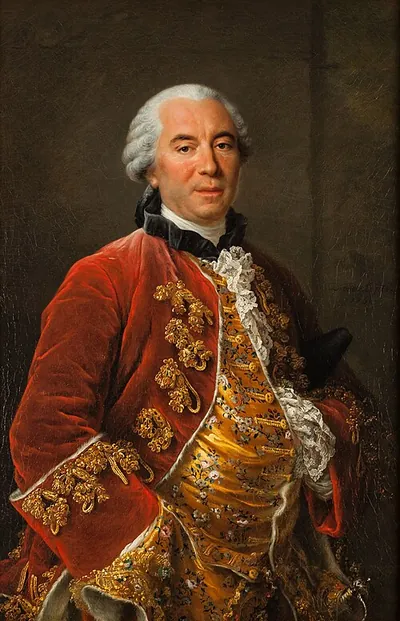 Georges-Louis Leclerc, Comte de Buffon1707–1788 · Biology
 Jean-Baptiste de Lamarck1744–1829 · Biology
 Edward Jenner1749–1823 · Biology
