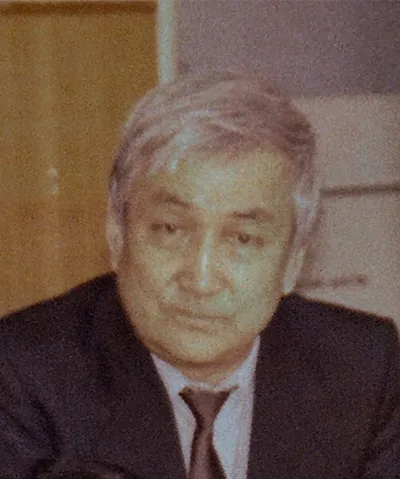
Rinchen Barsbold
Mongolian paleontologist and geologist, expert in extinct vertebrates and Gobi Desert theropod dinosaurs · 1935–2025
- Born
- December 21, 1935
- Died
- August 28, 2025
- Country
- Mongolia
- Section
- Earth sciences
Biography
Rinchen Barsbold (born 21 December 1935 in Ulaanbaatar; died 28 August 2025) was a Mongolian paleontologist and geologist and one of the most influential figures in dinosaur research in Central Asia during the second half of the twentieth century. His work brought Mongolia's fossil record to the attention of the wider world and helped scientists build a fuller picture of the later stages of dinosaur evolution in Eurasia.
Most of Barsbold's career was spent at the Institute of Geology in Ulaanbaatar. He specialised in extinct vertebrates and in Mesozoic stratigraphy, the study of the rock layers of the Mesozoic Era, which allows fossils to be dated by their position in the rock. His doctoral dissertation focused on the theropods of the Gobi Desert, the two-legged, mostly meat-eating dinosaurs, and this work made him a leading authority on the group.
In 1983 he published one of his most influential ideas. He noticed that in different theropod lineages, many features previously known only from birds had appeared in various combinations. He proposed that this process, which he called "ornithization", gave one or more lineages the right set of traits to evolve into modern birds. The idea was bold, but it spread slowly. His conclusions rested on a list of rather obscure anatomical features, his early papers were mostly written in Russian, which few Western scientists read fluently, and contact between Mongolian and Western researchers was limited. Evgeny Kurochkin, then one of the leading experts on fossil birds in the communist bloc, was also sceptical of the link between theropods and birds. As a result, Barsbold's theories were at first taken most seriously by dinosaur specialists in Mongolia, the Soviet Union and allied countries.
The picture changed in the late 1990s, when a growing number of feathered dinosaurs were identified, mainly in China. These discoveries gave new weight to Barsbold's hypothesis, which is now much more widely appreciated.
Barsbold was the son of the scholar and writer Byambyn Rinchen. He left a lasting mark on scientific nomenclature: he named numerous dinosaur genera and families, among them Gallimimus, Garudimimus and the family Oviraptoridae. The genus Barsboldia, named by other researchers, honours him, as does Rinchenia. His legacy lies in showing that Mongolian fossils were essential for understanding dinosaur evolution and its links with birds.
Main contributions
- 1972Gallimimus, a long-necked, fast-legged plant-eating dinosaur, described with H. Osmólska and E. Roniewicz.
- 1976The family Oviraptoridae, a group of theropod dinosaurs with toothless beaks.
- 1981Garudimimus and the family Garudimimidae, lightly built theropod dinosaurs.
- 1983The "ornithization" hypothesis: the proposal that several theropod lineages acquired bird-like traits and that one of them gave rise to modern birds.
- 1986Conchoraptor, a theropod dinosaur genus related to the oviraptorids.
- 1988Anserimimus, an ornithomimid theropod dinosaur.
Trivia and anecdotes
A name in the scientific record
The genus Barsboldia, described by other researchers in 1981, was named in his honour, as was Rinchenia.
Names that changed over time
Some of his families and genera are no longer in use: Enigmosauridae is now considered a synonym of Therizinosauridae, and the name Ingenia was already taken, so the species is now called Heyuannia yanshini.
Their contemporaries
While Rinchen Barsbold was alive (1935–2025)…
Alive at the same time
Discovered or invented in those years
- 1945ComputerA programmable machine that takes in data, processes it by following stored instructions, and produces results, able to switch tasks simply by running different software.
- 1957Artificial satelliteAn artificial satellite is a human-made object placed in orbit around a celestial body, usually Earth, to collect information, relay signals, or carry out a specific task.
- 1969InternetA global network of interconnected computer networks that communicate using the TCP/IP protocol suite.
- 1971EmailA network service that lets users send and receive digital messages through addressed mailboxes, much like postal mail but electronic.
- 1973Mobile phoneA handheld wireless phone that lets people make and receive calls while moving across a cellular network area.
- 1989World Wide WebA system of linked documents and resources, connected by hyperlinks and accessed over the Internet with web browsers.
 W. Jason Morgan1935–2023 · Earth sciences
 Sylvia A. Earle1935 · Earth sciences
 Syukuro Manabe1931 · Earth sciences
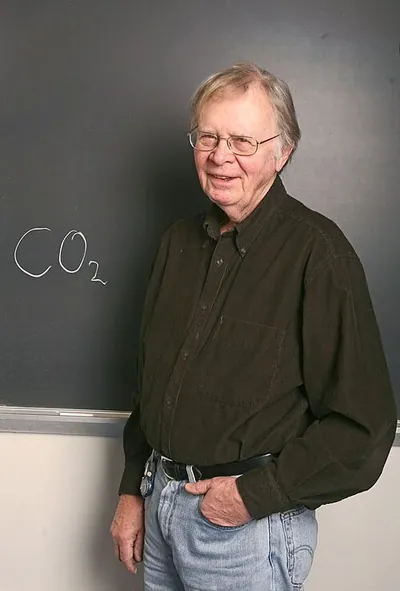 Wallace Broecker1931–2019 · Earth sciences
 Klaus Hasselmann1931 · Earth sciences
