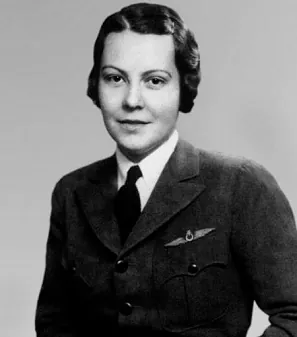
Sabiha Gökçen
Turkish aviator and military pilot, one of the first women fighter and combat pilots in the world · 1913–2001
- Born
- March 22, 1913
- Died
- March 22, 2001
- Country
- Turkey, Ottoman Empire
- Section
- Transport
Biography
Sabiha Gökçen (born in Bursa in 1913, died in Ankara in 2001) was a Turkish aviator and military pilot who built a career in the air force of the 1930s, at a time when women had little access to military training in her country. She is remembered as one of the world's first female fighter and combat pilots, and as a symbol of the secular, modern Turkish republic championed by Mustafa Kemal Atatürk.
Her origins are not entirely clear. Official Turkish historiography, and her own interviews, say she was the daughter of Mustafa Izzet Bey and Hayriye Hanım, both of Bosniak descent. In 1925, during Atatürk's visit to Bursa, the twelve-year-old girl asked to speak with him and said she wanted to attend a boarding school. Moved by her story and her hard living conditions, Atatürk decided to adopt her and took her to the presidential residence at Çankaya in Ankara, where she lived with his other adopted daughters. She attended the Çankaya Primary School in Ankara and the Üsküdar American Academy in Istanbul. After the Surname Law came into force, Atatürk gave her the family name Gökçen in 1934, a word meaning roughly 'belonging to the sky'.
In 1935 Atatürk took her to the opening of the Türkkuşu flight school. She had hoped to become a parachutist, but soon grew far more interested in flying. After advanced training in gliders and powered aircraft, first in Crimea in the Soviet Union and then at the aviation school in Eskişehir, she began flying a powered aeroplane in February 1936. Because Turkish military academies did not admit women at the time, Atatürk arranged a special eleven-month course for her at the Eskişehir aviation school, followed by pilot training with the first air regiment in the same city.
Her first combat service came in 1937, during military operations against the Dersim rebellion in eastern Turkey. Turkish aircraft attacked the local population, and Gökçen herself dropped bombs and fired machine guns at survivors, as she later acknowledged in an interview. She received a commendation for her work and the first Jeweled Medal of the Turkish Aeronautical Association. This episode is one of the most controversial parts of her record and should be read with that caveat.
In 1938, shortly before Atatürk's death, she made a five-day flight around the Balkan capitals that brought her wide fame. That same year she became chief instructor at the Türkkuşu school, where she taught until 1954 and trained several other women pilots. Over nearly three decades in the air force she logged, by her own account, around 8,000 flight hours and tested 22 aircraft types. She published a memoir about her life alongside Atatürk in 1981.
Her origins also sparked a national controversy in 2004, when a newspaper article claimed she was of Armenian descent. Turkish officials and people close to her rejected the claim, and the debate had tragic consequences, as it is widely believed to have contributed to the climate in which journalist Hrant Dink was assassinated in 2007.
Gökçen died in Ankara on 22 March 2001, her 88th birthday. Her legacy endures: Istanbul's second airport bears her name, the United States Air Force included her in a 1996 poster of the twenty greatest aviators in history as the only woman, and Google marked her birthday with a special logo in Turkey in 2009.
Main contributions
- 1937Took part in military operations against the Dersim rebellion, becoming one of the world's first female combat pilots, according to some sources.
- 1938A five-day flight around the Balkan capitals that made her famous.
- 1954End of her work as instructor at the Türkkuşu flight school, where she trained several female aviators.
- 1981Publication of her memoir about her life alongside Atatürk.
Trivia and anecdotes
US Air Force poster
In 1996 she was the only woman included in a United States Air Force poster of the twenty greatest aviators in history.
A birthday that was also her death day
She died on 22 March 2001, the same day she turned 88.
Their contemporaries
While Sabiha Gökçen was alive (1913–2001)…
Alive at the same time
Discovered or invented in those years
- 1916Black holeA region of space where gravity is so strong that nothing, not even light, can escape once it crosses a certain boundary.
- 1925TelevisionA system that sends moving pictures and sound over distance and shows them on a receiver, the television set.
- 1925Quantum mechanicsPhysical theory describing how matter and light behave at atomic and subatomic scales, where energy is exchanged in minimal packets and results are expressed as probabilities.
- 1931Big BangA cosmological model describing how the universe expanded from an early state of extreme density and temperature, about 13.8 billion years ago.
- 1945ComputerA programmable machine that takes in data, processes it by following stored instructions, and produces results, able to switch tasks simply by running different software.
- 1969InternetA global network of interconnected computer networks that communicate using the TCP/IP protocol suite.
 Malcom McLean1913–2001 · Transport
 Wernher von Braun1912–1977 · Transport
 Hans von Ohain1911–1998 · Transport
 Kelly Johnson1910–1990 · Transport
 Ferruccio Lamborghini1916–1993 · Transport
 Ferry Porsche1909–1998 · Transport
