
Shirley Ann Jackson
American physicist, president of Rensselaer Polytechnic Institute and chair of the U.S. Nuclear Regulatory Commission · 1946
- Born
- August 5, 1946
- Country
- United States
- Section
- Physics
Biography
Shirley Ann Jackson (born in Washington, D.C., in 1946) is an American physicist who went on to chair the U.S. Nuclear Regulatory Commission and to lead Rensselaer Polytechnic Institute. She belongs to the first generation of African American women to earn a physics doctorate in the United States, at a time when these fields were almost entirely male and white. Her career links materials research, nuclear energy regulation and university leadership, which makes her story relevant to both the history of science and the history of science policy.
She grew up in a family that valued education. Her father, George Jackson, took part in the Normandy landings and, after the war, worked as a mail carrier and later as a taxi driver. Her mother, Beatrice Cosby, had taught high school during the era of segregated schooling and later cared for children with intellectual disabilities in Laurel, Maryland. Jackson first attended a segregated school. After integration she moved to a mostly white, middle-class elementary school, where she had to work hard to match her classmates. Her father helped with her science projects, and after an IQ test in sixth grade she was placed in an honors group. She graduated from Roosevelt High School in 1964 with top grades and was chosen to give the graduation speech.
That same year she entered MIT. Of the 900 students in her class, 43 were women and only two were African American. She was the only student enrolled in theoretical physics, and she graduated in 1968. While studying she volunteered at a Boston hospital and tutored young people in the Roxbury neighborhood. She chose to stay at MIT for her doctorate, partly to encourage other African American students to apply. With a fellowship from the Martin Marietta Corporation, where she had worked one summer, she studied particle physics under James Young and completed her PhD in 1973. She became the first African American woman to earn a doctorate from MIT and the second in the United States to earn a physics doctorate.
After her degree she spent two years at Fermilab in Illinois, and with a Ford Foundation fellowship she spent time at CERN in Geneva. In 1976 she joined AT&T Bell Laboratories in New Jersey. There she studied the properties of materials, especially two-dimensional ones, meaning layers so thin that their electrons behave as if they were moving across a surface. Her work covered solid-state physics, optics and quantum physics, and she contributed to about a hundred publications. From 1991 to 1995 she taught at Rutgers University while continuing to consult for Bell Labs.
In 1995 President Bill Clinton appointed her chair of the Nuclear Regulatory Commission, making her the first woman and the first African American to hold the post. In 1997 she helped establish the International Nuclear Regulators Association, which she chaired until 1999, with senior regulators from countries such as Canada, France, Germany and Spain. That same year she left the commission to lead Rensselaer Polytechnic Institute, the oldest technological university in the country. During her tenure she promoted a strategic plan and a large building programme, and reported fundraising of more than a billion dollars. Her leadership also drew criticism. In 2006 the faculty narrowly rejected a no-confidence vote, her pay rose sharply, and in 2011 the student senate asked for a review of her leadership. In 2021 she announced that she would step down in 2022.
From 2000 she served as president of the American Association for the Advancement of Science, where she argued for bringing more minorities and women into science and engineering. From 2009 to 2014 she sat on the President's Council of Advisors on Science and Technology, which advises the White House on these areas. She is married to Morris A. Washington, also a physics professor at Rensselaer. While at MIT she helped co-found the university's Black Students' Union in 1968.
Her legacy combines research, regulation and advocacy for diversity in scientific careers. Her career shows how a scientist can shape public policy and institutions, and also how such influence can provoke debate about leadership.
Main contributions
- 1973PhD in physics from MIT, where she researched particle physics.
- 1976Joined Bell Laboratories, where she studied the optical and electronic properties of two-dimensional materials, layers so thin that their electrons move almost in a plane.
- 1995Chair of the U.S. Nuclear Regulatory Commission, which oversees the safety of nuclear power plants and other nuclear facilities.
- 1997Founding of the International Nuclear Regulators Association, which brings together nuclear safety officials from several countries.
- 1999Presidency of Rensselaer Polytechnic Institute, an American technological university founded in 1824.
- 2000Presidency of the American Association for the Advancement of Science, from which she promotes the participation of minorities and women in science and engineering.
Teachers and students
Trivia and anecdotes
Inventions credited to Bell Labs
Some sources link her research to inventions such as the touch-tone telephone or solar cells. She has not made that claim herself, and those advances predate her arrival in 1976.
A father at Normandy
Her father took part in the Normandy landings and, after the war, left the army to work as a mail carrier and later as a taxi driver.
A long list of honorary doctorates
She has received 53 honorary doctorates, in addition to numerous fellowships and awards over her career.
Their contemporaries
While Shirley Ann Jackson was alive (1946–)…
Alive at the same time
Discovered or invented in those years
- 1947TransistorA semiconductor component that amplifies or switches electrical current between two terminals, depending on a signal applied to a third.
- 1957Artificial satelliteAn artificial satellite is a human-made object placed in orbit around a celestial body, usually Earth, to collect information, relay signals, or carry out a specific task.
- 1969InternetA global network of interconnected computer networks that communicate using the TCP/IP protocol suite.
- 1971EmailA network service that lets users send and receive digital messages through addressed mailboxes, much like postal mail but electronic.
- 1973Mobile phoneA handheld wireless phone that lets people make and receive calls while moving across a cellular network area.
- 1989World Wide WebA system of linked documents and resources, connected by hyperlinks and accessed over the Internet with web browsers.
 Stephen Hawking1942–2018 · Physics
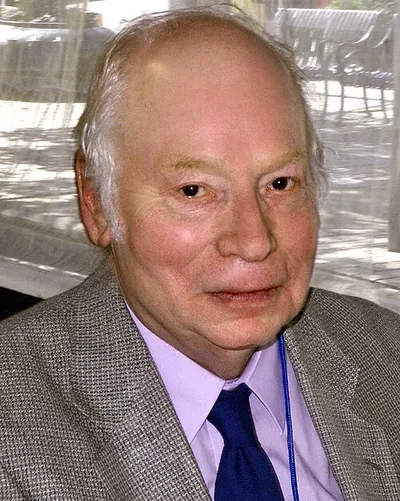 Steven Weinberg1933–2021 · Physics
 Donna Strickland1959 · Physics
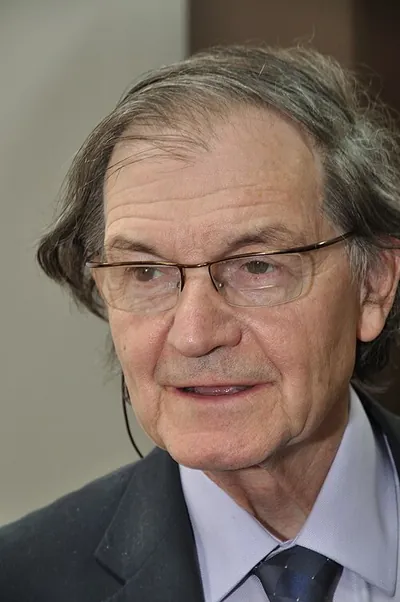 Roger Penrose1931 · Physics
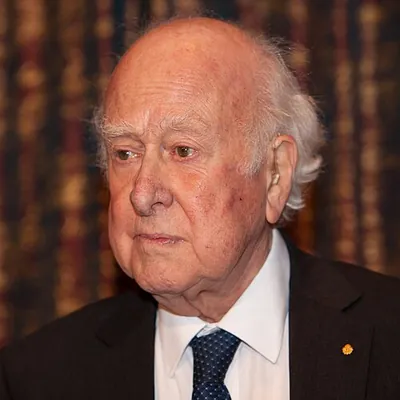 Peter Higgs1929–2024 · Physics
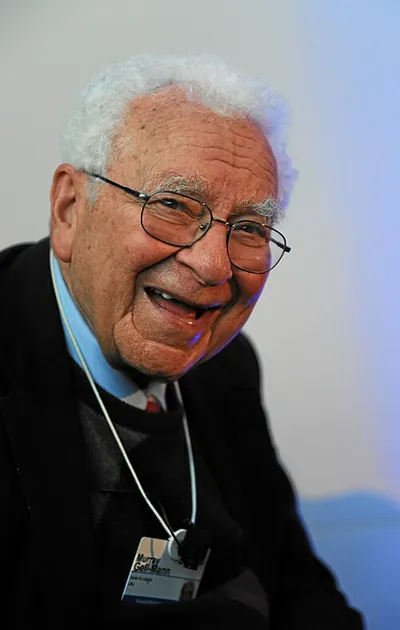 Murray Gell-Mann1929–2019 · Physics
