Smithson Tennant
English chemist, discoverer of iridium and osmium · 1761–1815
- Born
- November 30, 1761
- Died
- February 22, 1815
- Country
- United Kingdom of Great Britain and Ireland
- Section
- Chemistry
Biography
Smithson Tennant was an English chemist who lived between the late eighteenth and the early nineteenth century. His name is linked to the discovery of two members of the platinum group of metals, iridium and osmium, which widened the list of simple substances known at a time when chemistry was beginning to take shape as a modern science. His experiments also helped establish the relationship between diamond and charcoal.
He was born on 30 November 1761 in Selby, in Yorkshire, in the north of England. His father was Calvert Tennant, and his first name came from his grandmother Rebecca Smithson, widow of Joshua Hitchling, from whom the Smithson name was derived. He was educated at Beverley Grammar School, one of the oldest public schools in Britain, and a plaque above one of the entrances to the present school now commemorates his discovery of the two elements.
In 1781 he began to study medicine at Edinburgh, but after a few months he moved to Cambridge, where he devoted himself to botany, the study of plants, and to chemistry. He graduated as a doctor of medicine at Cambridge in 1796. At about the same time he bought an estate near Cheddar, where he carried out agricultural experiments, meaning tests on crops and farming methods. His training was therefore broader than that of a laboratory chemist alone, and this mix of interests stayed with him throughout his career.
His best-known discovery came in 1803. Tennant examined the residues left after platinum ores were dissolved in strong acids. An element is a substance that cannot be broken down into simpler ones by ordinary chemical means, and to identify a new one a chemist had to separate it from everything else and show that it behaved differently from anything already known. In those residues he found two such substances, which we now call iridium and osmium. The work demanded patience and small quantities of material, and Tennant's merit lay in recognising, within the mixture, something that had gone unnoticed until then.
He also contributed to settling a debate of his time: whether diamond and charcoal were the same substance. His experiments supported the view that both are made of carbon, an element whose presence in each had to be shown. He was not the only one working on the question, but his contribution helped bring the discussion to a close.
His academic career reached its height in 1813, when he was appointed professor of chemistry at Cambridge. However, he lived to deliver only one course of lectures. He died on 22 February 1815 near Boulogne-sur-Mer, in France, when a bridge over which he was riding collapsed beneath him. His death cut short a career that had only just begun to show its results in teaching.
His legacy lives on mainly in the naming of minerals and in local memory. The mineral tennantite is named in his honour. In Beverley, the school plaque recalls his discovery, and in modern industry iridium, the metal he helped identify, remains a valuable material. In 2006 the American company American Elements developed a technique for casting seamless iridium rings for use in spacecraft and satellites, and in 2016 the same company introduced a line of iridium wedding bands sold under the Smithson Tennant trademark.
Main contributions
- 1796Agricultural experiments on an estate near Cheddar, carried out around the time he earned his medical doctorate.
- 1803Discovery of iridium, a hard metal of the platinum group found in the residues left after dissolving platinum ores.
- 1803Discovery of osmium, a metal of the same group that forms compounds with a sharp smell.
- Contribution to showing that diamond and charcoal are the same substance, made of carbon.
Trivia and anecdotes
A plaque at his old school
At Beverley Grammar School, a plaque above one of the entrances commemorates his discovery of the two elements.
A course cut short
He was named professor at Cambridge in 1813, but he lived to give only one course of lectures.
His name in the market
In 2016 a company launched iridium wedding bands under the Smithson Tennant trademark, a commercial use of his name far removed from his laboratory.
Related discoveries and inventions
- 1803IridiumA hard, brittle, silvery-white metal and the most corrosion-resistant element known, discovered in 1803 in the residues left from platinum ores.
Their contemporaries
While Smithson Tennant was alive (1761–1815)…
Alive at the same time
Discovered or invented in those years
- 1766HydrogenThe lightest and most abundant chemical element in the universe, atomic number 1, which under normal conditions is a colourless, odourless and highly flammable gas.
- 1772NitrogenChemical element with atomic number 7, a colourless, odourless gas that makes up about 78% of Earth's air and is an essential part of proteins and nucleic acids.
- 1774OxygenA colorless, odorless gas, symbol O and atomic number 8, that forms the dioxygen in air and is essential for respiration in most living things.
- 1781UranusThe seventh planet from the Sun, an ice giant discovered by William Herschel in 1781, the first planet found with a telescope.
- 1803AtomThe basic unit of a chemical element: a nucleus of protons and usually neutrons surrounded by a cloud of electrons.
- 1811MoleculeAn electrically neutral group of at least two atoms held together by chemical bonds in a defined arrangement.
 John Dalton1766–1844 · Chemistry
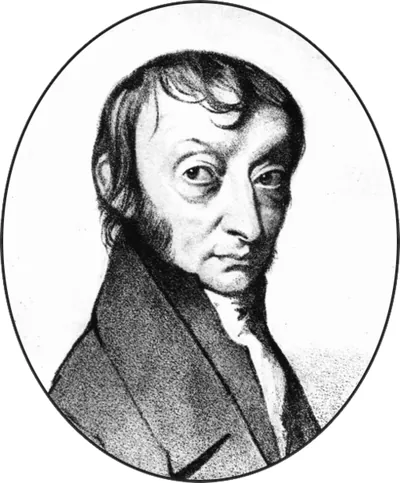 Amedeo Avogadro1776–1856 · Chemistry
 Humphry Davy1778–1829 · Chemistry
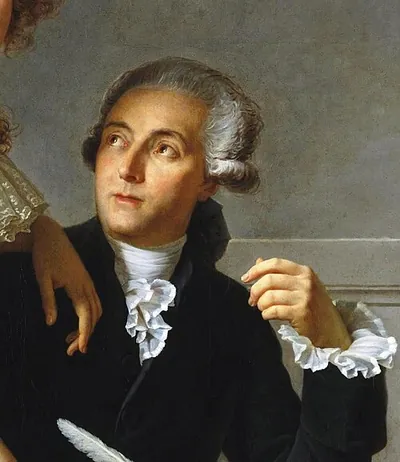 Antoine Lavoisier1743–1794 · Chemistry
 Jöns Jacob Berzelius1779–1848 · Chemistry
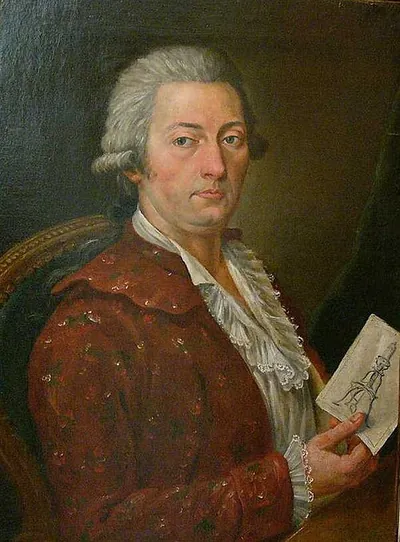 Carl Wilhelm Scheele1742–1786 · Chemistry