
Takakazu Seki
Japanese mathematician of the Edo period, samurai and official in the shogunate's service, who created his own algebraic notation and is considered a founder of wasan · 1642–1708
- Born
- 1642
- Died
- December 5, 1708
- Country
- Japan
- Section
- Mathematics
Biography
Takakazu Seki, also known as Seki Kōwa, was a Japanese mathematician of the Edo period who lived in the seventeenth and early eighteenth centuries. He laid the foundations for Japanese mathematics, known as wasan, and devised his own algebraic notation, which allowed him to express ideas more generally than his predecessors had. He has often been compared to Isaac Newton, although his work developed independently of European research. It matters because it shows that, at around the same time, Japan reached results by its own path that Europe would soon reach as well.
Seki's birth date is uncertain. Some sources place it anywhere between 1635 and 1643, and the year 1642 often cited is only one of the possibilities. His birthplace is also unclear: it has been given as Fujioka in Gunma Prefecture, or as Edo itself. He was born into the Uchiyama clan, which served the Kōshū domain, and as a young man he was adopted into the Seki family, whose members served the shogun directly. His birth father was a samurai in the service of Tokugawa Tadanaga, and in 1639 he held a post connected with Edo Castle. In 1704 Seki received the rank of hatamoto, a direct vassal of the shogun. While in the Kōshū domain he took part in a surveying project to produce a reliable map of his lord's lands.
His mathematical training drew largely on Chinese sources. Wasan rested on knowledge accumulated between the thirteenth and fifteenth centuries, including algebra with numerical methods, polynomial interpolation and indeterminate integer equations. Chinese algebraists systematically reduced geometric problems to algebra with the help of the Pythagorean theorem, but their notation was limited. They represented a formula as a row of numbers, so that (a b c) meant ax² + bx + c, and their two-dimensional arrays could handle at most four variables. For this reason, one aim of Seki and his contemporaries was to develop general equations with several unknowns and a theory of elimination, a way of reducing a system of equations to a single variable. Chinese polynomial interpolation had been designed to predict the motion of heavenly bodies from observations, and Seki most likely encountered it while studying Chinese calendars closely, since he wanted to replace the less accurate calendar then used in Japan.
In 1671 Sawaguchi Kazuyuki, a pupil of a teacher in Osaka, published Kokon Sanpō Ki, the first full account of Chinese algebra in Japan, and at its end he set fifteen problems that required equations with several unknowns. In 1674 Seki published Hatsubi Sanpō, which solved all fifteen. He introduced the use of kanji characters for unknowns and variables. His system could handle equations of very high degree, and he once worked with one of degree 1458, but it lacked symbols for parentheses, equality or division, so that ax+b could also be read as ax+b=0. The system was refined later by other mathematicians until it matched the expressive power of European notation. The book also had errors in its first edition, and a mathematician from the Hashimoto school said that only three of the fifteen problems were correctly solved. In 1678 Yamamoto of the Hashimoto school, working in Kyoto, published Sanpō Meiki, offering new solutions to Sawaguchi's problems using a multivariable algebra similar to Seki's. In 1685 one of Seki's pupils published notes explaining in detail the elimination process with algebraic symbols, answering these criticisms.
In 1683 Seki set out elimination theory based on resultants in Kaifukudai no Hō. A resultant is an expression that tells whether two equations share a common solution. To write resultants he developed the notion of the determinant, a single number computed from a square table of values that helps solve systems of equations. His manuscript gave a plainly wrong formula for 5×5 tables, always returning zero, but in Taisei Sankei, written between 1683 and 1710 together with Katahiro Takebe and his brothers, a correct and general formula appears, equivalent to Laplace's. In Europe, Leibniz had commented on the subject for matrices only up to 3×3, and the topic was forgotten until Gabriel Cramer returned to it in 1750. Étienne Bézout rediscovered an elimination theory equivalent to the wasan form in 1764. Seki had no knowledge of these European works, yet his first manuscript is almost as early as Leibniz's first comment.
Once the unknowns have been eliminated, one must find numerically the real roots of a single-variable equation. Horner's method was known in China, but it did not reach Japan in its final form, so Seki had to work out his own procedure. He is sometimes credited with Horner's method, which is not historically accurate. He also proposed improving it by dropping higher-order terms after a few iterations, a step that matches the Newton–Raphson method, although Seki reached it from a different starting point, since neither he nor his pupils had the concept of the derivative. He studied the conditions under which an equation has repeated roots, using the discriminant, and worked with a practical definition of the derivative based on the binomial theorem. Within his enri, or 'circle principles', he treated areas, volumes and infinite series. He calculated pi to ten decimal places using a procedure now called Aitken's delta-squared process, which Alexander Aitken rediscovered in the twentieth century.
Seki died in 1708, and his legacy lasted. His successors founded the Seki school, which dominated Japanese mathematics until the end of the Edo period. Because many of his results survive only in writings by his pupils, it is not always clear which parts were his alone and which came from his circle. He is credited with Bernoulli numbers, published in 1712, and with the resultant and the determinant. An asteroid, 7483 Sekitakakazu, bears his name.
Main contributions
- 1671The first full account of Chinese algebra in Japan, with fifteen problems set for other mathematicians.
- 1674Hatsubi Sanpō, which solved the fifteen problems and used kanji to represent unknowns in equations.
- 1683Elimination theory based on resultants, expressions that show whether two equations share a common solution.
- 1710A general formula for the determinant, equivalent to Laplace's, published in Taisei Sankei with Takebe and his brothers.
- 1712Bernoulli numbers, credited to Seki and published in 1712.
- A calculation of pi to ten exact decimal places using a procedure now called Aitken's delta-squared process.
Teachers and students
Trivia and anecdotes
Japan's Newton
He has been described as Japan's Newton, although his work developed independently of Newton and Leibniz.
A harsh verdict
A mathematician from the Hashimoto school said that only three of the fifteen problems were correctly solved in the first edition of his book.
An enormous degree
His notation could handle equations of very high degree, and he is said to have worked with one of degree 1458.
Related discoveries and inventions
- 1710Bernoulli numberA sequence of rational numbers that arises when summing powers of natural numbers and plays a major role in number theory and analysis.
Their contemporaries
While Takakazu Seki was alive (1642–1708)…
Alive at the same time
Discovered or invented in those years
- 1665CellThe smallest unit of matter that can be considered alive: a compartment enclosed by a membrane that holds genetic material and carries out the functions of life on its own.
- 1676BacteriaSingle-celled prokaryotic microorganisms without a defined nucleus, forming one of the three great domains of life.
- 1687GravityThe attraction that every body with mass exerts on every other, responsible for objects falling and planets circling the Sun.
- 1687ForceA vector quantity that changes the motion of a body or deforms it, measured in newtons.
- 1687Newton's laws of motionThree principles linking the motion of a body to the forces acting on it, the foundation of classical mechanics.
- 1700PianoA keyboard instrument in which each key sets a felt-covered hammer moving to strike a tensioned string, letting the player control loudness through touch.
 Gottfried Wilhelm Leibniz1646–1716 · Mathematics
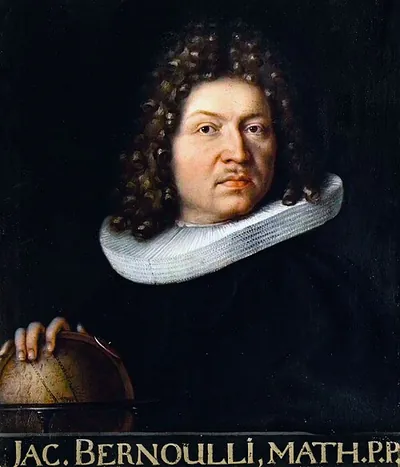 Jacob Bernoulli1654–1705 · Mathematics
 Blaise Pascal1623–1662 · Mathematics
 Johann Bernoulli1667–1748 · Mathematics
 Pierre de Fermat1607–1665 · Mathematics
 René Descartes1596–1650 · Mathematics
