
Gabriel Cramer
Genevan mathematician, author of the 1750 treatise on algebraic curves and of the rule that bears his name · 1704–1752
- Born
- July 31, 1704
- Died
- January 4, 1752
- Country
- Republic of Geneva
- Section
- Mathematics
Biography
Gabriel Cramer (Geneva, 1704-1752) was a mathematician from the Republic of Geneva who worked in the first half of the eighteenth century, when the ideas of Newton and Leibniz were spreading across Europe. He is remembered mainly for his 1750 treatise on algebraic curves and for the rule that carries his name for solving systems of linear equations.
He was born on 31 July 1704 in Geneva, the son of Jean-Isaac Cramer, a physician, and Anne Mallet, whose family was of Huguenot origin. The Cramers had been in the city since the seventeenth century, when his great-grandfather Jean-Ulrich Cramer arrived from Strasbourg. The boy showed an early gift for mathematics. In 1722, at eighteen, he took his doctorate at the Academy of Geneva, and at twenty he shared the mathematics chair there with Jean-Louis Calandrini. In 1734 he became the only professor of the subject, and in 1750 he took up the chair of philosophy at the same institution.
Cramer was also active in the civic life of the republic. He joined the Council of Two Hundred in 1734 and the Council of Sixty in 1750. He belonged to the science academies of Bologna, Lyon and Montpellier, and was a foreign member of the Royal Society in London and of the Berlin Academy of Sciences.
His first notable work appeared in 1728, when he offered a way out of the St Petersburg paradox, a gambling problem whose expected payout is infinite, yet which no sensible person would pay much to play. His reasoning came surprisingly close to the idea of expected utility, which Daniel Bernoulli would publish about a decade later. In the late 1730s he travelled widely across Europe, and these journeys broadened his circle of contacts and ideas.
In 1730 he sent a memoir to the Paris Academy asking why the planets are slightly flattened rather than perfectly round, and why their aphelia, the points on their orbits farthest from the Sun, shift over time. The essay earned him the academy's second prize.
Cramer was also a dedicated editor. He produced the collected works of Johann Bernoulli in 1742 and those of Jacques Bernoulli in 1744, and in 1745, working with Johann Castillon, he published the correspondence between Johann Bernoulli and Leibniz. Such editions made the work of earlier mathematicians available to a far wider readership. In 1746 he also wrote on Newton's treatment of cubic curves.
His principal book was the Introduction à l'analyse des lignes courbes algébriques (1750). An algebraic curve is a line described by a polynomial equation, and its degree is the highest power appearing in that equation. Cramer showed that a curve of degree n is fixed by n(n+3)/2 of its points, provided they are in general position. This count gave rise to a misunderstanding known as Cramer's paradox, which concerns how many points two curves share compared with how many points are needed to define each one.
The same treatise contains the rule that now bears his name. A system of linear equations is a set of first-degree equations with several unknowns. The rule expresses each unknown as a quotient of determinants, which are numbers calculated from the system's coefficients. Colin Maclaurin had published a similar method in 1748 and probably knew of it from 1729, so the credit is still debated. The rule remains a standard procedure in linear algebra.
Cramer died on 4 January 1752 at Bagnols-sur-Cèze, in southern France, where he had gone to recover his health. His legacy lies in his work on curves, in the rule still taught in algebra courses, and in the editions that preserved the writings of the Bernoullis.
Main contributions
- 1728Proposed a solution to the St Petersburg paradox, close to the later idea of expected utility.
- 1730Memoir on the elliptical shape of the planets and the motion of their aphelia, submitted in Paris.
- 1745Edition, with Johann Castillon, of the correspondence between Johann Bernoulli and Leibniz.
- 1750Introduction à l'analyse des lignes courbes algébriques, a treatise showing how many points determine a curve of degree n.
- 1750Cramer's rule, which gives the solution of a linear system of equations using determinants.
Trivia and anecdotes
A rule with a dispute
Colin Maclaurin published a similar method in 1748 and is thought to have known it from 1729, so Cramer's name is not beyond dispute.
A paradox that is not one
The so-called Cramer's paradox came from a misunderstanding about where two curves intersect and contains no real contradiction.
Their contemporaries
While Gabriel Cramer was alive (1704–1752)…
Alive at the same time
Discovered or invented in those years
- 1712Steam engineAn engine that turns the heat energy of water vapour into mechanical motion, using a piston that moves back and forth inside a cylinder.
- 1715Taylor seriesA way to write a function as an infinite sum of powers, built from its derivatives at a single point.
- 1735CobaltA bluish-white metal with atomic number 27 and symbol Co, known for its deep blue pigments and its role in modern batteries.
- 1736Graph theoryA branch of mathematics that studies networks of points joined by lines, used to model routes, connections and relationships.
- 1745CapacitorAn electronic component that stores electric charge and energy between two conductors separated by an insulator.
- 1751NickelA silvery-white, corrosion-resistant metal with atomic number 28 and symbol Ni, mostly used today in stainless steel.
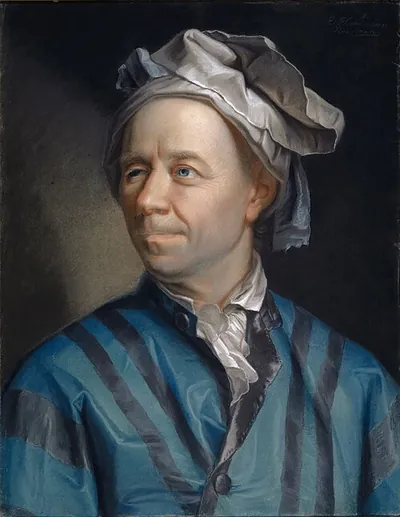 Leonhard Euler1707–1783 · Mathematics
 Daniel Bernoulli1700–1782 · Mathematics
 Joseph-Louis Lagrange1736–1813 · Mathematics
 Johann Bernoulli1667–1748 · Mathematics
 Gaspard Monge1746–1818 · Mathematics
 Pierre-Simon Laplace1749–1827 · Mathematics
