Thābit ibn Qurra
Mathematician, astronomer, physician and translator from the Sabian community of Harran, active in Abbasid Baghdad · 836–901
- Born
- 836
- Died
- 901
- Country
- Abbasid Caliphate
- Section
- Mathematics
Biography
Thābit ibn Qurra (born in Harran around 826 or 836, died in Baghdad in 901) was a mathematician, astronomer, physician and translator who worked in the capital of the Abbasid Caliphate in the second half of the ninth century. He belonged to the Sabians of Harran, a religious community with pagan roots and an astral cult that still survived in his home city. He matters because he translated and revised major Greek works on mathematics and astronomy, and because his own writings carried ancient knowledge forward to later generations.
He was born in Harran, in Upper Mesopotamia, then part of the al-Jazira region of the caliphate. His native language was Syriac, the Aramaic dialect of Edessa, and he later became fluent in Greek and Arabic, a rare combination among scholars of his day. Some later writers claim that he worked as a money changer in a Harran market before he took up learning, but the historian Tamara Green has questioned this detail, arguing that his command of Greek science points to an earlier academic education rather than a commercial trade. He is also said to have quarrelled with other Sabians in his city over matters of doctrine.
His career changed when he met Muhammad ibn Musa, the eldest of three brothers known as the Banu Musa, a family of mathematicians and astronomers. Under this patronage he moved to Baghdad, where he studied mathematics, astronomy and philosophy and worked with the group on translating Greek mathematical texts. In the capital he founded a school staffed by fellow Harranians. According to the bibliographer Ibn al-Nadim, he came to lead the pagan community of Baghdad before the caliphs, and he was reported to speak for the Sabians of Harran at court. His linguistic skill gave him access to the circles of power and learning in the city.
Translation became one of his lasting contributions. He rendered works by Archimedes, Apollonius, Euclid and Ptolemy from Greek into Arabic. He revised Hunayn ibn Ishaq's version of Euclid's Elements, rewrote the translation of Ptolemy's Almagest and translated Ptolemy's Geography. One of his translations, a text by Archimedes describing how to construct a regular heptagon, came to light only in the twentieth century, because the Greek original had been lost. These Arabic versions reached Western Europe in the twelfth century, when they were translated again into Latin; the translator Gerard of Cremona was among those who used them.
In mathematics, his best-known result is a rule for finding amicable numbers, pairs of numbers in which each equals the sum of the proper divisors of the other. His proof shows that if three numbers built from powers of two are all prime, then two numbers formed by multiplying a power of two by certain products form an amicable pair. For n = 4 the rule gives 17,296 and 18,416. Working on these numbers led him to use them to describe ratios between geometric magnitudes, a step the Greeks had not taken. He also studied conic sections, especially the parabola and the ellipse, and wrote equations for the areas and volumes of solid shapes using a procedure similar to the one Newton would later develop as integral calculus. He is also credited with a generalized proof of the Pythagorean theorem.
In astronomy he was one of the earliest critics and reformers of Ptolemy's system. He analysed the motion of the planets and the apparent movement of the Sun and Moon above the horizon, and wrote treatises on gnomonics, the craft of designing sundials. He calculated the sidereal year, the time the Earth takes to complete one turn against the fixed stars, as 365 days, 6 hours, 9 minutes and 12 seconds, an estimate with an error of only 2 seconds. Copernicus mentions this figure in his work. The theory of the trepidation of the equinoxes is often credited to him, although Theon of Alexandria had already described it.
In mechanics he is regarded as one of the founders of statics, the branch of physics that studies bodies at rest. He examined the conditions of balance in beams, levels and equal-armed balances, and one of his works contains a proof of the law of the lever. He rejected the Aristotelian idea that each element has a natural place toward which it tends, and proposed instead that upward and downward motion both arise from weight. He also wrote many medical treatises, among them a large compendium called A Treasury of Medicine, and commentaries on Galen. A story recorded by Ibn al-Qifti says he cured a butcher who was thought to be doomed, but the tale is more legend than documented fact.
Late in life he served as an astronomer and courtier to the caliph al-Mu'tadid, with whom he developed a close friendship. He died in Baghdad in 901. His son Sinan and grandson Ibrahim ibn Sinan carried on his work in medicine and science, and the grandson investigated the curves involved in sundial design. He is credited with about 150 works, but fewer than a dozen survive in their original form. His legacy lives on mainly through his translations and the ideas they carried to Europe. The lunar crater Thebit is named in his honour.
Main contributions
- Rule for amicable numbers: a formula for finding pairs of numbers in which each equals the sum of the proper divisors of the other.
- Arabic translations of Archimedes, Apollonius, Euclid and Ptolemy, which reached Europe in the twelfth century.
- Calculation of the sidereal year as 365 days, 6 hours, 9 minutes and 12 seconds, with an error of 2 seconds.
- Treatises on gnomonics, explaining how to build sundials and studying the apparent motion of the Sun and Moon.
- Work on equilibrium, including a proof of the law of the lever, which places him among the founders of statics.
- Methods for calculating areas and volumes of solid shapes, using a procedure similar to integral calculus.
- A Treasury of Medicine, a large medical compendium gathering his medical knowledge.
Teachers and students
Trivia and anecdotes
Money changer or scholar
Some chroniclers say he was a money changer in a Harran market, but the historian Tamara Green doubts this account.
A recovered heptagon
His translation of an Archimedes text on the regular heptagon came to light in the twentieth century, when the Greek original had already been lost.
The cured butcher
According to Ibn al-Qifti, he cured a butcher thought to be doomed, though the story is more legend than documented fact.
Their contemporaries
While Thābit ibn Qurra was alive (836–901)…
Alive at the same time
Discovered or invented in those years
- 900GunpowderA mixture of sulfur, charcoal and potassium nitrate that burns very fast and, when confined, propels projectiles or causes explosions. It is the oldest known chemical explosive.
- 900Frequency analysisA codebreaking technique that deciphers a coded text by counting how often its letters appear and comparing those counts with the usual letter patterns of the language.
- 900Fire lanceAn early gunpowder weapon: a tube of explosive tied to a spear, the forerunner of the hand cannon and of modern firearms.
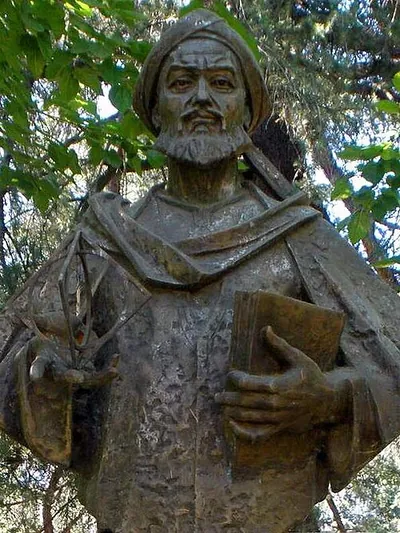 Muḥammad ibn Musa al-Khwarizmi780–850 · Mathematics
 Brahmagupta598–670 · Mathematics
 Fibonacci1170–1240 · Mathematics
 Aryabhata476–550 · Mathematics
 François Viète1540–1603 · Mathematics