
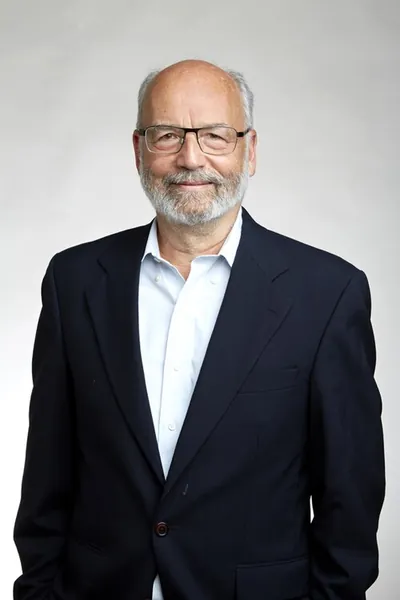
Van Jacobson
American computer scientist, one of the main contributors to the TCP/IP protocol stack · 1950
- Born
- 1950
- Country
- United States
- Section
- Computing
Biography
Van Jacobson is an American computer scientist known for his work on the performance and scaling of TCP/IP networks, the set of protocols on which much of today's Internet relies. His work, carried out mainly in the late 1980s and the 1990s, helped the network keep growing without collapsing, and made him a reference for people who design communication systems.
He studied modern poetry, physics and mathematics. He earned a bachelor's degree in mathematics and a master's degree in physics at the University of Arizona, and then did graduate work at the Lawrence Berkeley Laboratory in California. That laboratory was his main workplace for more than two decades: he joined in 1974 as a research scientist in its real-time controls group and later led the network research group.
His best-known contribution is the redesign of TCP's congestion control algorithms. Congestion happens when more data packets arrive at a router than it can forward, so some must be discarded and sent again. Jacobson proposed that each sender slow down when it detects losses and speed up gradually when the network is free, so that all senders share the available capacity. The story goes that these changes saved the Internet from collapse in the late 1980s and early 1990s, though how large that effect really was is open to interpretation.
Jacobson also devised a way to compress the headers of TCP/IP packets, the control information that travels with every piece of data. He described it in RFC 1144, and it proved especially useful on slow serial links, where every byte counts. He also co-wrote widely used network diagnostic tools such as traceroute, tcpdump and pathchar, which trace the route taken by packets and help analyse how a network behaves.
In multimedia he played a leading role in developing the Multicast Backbone, or MBone, a virtual network that lets one audio or video stream reach many recipients at once without being duplicated for each. Together with his colleague Steven McCanne, he built a set of video and audio conferencing programs for that network, the tools vic, vat and wb, which earned them an R&D 100 Award from R&D Magazine in 1995.
After his years at Berkeley he was chief scientist at Cisco Systems from 1998 to 2000, and then held the same post at Packet Design and at a spin-off company, Precision I/O. In 2006 he joined PARC as a research fellow, where he focused on Named Data Networking, an approach in which the network is organised around the content users request rather than the machines that store it. Since 2013 he has been an adjunct professor at the University of California, Los Angeles, where he continues this line of work, and he takes part in the NDN Consortium, funded by the National Science Foundation.
His work has received many honours: the ACM SIGCOMM Lifetime Achievement Award in 2001, the IEEE Koji Kobayashi Computers and Communications Award in 2002, election to the National Academy of Engineering in 2004, and induction into the Internet Hall of Fame in 2012. His legacy is twofold: the technical solutions that keep the network running, and a way of thinking about communication centred on content that remains an active research subject.
Main contributions
- 1988Redesign of TCP congestion control algorithms, which help share network capacity among senders.
- 1989Traceroute, a tool that shows the route packets take to a destination.
- 1990TCP/IP header compression for slow serial links, described in RFC 1144.
- 1995The vic, vat and wb tools for video and audio conferencing over the MBone, awarded the R&D 100.
- 2006Named Data Networking, a proposal for networks centred on content rather than on machines.
Teachers and students
Trivia and anecdotes
Poetry alongside science
Jacobson studied modern poetry as well as physics and mathematics, an unusual mix for a network researcher.
Everyday tools
Traceroute and tcpdump are still common utilities for network administrators and students.
Their contemporaries
While Van Jacobson was alive (1950–)…
Alive at the same time
Discovered or invented in those years
- 1957Artificial satelliteAn artificial satellite is a human-made object placed in orbit around a celestial body, usually Earth, to collect information, relay signals, or carry out a specific task.
- 1969InternetA global network of interconnected computer networks that communicate using the TCP/IP protocol suite.
- 1971EmailA network service that lets users send and receive digital messages through addressed mailboxes, much like postal mail but electronic.
- 1973Mobile phoneA handheld wireless phone that lets people make and receive calls while moving across a cellular network area.
- 1989World Wide WebA system of linked documents and resources, connected by hyperlinks and accessed over the Internet with web browsers.
- 1990Web browserA program that lets people access the web by fetching a page's files from a server and displaying them on screen as an interactive page.
 Steve Wozniak1950 · Computing
 Bjarne Stroustrup1950 · Computing
 Adi Shamir1952 · Computing
 Geoffrey Hinton1947 · Computing
 Ron Rivest1947 · Computing
 Tim Berners-Lee1955 · Computing
