
Vladimir Ipatieff
Russian-American chemist known for high-pressure catalysis and petroleum chemistry · 1867–1952
- Born
- November 21, 1867
- Died
- November 29, 1952
- Country
- United States, Soviet Union, Russian Empire
- Section
- Chemistry
Biography
Vladimir Nikolayevich Ipatieff (Moscow, 1867 - Chicago, 1952) was a Russian and later American chemist whose work on catalysts used under high pressure and on petroleum chemistry changed how better fuels were made. He lived through tsarist Russia, the Soviet revolution and the American chemical industry, and his story matters both for his discoveries and for the way politics shaped his life.
Born in Moscow, he first trained at the Mikhailovskaya Artillery Academy in Saint Petersburg, then turned to chemistry under Alexei Favorskii and continued his studies in Germany. His early work dealt with metals and explosives. His family was prominent: in July 1918 the Romanov imperial family was murdered in the basement of a holiday house owned by the Ipatieffs in Yekaterinburg.
He became famous for his studies of catalysis under high pressure. A catalyst is a substance that speeds up a chemical reaction without being used up in it. For these experiments he used massive steel vessels able to withstand extreme pressure, sometimes called Ipatieff bombs. When the First World War began, he set up a laboratory in Petersburg that improved chemical weapons for the army and methods of protecting troops against them. Before the revolution he was a general in the Russian army and a member of the Russian Academy of Sciences, which had elected him in 1916.
Despite sympathies with the liberal Kadet party, he agreed after the Bolshevik revolution to advise the new government as a specialist in the Vesenka economic body. He founded and led several chemical research centres, and Lenin described him as the head of the Soviet chemical industry. Yet he was moved out of the leadership of a major scientific institute into a lesser post, an early sign that his past made him suspect. During talks in 1928 and 1929 that defused a clash with the regime, he admitted Nikolai Bukharin and other communists to the Academy, but he felt increasingly exposed because he had served the tsar and had friends among those convicted in the Industrial Party trial.
In June 1930, fearing persecution, he withdrew money from his accounts and travelled to Munich for an industry conference. He brought his wife and suggested she bring her jewels. According to family accounts, as the train reached the Polish border he told her to look back at Mother Russia, because she would never see it again. Speaking no English, he made his way to the United States.
There he took a research-focused professorship at Northwestern University in Evanston, near Chicago. With his assistant Herman Pines he found fuel mixtures and procedures that greatly improved engine performance. It is said that British RAF pilots gained an edge over German aircraft after switching to these blends, though the claim is poorly documented. He later worked extensively for Universal Oil Products (UOP) on commercial uses of his findings. He and his students contributed to organic synthesis and petroleum refining, and he is regarded as one of the founders of modern petroleum chemistry in the United States.
He had three sons. Dmitry died in the First World War. Nikolai, who had joined the White movement, emigrated after the civil war and died in Africa while testing a yellow fever treatment he had devised. Vladimir Jr., also a chemist, stayed in the USSR and was arrested after his father's flight. The family also adopted two Russian girls in the United States.
Ipatieff died suddenly in Chicago in 1952. He held more than 200 patents and published over 300 research papers. His name lives on in the Ipatieff Prize, established by the American Chemical Society with funds from UOP. Awarded every three years, it honours outstanding experimental work in catalysis or high-pressure chemistry by researchers under 40.
Main contributions
- 1916Election to the Russian Academy of Sciences, recognising his standing as a scientist.
- High-pressure catalysis: reactions sped up by catalysts inside steel vessels that withstand extreme pressures.
- Fuel blends and procedures developed at Northwestern that improved engine performance.
- Work with UOP on organic synthesis and petroleum refining, with industrial applications.
- More than 200 patents and over 300 published research papers.
Teachers and students
Trivia and anecdotes
A family house and a historic crime
A holiday house owned by the Ipatieff family in Yekaterinburg was where the imperial Russian family was murdered in July 1918.
A line at the border
According to family accounts, he told his wife to look back at Mother Russia as they crossed into Poland. It is a story passed down within the family and is not independently verified.
Lenin's praise
Lenin called Ipatieff the head of the Soviet chemical industry, a sign of his weight in Soviet chemistry before he fell out of favour.
Their contemporaries
While Vladimir Ipatieff was alive (1867–1952)…
Alive at the same time
Discovered or invented in those years
- 1869Periodic tableAn arrangement of the chemical elements into rows (periods) and columns (groups), ordered by atomic number, that reveals recurring chemical behaviour and lets scientists predict properties.
- 1876TelephoneA device that carries the human voice over distance by turning sound into electrical signals and back into sound at the other end of the line.
- 1884CarA road vehicle with four wheels and its own engine, mainly built to carry people.
- 1903AirplaneA fixed-wing aircraft, heavier than air, powered by engines or rockets, that stays aloft because its wings generate lift.
- 1925TelevisionA system that sends moving pictures and sound over distance and shows them on a receiver, the television set.
- 1945ComputerA programmable machine that takes in data, processes it by following stored instructions, and produces results, able to switch tasks simply by running different software.
 Marie Curie1867–1934 · Chemistry
 Fritz Haber1868–1934 · Chemistry
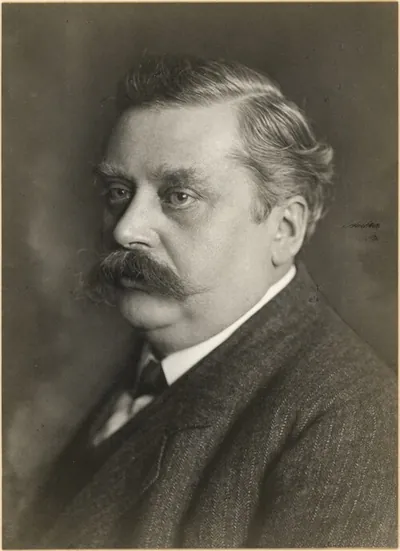 Alfred Werner1866–1919 · Chemistry
 Walther Hermann Nernst1864–1941 · Chemistry
 Svante August Arrhenius1859–1927 · Chemistry
 Otto Hahn1879–1968 · Chemistry
