
William Daniel Phillips
American physicist, 1997 Nobel Prize in Physics for methods of cooling and trapping atoms with lasers · 1948
- Born
- November 5, 1948
- Country
- United States
- Section
- Physics
- Awards
- Nobel Prize in Physics
Biography
William Daniel Phillips is an American physicist whose work on cooling atoms with laser light earned him the 1997 Nobel Prize in Physics, which he shared with Claude Cohen-Tannoudji and Steven Chu. His research belongs to the atomic physics of the late twentieth century, a period when scientists learned to control atoms with light with a precision that had once seemed out of reach. His importance lies in the fact that these techniques made it possible to study matter at temperatures close to absolute zero and opened the way to new measuring instruments and experiments on quantum states of matter.
Phillips was born on November 5, 1948, in Wilkes-Barre, Pennsylvania. His mother, Mary Catherine Savino, came from an Italian background, while his father, William Cornelius Phillips, belonged to a Methodist family of Welsh descent. Both parents had university education and instilled in their children a strong commitment to learning. He showed an early interest in science, and at the age of eight he was identified as gifted and placed in an experimental accelerated education project in Butler, near Pittsburgh, where his family had moved. In 1959 the family settled permanently in Camp Hill, near Harrisburg.
In his last years of high school he met Jane Van Wynen, whom he would later marry. He earned a degree in physics from Juniata College in 1970, the same year they wed, and the couple moved to Boston. There he completed his doctorate at the Massachusetts Institute of Technology in 1976. His thesis examined the magnetic moment of the proton in water, a measure of how strongly a particle responds to a magnetic field. After two years as a postdoctoral researcher at MIT, he joined the National Bureau of Standards in Gaithersburg, Maryland, in 1978. The agency, which set standards for measurement, was soon renamed the National Institute of Standards and Technology, or NIST, and it was there that his prize-winning work took place.
His starting point was the work of Steven Chu, who used laser beams to slow atoms down. When light strikes an atom, it gives it small pushes that reduce its speed, and since temperature is tied to the motion of particles, a slower atom is a colder one. Phillips developed improved ways of measuring that temperature. In 1988 he found that atoms reached a temperature six times lower than the theoretical limit then expected. Cohen-Tannoudji refined the theory to explain the unexpected result, and the two continued searching for ways to trap atoms at even lower temperatures.
One outcome of these techniques was the first observation of a Bose-Einstein condensate in 1995. This state of matter had been predicted some seventy years earlier by Albert Einstein and the Indian physicist Satyendra Nath Bose. When atoms are cooled so far and so slowly, they merge and behave as a single quantum entity much larger than any individual atom. In 1997 Phillips shared the Nobel Prize with his two colleagues for their contributions to laser cooling, a method that slows gaseous atoms so they can be studied more closely. He also became known for his invention of the Zeeman slower, a device that uses magnetic fields to slow atoms.
Phillips is a Protestant Christian and a member of the Methodist Church. He is a professor of physics at the University of Maryland and one of the founders of the International Society for Science and Religion, which seeks to encourage dialogue between science and faith. He is a member of the Pontifical Academy of Sciences and, since 1995, of the American Academy of Arts and Sciences. Two years later he was elected to the United States National Academy of Sciences. He has also signed letters, alongside other Nobel laureates, supporting basic science funding and clean energy research.
His legacy lies in the widespread use of laser cooling in atomic physics, in precision metrology, and in research on ultracold quantum gases, fields that are now central to atomic clocks and quantum simulators. He is also remembered as one of the few scientists who have openly built bridges between the practice of physics and religious reflection.
Main contributions
- 1976Doctoral thesis on the magnetic moment of the proton in water, completed at MIT.
- 1988Measurement of laser-cooled atoms at a temperature six times below the predicted theoretical limit.
- 1995First observation of the Bose-Einstein condensate, a state of matter in which atoms behave as a single quantum entity.
- 1997Nobel Prize in Physics for developing methods to cool and trap atoms with lasers.
Teachers and students
Trivia and anecdotes
An accelerated childhood
At eight he was placed in an experimental accelerated education project because of his early aptitude for science.
Letters to presidents
Together with other Nobel laureates he signed letters to American presidents asking for more funding for basic science and clean energy.
Their contemporaries
While William Daniel Phillips was alive (1948–)…
Alive at the same time
Discovered or invented in those years
- 1957Artificial satelliteAn artificial satellite is a human-made object placed in orbit around a celestial body, usually Earth, to collect information, relay signals, or carry out a specific task.
- 1969InternetA global network of interconnected computer networks that communicate using the TCP/IP protocol suite.
- 1971EmailA network service that lets users send and receive digital messages through addressed mailboxes, much like postal mail but electronic.
- 1973Mobile phoneA handheld wireless phone that lets people make and receive calls while moving across a cellular network area.
- 1989World Wide WebA system of linked documents and resources, connected by hyperlinks and accessed over the Internet with web browsers.
- 1990Web browserA program that lets people access the web by fetching a page's files from a server and displaying them on screen as an interactive page.
 Stephen Hawking1942–2018 · Physics
 Donna Strickland1959 · Physics
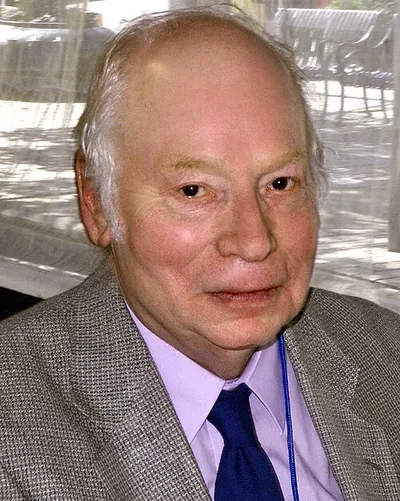 Steven Weinberg1933–2021 · Physics
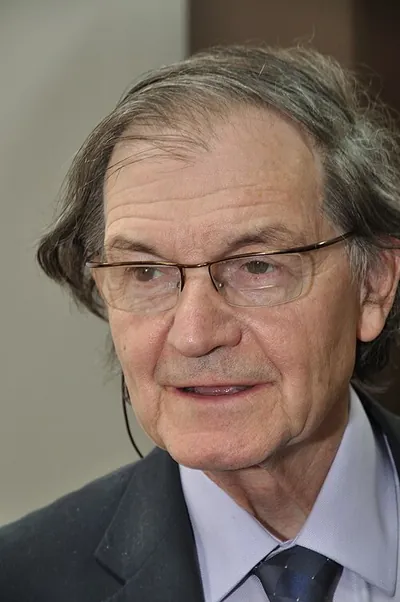 Roger Penrose1931 · Physics
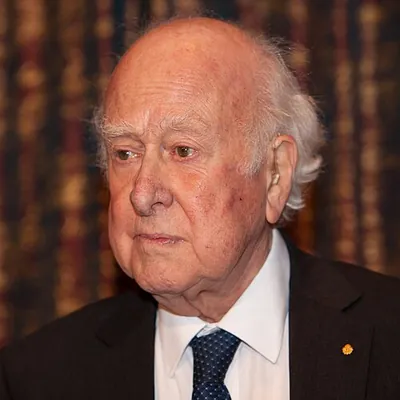 Peter Higgs1929–2024 · Physics
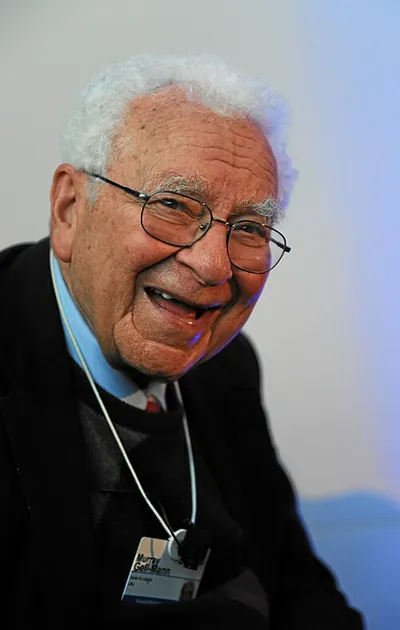 Murray Gell-Mann1929–2019 · Physics
