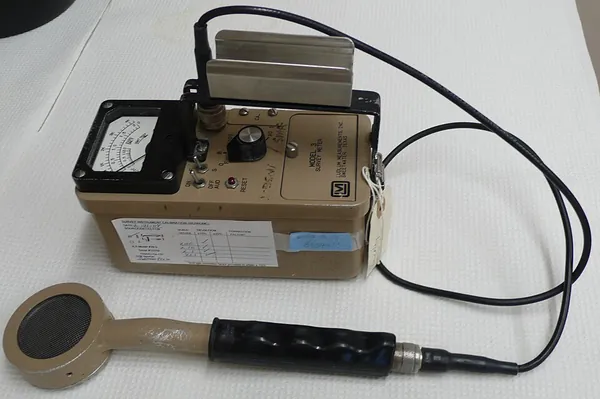
Geiger counter
An instrument that detects and measures ionizing radiation using a gas-filled tube that produces an electrical pulse for each particle it registers.
- Year
- 1908
- People involved
- Hans Geiger
- Section
- Scientific instruments
History
A Geiger counter is an instrument that detects ionizing radiation, meaning radiation carrying enough energy to knock electrons off atoms. It is used in radiation dosimetry, radiological protection, experimental physics and the nuclear industry, and it is probably the radiation detector best known to the general public.
At the end of the nineteenth century and the beginning of the twentieth, physicists were studying how gases become electrically conductive when radiation strips electrons from their atoms. Between 1897 and 1901 John Sealy Townsend described the multiplication of charges that now bears his name, the Townsend discharge. Before instruments like this existed, radiation was detected with photographic plates, electroscopes and ionization chambers. These were useful but poorly suited to counting particles one at a time.
In 1908, at the University of Manchester, Hans Geiger worked under Ernest Rutherford on an experimental setup for detecting alpha particles. That first counter could only register alpha particles, and it formed part of a larger apparatus. It relied on a thin metal wire running down the centre of a tube, held at high voltage and surrounded by low-pressure gas. When a particle ionizes the gas, the freed electrons are accelerated by the electric field, collide with further atoms and trigger an avalanche that produces a measurable current pulse. Since every particle produces a pulse of the same size, counting the pulses is enough to count the particles.
The practical breakthrough came in 1928, when Geiger and Walther Müller, a doctoral student of Geiger, developed a sealed and rugged tube. It could detect alpha and beta radiation, and also gamma radiation. It was small, relatively cheap to make, and produced a signal so strong that it needed little electronic processing. That simplicity mattered greatly in the age of thermionic valves, where fewer valves meant lower power use. The instrument quickly became a popular portable radiation detector.
The design had clear limits. Each pulse is the same size whatever the energy of the radiation, so the tube cannot tell radiation types apart or measure their energy, and it cannot give an exact dose on its own. After each discharge there is also a brief dead time during which new particles go uncounted, so readings fall short at very high rates, roughly above 10,000 to 100,000 counts per second depending on the tube. For very intense radiation, ionization chambers are preferred.
In 1947 Sidney H. Liebson introduced halogen quench gases, which stop each discharge quickly and replaced the organic compounds used earlier. Halogens lasted much longer and allowed operation at lower voltages, typically between 400 and 900 volts. Around 1930 a mica window had also been added to the cylindrical design, so that weakly penetrating radiation could reach the gas.
Over time different tube designs emerged for different kinds of radiation. End-window tubes, with a very thin membrane, suit low-energy alpha and beta particles, although they cannot separate the two on their own. Thick-walled steel tubes, one to two millimetres thick, exploit the fact that high-energy photons knock electrons out of the wall, and they use energy compensation to even out their response. Neutrons are detected with tubes containing boron trifluoride or helium-3, surrounded by a plastic moderator that slows the neutrons down. Pancake-shaped designs offer a larger detection area, which speeds up contamination surveys.
Today the Geiger counter remains in use in hospitals, nuclear plants, mines, laboratories and environmental monitoring. Many fixed installations rely on the same principle in area alarms. In everyday speech the name is applied to any radiation meter, but strictly speaking it refers to one specific type of dosimeter. Its low cost, robustness and simplicity explain why it is still a basic tool more than a century after its first version.
Timeline
- 1897John Sealy Townsend studies, between 1897 and 1901, the discharge that multiplies ionization in gases.
- 1908In Manchester, Hans Geiger develops with Rutherford a technique for detecting alpha particles.
- 1928Geiger and Walther Müller present the sealed tube that makes a practical, portable instrument possible.
- 1930Around 1930 a mica window is added to the cylindrical design for low-penetration radiation.
- 1947Sidney H. Liebson introduces halogen quench gases, which last longer and need lower voltages.
Trivia and anecdotes
The sound of the detector
Many counters emit a click for each detected event, so users can follow the radiation by ear while moving the instrument.
A generic name
In everyday use any radiation meter is called a Geiger counter, although scientifically it is just one specific type of dosimeter.
 Hans Geiger1882–1945 · Physics
