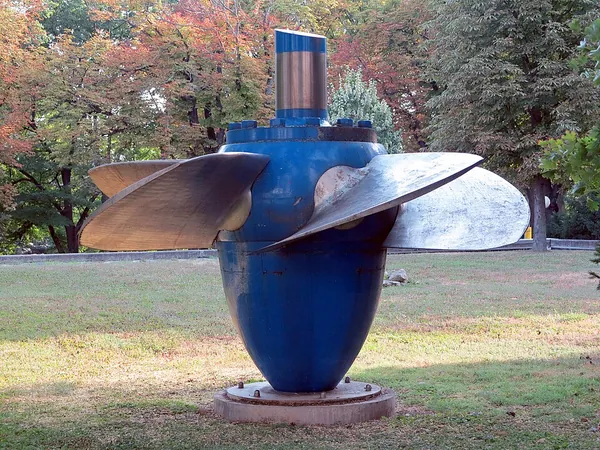
Kaplan turbine
A propeller-type water turbine with adjustable blades, designed for low-head sites with large water flows.
- Year
- 1913
- People involved
- Viktor Kaplan
- Section
- Energy
History
The Kaplan turbine is a machine that turns the energy of moving water into rotation, which then drives a generator to make electricity. Its defining feature is a propeller-like runner whose blades can be adjusted while the turbine is running. This lets it cope with changes in water flow and level without losing much efficiency. Its importance lies in making it practical to harness very low drops of water, something earlier turbines handled poorly.
Before Kaplan, the main reference was the Francis turbine, which uses water flowing inward and works well under high drops but loses efficiency at small heights. Fixed-blade propeller turbines already existed, but they only suited sites where flow and head stayed nearly constant, since they could not adapt to a river's natural variations. The Austrian engineer Viktor Kaplan, working in Brno, then part of Austria-Hungary and now in the Czech Republic, combined adjustable propeller blades with adjustable guide vanes that direct the water onto the runner. He obtained his first patent in 1912, but turning the idea into a commercially successful machine took another decade.
The main obstacle was cavitation, in which water forms vapour bubbles where pressure drops around the blades; these bubbles gradually damage the metal. Kaplan installed a demonstration unit at Poděbrady in 1919, but abandoned his research in 1922 for health reasons. That same year Voith introduced a turbine of about 800 kW aimed mainly at rivers. Commercial success came in 1924, when an 8 MW unit began operating at Lilla Edet in Sweden, showing that the design could work reliably at scale. From there its use spread across Europe and then around the world.
In operation, water enters through a spiral-shaped casing, passes through guide vanes that direct it onto the propeller, and leaves through a specially shaped draft tube that slows the flow and recovers some of the remaining energy. Large machines are designed for each site and usually exceed 90 percent efficiency, though this falls in very low-head installations. Today Kaplan turbines are common in hydroelectric plants with low head and high flow, and small units are built for individual power production. Their design has also inspired variants such as tubular and bulb turbines, and it has been explored for offshore wave energy. They are expensive to install, but they can run for decades, making them a key part of modern hydropower.
Timeline
- 1912Viktor Kaplan obtains his first patent for an adjustable-blade propeller turbine.
- 1919A demonstration unit of the design is installed at Poděbrady.
- 1922Voith introduces a Kaplan turbine of about 800 kW for rivers, and Kaplan abandons his research for health reasons.
- 1924An 8 MW unit goes into service at Lilla Edet, Sweden, marking the start of its commercial success.
 Viktor Kaplan1876–1934 · Energy
