
Lie group
A mathematical structure that is both a group and a smooth manifold: a continuous space in which elements can be combined and inverted in a smooth way, used to describe continuous symmetries.
- Year
- 1870
- People involved
- Sophus Lie
- Section
- Mathematics
History
A Lie group is a set of elements that can be combined by an operation similar to multiplication, where every element has an inverse, and that forms a continuous space, such as a curve or a surface, in which the operation changes smoothly. This combination makes it possible to study continuous symmetries, meaning transformations that can be carried out in small steps without changing the object, such as turning a circle through any angle. That is why they matter in analysis, geometry and physics, where they describe laws that stay the same when the point of view changes.
Before Lie, mathematicians had studied mostly discrete groups, with finitely or countably many elements, such as those used in Galois theory to solve algebraic equations. Some continuous examples were known in the form of groups of invertible matrices, such as the rotations in three-dimensional space, but no general theory treated them as a class of their own.
Sophus Lie, a Norwegian mathematician (1842-1899), developed that theory with the aim of doing for differential equations what Galois had done for algebraic ones: classifying them by their symmetries. According to Thomas Hawkins, the decisive impetus came between 1869 and 1873, a period of intense research activity; Lie himself regarded the winter of 1873-1874 as the birth of his theory of continuous groups. During those years he worked closely with Felix Klein, meeting him almost daily from 1869 to 1872 in Berlin, Paris, Göttingen and Erlangen. His early papers appeared in Norwegian journals, which slowed their recognition elsewhere in Europe. In 1884 the young German mathematician Friedrich Engel joined him, and together they produced the three-volume Theorie der Transformationsgruppen, published between 1888 and 1893. The French term groupes de Lie first appeared in 1893, in a thesis by one of Lie's students.
The theory drew on three great currents of the nineteenth century: Galois's idea of symmetry, the geometry and mechanics of equations developed by Jacobi and Poisson, and the new geometry that culminated in Riemann's work. A crucial step in understanding their internal structure was taken by Wilhelm Killing, who began publishing a classification in 1888, later refined by Élie Cartan. Hermann Weyl, in the early twentieth century, clarified the difference between Lie groups and their Lie algebras and connected the theory with quantum mechanics. Claude Chevalley later rewrote it in modern mathematical language. The central idea is to replace the global group with its linearized version, the Lie algebra, which is easier to study.
Today Lie groups are a basic tool in particle physics, where representations of groups such as SU(3) or the Poincaré group describe particles and their interactions, and in geometry, where they express which properties of a space survive transformations. They also appear in number theory and in cryptography based on elliptic curves.
Timeline
- 1870Sophus Lie introduces Lie groups to study symmetries of differential equations.
- 1888Lie and Friedrich Engel publish the first volume of their systematic treatise, and Killing begins classifying continuous groups.
- 1893The French term groupes de Lie appears in a thesis by one of Lie's students.
- 1900David Hilbert poses his Fifth Problem in Paris, addressed to Lie theorists.
- 1925Hermann Weyl clearly distinguishes Lie groups from Lie algebras and links the theory to quantum mechanics.
Trivia and anecdotes
A treatise written with a partner
Lie did not write his main work alone: the three-volume treatise was published together with Friedrich Engel, who joined him in 1884.
Publishing in Norwegian
During the 1870s almost all of Lie's papers appeared in Norwegian journals, which delayed his recognition elsewhere in Europe.
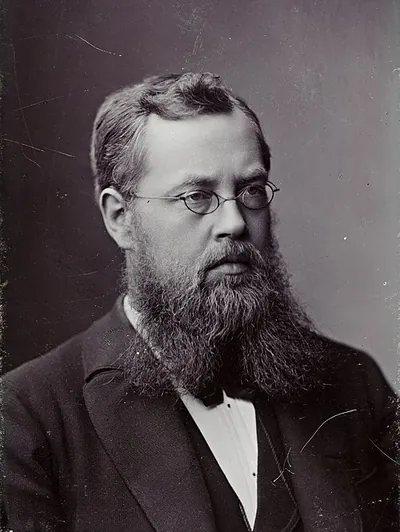 Sophus Lie1842–1899 · Mathematics
