
Proper motion
The apparent, very slow shift of a star's position across the sky, measured in arcseconds per year.
- Year
- 1718
- People involved
- Edmond Halley
- Section
- Astronomy and space
History
Proper motion is the change in a star's position on the sky over time, once the apparent drift caused by the Earth's own movement has been set aside. For centuries the stars seem to hold nearly fixed positions relative to one another, so the constellations look unchanged over a human lifetime. Careful observations over long periods show, however, that constellations do slowly change shape, because each star moves independently. That real motion comes from the stars' movement relative to the Sun and the Solar System through space.
Two quantities describe it. The first is the position angle, which gives the direction on the celestial sphere: 0 degrees means northward and 90 degrees eastward. The second is the magnitude, or how far the star shifts, expressed in arcseconds per year. An arcsecond is a tiny fraction of a degree, so these shifts are minute and only become visible after years of observation. When the proper motion, the distance and the radial velocity, meaning the speed toward or away from us, are known, the star's true motion through space can be calculated.
The idea has older roots. According to the Roman writer Macrobius, around AD 400, astronomers already suspected that stars were not entirely motionless, though no proof existed. The demonstration came in 1718, when Edmond Halley compared the positions of Sirius, Arcturus and Aldebaran with those recorded by the Greek astronomer Hipparchus of Nicaea about 1850 years earlier. All three had shifted by more than half a degree, too large a difference to be blamed on measurement error. Halley was therefore the first to show that stars move.
Today the measurement is made with growing precision. Most stars show very small motions, a few thousandths of an arcsecond per year, because they lie far away. Those with large shifts are usually nearby. Barnard's Star moves fastest of all, at 10.3 arcseconds per year, and lies about 6 light-years away, making it the nearest known star after the Sun and Alpha Centauri. It is a red dwarf too faint to see without a telescope or powerful binoculars. To find high-motion stars, astronomers have compared sky photographs taken years apart. Early searches used blink comparators, devices that flicked between two images, while modern methods do the job automatically with digital images.
Such surveys show that most of the nearest stars are intrinsically faint, such as red dwarfs, which gives a fair census of the stellar neighbourhood. Proper motions have also helped estimate the masses and distances of star clusters and nearby galaxies, and even supported the case for a supermassive black hole at the heart of the Milky Way. The Triangulum Galaxy's motion was first measured in 2005, and Andromeda's in 2012. Today the concept is central to mapping the structure of our galaxy and predicting how our local neighbourhood will change.
Timeline
- 130 BCHipparchus of Nicaea records the positions of bright stars, which later serve as a reference.
- 400Macrobius suggests stars may not be entirely motionless, though without proof.
- 1718Edmond Halley demonstrates proper motion by comparing old and modern positions of Sirius, Arcturus and Aldebaran.
- 1992Rho Aquilae loses its Bayer designation after moving into the neighbouring constellation of Delphinus.
- 2005The proper motion of a galaxy, the Triangulum Galaxy, is measured for the first time.
- 2012The motion of the Andromeda Galaxy is measured.
Trivia and anecdotes
A predicted collision
According to the measurements, the Andromeda Galaxy and the Milky Way are predicted to collide in about 4.5 billion years.
A change of constellation
In 1992, Rho Aquilae became the first star to lose its Bayer designation by moving into a neighbouring constellation.
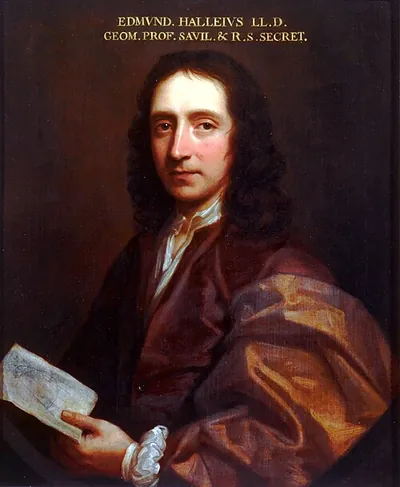 Edmond Halley1656–1742 · Astronomy and space
