
Lagrangian point
Five points in a two-body system where a small object can stay fixed relative to the two large bodies.
- Year
- 1772
- Section
- Astronomy and space
History
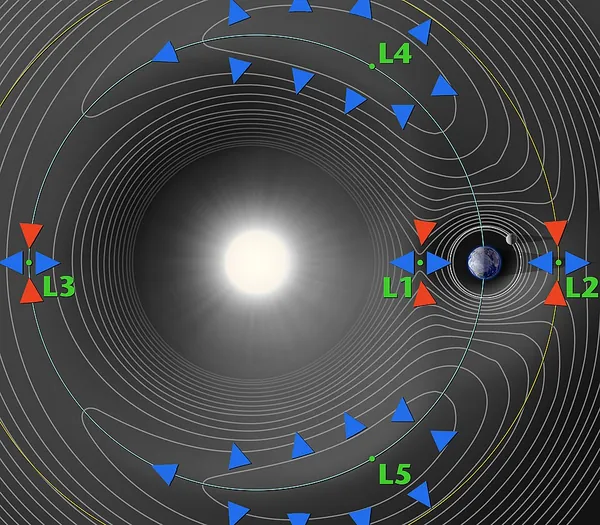
Lagrange points are places in space where a very small object, acted on only by gravity, can stay still relative to two much larger bodies that orbit each other, such as the Sun and Earth or Earth and the Moon. At these points the combined pull of the two large bodies balances the centrifugal effect seen from a frame that rotates with them. This makes them attractive for satellites that must hold a steady position without spending much fuel on orbit corrections.
Leonhard Euler had already found the three collinear points, lying on the line through the two large bodies, around 1750. His work belonged to the three-body problem, which asks how three masses attracting one another will move. Two bodies can be handled with simple formulas, but adding a third makes the calculations far harder and can make the motion chaotic.
In 1772, Joseph-Louis Lagrange, an Italian-born mathematician who worked in France, published an essay on the three-body problem. He aimed to find a general way to handle gravitational interactions. He started from a principle that a body follows the path that makes a quantity called the action as small as possible, where the action is computed by subtracting potential energy from kinetic energy. From this idea he reformulated Newtonian mechanics into what is now called Lagrangian mechanics. Within this work he found two special solutions for three masses in circular orbits: the aligned one already known, and a triangular arrangement in which the third body forms an equilateral triangle with the other two. These two triangular points, L4 and L5, completed the set of five.
The collinear points L1, L2 and L3 are unstable, so an object drifting away from them tends to keep moving away. L4 and L5 can be stable when the larger body is massive enough compared with the smaller one; in the Sun–Jupiter system, for example, many trojan asteroids gather around them. For a long time these points were mainly a mathematical result, but in the twentieth century they became practical sites for spacecraft. The L1 point of the Sun–Earth system, about 1.5 million kilometres from Earth, allows continuous observation of the Sun and measurement of the solar wind. L2, on the far side of Earth, hosts telescopes such as the James Webb, which keep the Earth, Sun and Moon in one direction so their shielding can work without rotating. In the Earth–Moon system, L1 and L2 have been proposed as waypoints for trips to the Moon and as relay points for communications with the far side. An idea born from an eighteenth-century mathematical problem thus supports much of modern space astronomy.
Timeline
- 1750Leonhard Euler discovers the three collinear points, L1, L2 and L3.
- 1772Joseph-Louis Lagrange publishes his essay on the three-body problem and identifies the triangular points L4 and L5.
- Jupiter's trojan asteroids, near L4 and L5, are named after characters from the Iliad.
- The SOHO observatory is placed at the Sun–Earth L1 point to observe the Sun.
- The James Webb Space Telescope is positioned at the Sun–Earth L2 point.
Trivia and anecdotes
Jupiter's trojans
The asteroids at Jupiter's L4 and L5 points were named after characters from the Trojan War. Those ahead of the planet form the Greek camp, and those behind it the Trojan camp.
A counterintuitive point
A satellite at L1 keeps the same orbital period as Earth even though it sits closer to the Sun, which goes against intuition.