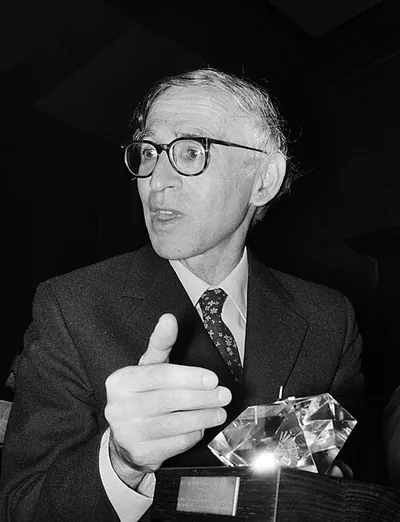
Aaron Klug
British chemist and biophysicist of Lithuanian birth, Nobel Prize in Chemistry in 1982 for developing crystallographic electron microscopy · 1926–2018
- Born
- August 11, 1926
- Died
- November 20, 2018
- Country
- United Kingdom
- Section
- Biology
- Awards
- Nobel Prize in Chemistry
Biography
Aaron Klug (Želva, Lithuania, 1926 - Cambridge, United Kingdom, 2018) was a British scientist of Lithuanian birth who won the Nobel Prize in Chemistry in 1982. He worked mainly in the second half of the twentieth century, when biology was beginning to be explained in terms of molecular structures. His importance lies in creating methods to see the three-dimensional shape of viruses and of complexes made of nucleic acids and proteins, which are essential parts of how living things function.
He was born into a Jewish family that spoke Yiddish at home. His father, Lazar, was a drover who worked with horses, and in 1928 the family emigrated to Durban, in the Union of South Africa, now South Africa. His mother died of pneumonia in 1932, and a maternal aunt, Rose, lived with the family; she later married his father. Klug received both a secular and a traditional Jewish education. At Durban High School, the 1926 book Microbe Hunters by Paul de Kruif awakened his interest in microbiology. In 1941, aged fifteen, he won a scholarship to study medicine at the University of the Witwatersrand in Johannesburg. After a year he switched to science and graduated in physics, chemistry and mathematics. At the urging of a friend he joined the Hashomer Hatzair Zionist youth movement in Johannesburg, where he met his future wife, Liebe Bobrow. He studied physics under Reginald W. James and took a master's degree at the University of Cape Town. The sources note that he faced discrimination in South Africa, a experience that shaped his early years.
A research fellowship from the Royal Commission for the Exhibition of 1851 allowed him to move to England. He completed his doctorate in research physics at Trinity College, Cambridge, in 1953. Late that year he joined Birkbeck College of the University of London, where he began working with Rosalind Franklin, a chemist and X-ray crystallographer, in the laboratory of John Bernal. X-ray crystallography works out the arrangement of atoms in a substance by observing how X-rays scatter when they pass through a crystal. During his time in London he made discoveries about the structure of the tobacco mosaic virus, and this experience gave him a lifelong interest in viruses. In 1962 he moved to the newly built Laboratory of Molecular Biology of the Medical Research Council in Cambridge, and that same year he became a Fellow of Peterhouse.
The following decade brought the methods for which he is best known. He combined X-ray diffraction, microscopy and structural modelling to develop crystallographic electron microscopy. The idea is easy to describe: a series of two-dimensional images of a crystal, taken from different angles, is combined to produce a three-dimensional image of the object studied. With this technique he studied the structure of transfer RNA, a molecule that helps turn genetic information into proteins. He also found what are known as zinc fingers, small protein structures that grip nucleic acids with the help of a zinc atom, and he studied the neurofibrils present in Alzheimer's disease. His work on the structure of spherical viruses, carried out with Donald Caspar, led to a general theory of how the shells of these particles are arranged, a theory that he and his colleagues tested with X-ray and electron microscopy studies.
Between 1986 and 1996 he directed the Cambridge laboratory. Together with Dai Rees he approached the Wellcome Trust to found the Wellcome Sanger Institute, which was a key player in the Human Genome Project. He served as President of the Royal Society from 1995 to 2000, and he was appointed to the Order of Merit in 1995, as is customary for the Society's presidents. He was knighted by Queen Elizabeth II in 1988. Earlier, in 1981, he had received the Louisa Gross Horwitz Prize from Columbia University, and in 1985 the Copley Medal. He was a member of the American Academy of Arts and Sciences and the American Philosophical Society, and in 2005 he received South Africa's Order of Mapungubwe for exceptional achievements in medical science.
He married Liebe Bobrow in 1948, and they had two sons, one of whom died in 2000. According to Sydney Brenner, Klug became more religious as he grew older. He died in Cambridge on 20 November 2018. His legacy lies in the microscopy methods that are still used to study viruses and molecular complexes, and in the commemoration of his name: in 2013 Ben-Gurion University of the Negev in Israel dedicated its centre for structural biology to him, and he kept close ties with that university and with the town of Be'er Sheva, which he visited many times.
Main contributions
- 1953Discoveries about the structure of the tobacco mosaic virus, made during his time in London, which started a lifelong interest in viruses.
- 1970Crystallographic electron microscopy, a technique that rebuilds three-dimensional images of a molecule from two-dimensional images taken from different angles.
- Study of the structure of transfer RNA, the molecule that helps turn genetic information into proteins.
- Discovery of zinc fingers, protein motifs that bind nucleic acids with the help of a zinc atom.
- A general theory, developed with Donald Caspar, of spherical shells built from regularly arranged particles, applied to the structure of spherical viruses.
Teachers and students
Trivia and anecdotes
A book from youth
Paul de Kruif's 1926 book Microbe Hunters was what sparked his interest in microbiology during his school years in Durban.
A meeting in a youth movement
He joined the Zionist youth movement Hashomer Hatzair at the urging of a friend, and there he met Liebe Bobrow, whom he married in 1948.
A faith that grew with age
Although he faced discrimination in South Africa, according to Sydney Brenner, Klug became more religious in his later years.
Their contemporaries
While Aaron Klug was alive (1926–2018)…
Alive at the same time
Discovered or invented in those years
- 1931Big BangA cosmological model describing how the universe expanded from an early state of extreme density and temperature, about 13.8 billion years ago.
- 1932NeutronA subatomic particle with no net electric charge, found in the nucleus of almost every atom alongside protons.
- 1945ComputerA programmable machine that takes in data, processes it by following stored instructions, and produces results, able to switch tasks simply by running different software.
- 1969InternetA global network of interconnected computer networks that communicate using the TCP/IP protocol suite.
- 1973Mobile phoneA handheld wireless phone that lets people make and receive calls while moving across a cellular network area.
- 1989World Wide WebA system of linked documents and resources, connected by hyperlinks and accessed over the Internet with web browsers.
 Paul Berg1926–2023 · Biology
 Sydney Brenner1927–2019 · Biology
 Marshall Warren Nirenberg1927–2010 · Biology
 César Milstein1927–2002 · Biology
 James Watson1928–2025 · Biology
 Carl Woese1928–2012 · Biology
