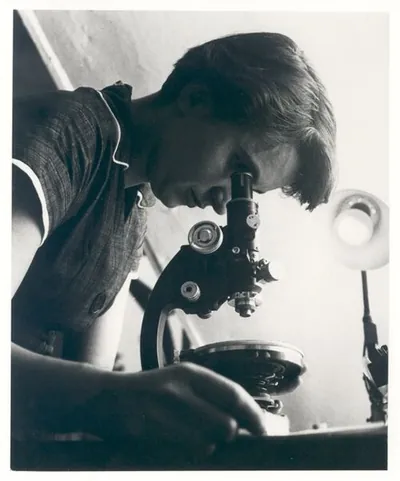
Rosalind Franklin
British chemist and X-ray crystallographer, a key figure in the study of DNA · 1920–1958
- Born
- July 25, 1920
- Died
- April 16, 1958
- Country
- United Kingdom, United Kingdom of Great Britain and Ireland
- Section
- Chemistry
Extended biography
Early years and training
Rosalind Elsie Franklin was born on 25 July 1920 in Notting Hill, London, into an affluent and influential British Jewish family. She was the eldest daughter and the second of five children. Her father, Ellis Arthur Franklin, was a liberal-minded merchant banker who taught at the Working Men's College; her mother, Muriel Waley, came from the same community. The family had a tradition of public service. One of her aunts was active in trade unions and the campaign for women's suffrage, and a distant relative, Herbert Samuel, became a senior minister in the British government.
From an early age she showed a strong aptitude for mathematics and science. A story preserved in the family says she did sums for pleasure and usually got them right. She attended several schools, some of them boarding schools, and in 1938 entered St Paul's Girls' School in Hammersmith, one of the few girls' schools in London that taught physics and chemistry. There she excelled in science, Latin and sport, and she became fluent in French. When her father suggested she give up a university scholarship to help a refugee student, she chose to keep it, reasoning that she might need it one day.
At Newnham College, Cambridge, she studied chemistry as part of the Natural Sciences course. It was there that she met Adrienne Weill, a French refugee who had once been a student of Marie Curie. Weill had a lasting influence on her career and on her affection for France, and helped her improve her French. These years confirmed Franklin's preference for experimental research.
Cambridge and the war
After graduating in 1941, Franklin hoped to do a doctorate in physical chemistry under Ronald Norrish, a professor who would later win the Nobel Prize in Chemistry. The experience was unsatisfactory. She found it hard to get a clear research direction from Norrish, and his biographer describes him as stubborn and sensitive to criticism. Franklin left his laboratory.
In 1942, during the war, she fulfilled her national service obligations by joining the British Coal Utilisation Research Association (BCURA), based on an estate outside London. The practical problem there was that coal was used as fuel and in wartime production, and it mattered to understand how it behaved when heated and what its internal structure looked like. Franklin studied the porosity of coal, meaning the number and size of the tiny holes it contains and how gases pass through them. She used helium, a gas small enough to enter the finest pores, to measure density, and found that the substances released by heated coal left in order of molecular size. These findings helped classify coals and predict their performance, which was also useful for making gas masks.
This work formed the basis of her doctoral thesis on the physical chemistry of solid organic colloids, for which Cambridge awarded her the degree in 1945. The war was ending, and she looked abroad for work, which led her toward a very different field: X-ray crystallography.
From coal to crystallography in Paris
X-ray crystallography is a technique for working out how atoms are arranged inside a material. A beam of X-rays is aimed at a sample; the atoms scatter the beam into a pattern of spots on a plate, and from that pattern the structure can be reconstructed. Franklin had worked on coal, a disordered material, and in 1947 she joined the laboratory of Jacques Mering in Paris, where the technique was applied to amorphous substances, meaning materials without a regular crystal structure, in contrast to most earlier studies.
In that laboratory she learned the practical side of a discipline that demands patience and careful interpretation. She studied how the arrangement of carbon atoms changes when coal turns into graphite, the ordered crystalline form of the same element. Her work is considered foundational for much of what is known about the physics and chemistry of carbon. She introduced the terms graphitising and non-graphitising carbon to distinguish two different behaviours when carbon is heated.
Her time in Paris also consolidated her reputation. She became skilled in diffraction methods and gained a standing that would open the door to London. In 1950 she was awarded a three-year fellowship at King's College London, and in January 1951 she joined the Medical Research Council's Biophysics Unit, directed by John Randall.
King's College and the structure of DNA
When she arrived in London, Franklin had been brought in to study proteins and lipids in solution, but Randall redirected her toward DNA, the molecule that carries genetic information. The reason was that the group already had advanced work on DNA and she was the only experienced diffraction researcher in the laboratory. However, Randall did not clearly tell Maurice Wilkins that the DNA work would now pass to Franklin. That lack of clarity fuelled a personal and professional tension that shaped the laboratory for months.
Franklin worked with Raymond Gosling, a doctoral student assigned to assist her. She improved the equipment, refining the X-ray tube and the microcamera, and designed a chamber in which the humidity of the sample could be controlled using saturated salt solutions. That control was crucial because DNA changes its appearance depending on how much water it retains. When humid, the fibres took a long, thin form; when drier, a short, broad one. Franklin called the first form B and the second A, and she chose to concentrate on the A form, which had richer data, while Wilkins took the B form.
Franklin insisted that the data should be allowed to speak before any models were built. Her 1951 notes suggested a helical structure with two, three or four chains, with phosphate groups pointing outward. This was an important conclusion, though it did not settle how many chains there were or how they were joined. One of Gosling's images, known as Photo 51, showed a clear X-shaped pattern characteristic of a helix. Its value was very great, but historians still debate how fully its significance was understood at the time.
The double helix and the controversy
In 1953, James Watson and Francis Crick at Cambridge were building molecular models of DNA, partly using data that originated at King's College. Their first attempt, a three-chain model, was wrong. According to Watson's own account, a meeting with Franklin at King's was tense: she rejected his suggestion that she did not know how to interpret her own data. Later, Wilkins showed Watson one of Gosling's diffraction images, and that information was important to the Cambridge pair.
The double-helix model, with two chains winding in opposite directions and linked by complementary pairs of bases, was published in Nature on 25 April 1953. The article included a footnote acknowledging the unpublished contributions of Franklin and Wilkins. In the same issue, papers by both of them, containing their diffraction data, were placed as support for the Watson and Crick article. Franklin did not formulate the idea of complementary base pairing, and although her drafts had moved toward a double-chain structure, as Aaron Klug documented years later, she had not reached the final model.
How to assess Franklin's role has been debated for decades. Watson portrayed her in his book The Double Helix with a mixture of admiration and criticism, and for a long time her contribution was underrated. Historians of science have since refined that picture, noting that her data were essential and that she was close to the solution. Questions remain about whether she had equal access to the data. Not every detail of these events can be established with certainty, so it is important to separate documented facts from interpretation. In 1962 Watson, Crick and Wilkins received the Nobel Prize in Physiology or Medicine. Franklin had died four years earlier, and Nobel Prizes are not awarded posthumously.
Birkbeck, viruses and final years
In March 1953 Franklin moved to Birkbeck College in London, after disagreements with her director and with Wilkins. Her new head, John Desmond Bernal, a respected crystallographer, encouraged her to lead her own research group, funded by the Agricultural Research Council. She later described the move with humour, as going from a palace to the slums, though pleasanter all the same. The laboratories were old and poorly suited to the work, with equipment spread across several floors.
At Birkbeck she turned to RNA and viruses. Tobacco mosaic virus has RNA as its genetic material, and its structure helped explain how viral particles are organised. In 1955 Franklin showed that all the particles of this virus had the same length, which contradicted an influential virologist of the period, though her observation was ultimately confirmed. With her student Kenneth Holmes, she established that the protein coat of the virus was arranged in a helix. Donald Caspar, an American researcher, showed in 1956 that the RNA winds along the inner surface of the hollow virus; Franklin had to write much of the manuscript because Caspar struggled with writing.
In 1957 she accepted an invitation to build a model of the virus about 1.5 metres tall for the 1958 Brussels International Exhibition. She used simple materials, such as table tennis balls and plastic bicycle handlebar grips. That same year she began studying the polio virus. She fell ill with ovarian cancer and died on 16 April 1958, aged 37. The exhibition opened the following day. After her death, Klug and his team continued the work, and in 1959 they published findings on the symmetry of spherical viruses, research that later contributed to his Nobel Prize in Chemistry in 1982.
Personal life and legacy
Franklin described herself as an agnostic. According to her mother, as a child she questioned the existence of God with an ironic and very rational tone. Nevertheless, she kept Jewish traditions. She was the only Jewish pupil at her school and taught herself Hebrew. Her sense of family identity was serious, though not religious in a strict sense.
She loved travel and mountain walking. A stay in France in 1938 left her with a lasting affection for the country and its language. In 1946 she suffered a serious accident in the French Alps, from which she barely escaped. Her American colleagues remembered a cheerful side and a good sense of humour, quite different from the sterner portrait that later circulated. She could be direct and sometimes impatient, and she disliked being called Rosy, the nickname used behind her back at King's College. She preferred to be called Rosalind.
Her legacy has several dimensions. Scientifically, her work on coal shaped a whole field, and her studies of DNA and viruses were decisive for understanding the structure of biological molecules. Historically, her figure has become a symbol of the difficulties faced by many women scientists in gaining recognition. Some have presented her as a forgotten heroine; others prefer a more nuanced account that acknowledges her achievements without turning her into a figure without contradictions. She is remembered today for the rigour of her experimental work and her conviction that conclusions must rest on solid data.
Quotes
“What’s the use of doing all this work if we don't get some fun out of this?”
“Science and everyday life cannot and should not be separated.”
“I agree that faith is essential to success in life, but I do not accept your definition of faith, i.e., belief in life after death. In my view, all that is necessary for faith is the belief that by doing our best we shall come nearer to success and that success in our aims (the improvement of the lot of mankind, present and future) is worth attaining”
Main contributions
- 1945Doctoral thesis on the porosity of coal: she showed that gases leave coal's pores according to molecular size, which helped classify different coals.
- 1951Forms A and B of DNA: she distinguished two forms of DNA according to humidity, a long thin one and a short wide one, and named them.
- 1952Photo 51: an X-ray diffraction image of DNA taken by Raymond Gosling under Franklin's supervision, which suggested a helix and provided key measurements.
- 1953Data behind the double helix model: her measurements and her conclusion that DNA had two helices were used by Watson and Crick as a basis for their model.
- Studies of graphite: she described how carbon atoms rearrange when coal becomes graphite, and coined the terms graphitising and non-graphitising carbon.
- Virus studies at Birkbeck: she investigated the structure of viruses such as poliovirus and tobacco mosaic virus, but did not live to finish the work.
Teachers and students
Trivia and anecdotes
A mock funeral notice
In July 1952 Franklin and Gosling wrote a mock funeral notice for the 'death' of the crystalline DNA helix, aimed at Wilkins, who believed both forms were helical.
Refugees at home
Franklin's parents took in Jewish refugee children fleeing the Nazis. One of them, Evi Eisenstädter, shared a room with her sister Jenifer.
A call from the music teacher
According to a well-known account, the composer Gustav Holst, the school's music director, once phoned her mother to ask whether Franklin had a hearing problem, since her only academic difficulties were in music.
Related discoveries and inventions
- 1953Nucleic acid double helixA spiral structure formed by two nucleic acid strands, such as DNA, held together by matching pairs of bases.
Their contemporaries
While Rosalind Franklin was alive (1920–1958)…
Alive at the same time
Discovered or invented in those years
- 1925TelevisionA system that sends moving pictures and sound over distance and shows them on a receiver, the television set.
- 1925Quantum mechanicsPhysical theory describing how matter and light behave at atomic and subatomic scales, where energy is exchanged in minimal packets and results are expressed as probabilities.
- 1931Big BangA cosmological model describing how the universe expanded from an early state of extreme density and temperature, about 13.8 billion years ago.
- 1932NeutronA subatomic particle with no net electric charge, found in the nucleus of almost every atom alongside protons.
- 1945ComputerA programmable machine that takes in data, processes it by following stored instructions, and produces results, able to switch tasks simply by running different software.
- 1957Artificial satelliteAn artificial satellite is a human-made object placed in orbit around a celestial body, usually Earth, to collect information, relay signals, or carry out a specific task.
 Derek Barton1918–1998 · Chemistry
 Robert Burns Woodward1917–1979 · Chemistry
 Ilya Prigogine1917–2003 · Chemistry
 John Pople1925–2004 · Chemistry
 Manfred Eigen1927–2019 · Chemistry
