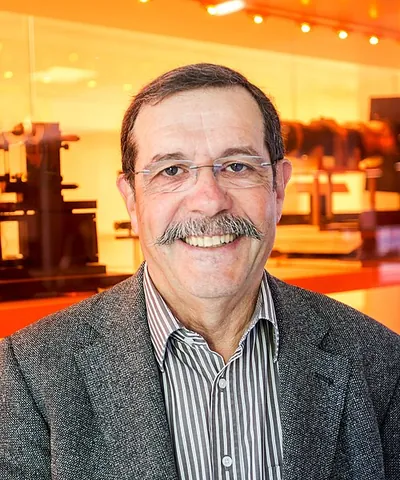
Alain Aspect
French experimental physicist, 2022 Nobel Prize in Physics for experiments with entangled photons · 1947
- Born
- June 15, 1947
- Country
- France
- Section
- Physics
- Awards
- Nobel Prize in Physics
Biography
Alain Aspect (born in Agen, France, on 15 June 1947) is an experimental physicist whose work on quantum entanglement places him among the most important scientists of recent decades. In 2022 he shared the Nobel Prize in Physics with John Clauser and Anton Zeilinger for experiments showing that Bell's inequalities are violated, meaning that nature does not behave the way a purely local description of reality would predict. His work turned a debate that had long been largely philosophical into a question that could be tested in the laboratory.
He was born in Agen, in south-western France, on 15 June 1947. He studied at the École Normale Supérieure de Cachan, one of the French institutions that train teachers and researchers. In 1969 he passed the agrégation in physics, the competitive examination that qualifies people to teach at university level in France. His interest in quantum mechanics, the theory describing the behaviour of atoms, electrons and photons, developed early and was largely self-taught: in his free time he read the textbook by Claude Cohen-Tannoudji, Bernard Diu and Franck Laloë, a standard reference in the field. He received his PhD in 1971 from the École supérieure d'optique, linked to the University of Orsay. That same year he began his alternative to compulsory military service, teaching for three years in Cameroon. The experience took him away from research at a time when many physicists of his generation were working on the foundations of the theory.
On his return he came across the work of John Stewart Bell, an Irish physicist who had proposed a way to put to experimental test the ideas that Albert Einstein, Boris Podolsky and Nathan Rosen had raised about quantum mechanics. Their 1935 argument rested on a puzzling consequence of the theory: two particles that have interacted can remain linked after they separate, so that measuring one affects the result obtained for the other. Einstein called this "spooky action at a distance" and suspected the theory was incomplete. Bell showed that if a deeper description based on local hidden variables existed, a certain mathematical inequality had to hold, while quantum predictions could violate it. The inequality thus became a practical criterion for choosing between two views of the world.
Quantum entanglement is the phenomenon Bell's test was designed to probe. A simple version of the experiment uses a source that emits two photons in opposite directions. Each photon meets a polarisation analyser, a filter that either lets it through or blocks it, followed by a detector that records whether it arrives. Quantum mechanics predicts correlations between the results on the two sides that cannot be explained by signals passing between them. The first experiment of this kind, carried out by Stuart Freedman and John Clauser in 1972, broadly confirmed the quantum predictions, but it had a weak point: the orientations of the analysers were fixed before the photons were emitted, so an exchange of information between the two ends could not be ruled out.
Aspect built a setup in which a laser excited calcium atoms in a radiative cascade, producing pairs of entangled photons of sufficient quality for the test. In the early 1980s he repeated the experiments of his predecessors and fixed the weak point: he changed the orientation of the analysers while the photons were already in flight, so that no signal could travel from one side to the other in time. The results violated Bell's inequality and confirmed the predictions of quantum mechanics. The experiments were not entirely conclusive, because technical gaps, such as the efficiency of the detectors, still left room in principle for alternative explanations compatible with local realism. Even so, they closed much of the most debated gap and were regarded as strong evidence that the quantum world does not fit classical intuition.
His doctoral thesis, the doctorat d'État, was defended in 1983 at the University of Paris-Sud. Its jury included Cohen-Tannoudji, who later also won the Nobel Prize, and Bell himself. After his work on the inequalities, Aspect turned to laser cooling of neutral atoms, a technique that uses light to slow atoms to very low temperatures, and to Bose-Einstein condensates, a state of matter in which many atoms occupy the same quantum state. This research was carried out at the Kastler-Brossel Laboratory, where he has spent much of his career. He was deputy director of the École supérieure d'optique until 1994 and has taught at the École polytechnique. He is a member of the French Academy of Sciences and of the French Academy of Technologies.
His international recognition grew steadily. He received the gold medal of the French National Centre for Scientific Research in 2005, the Wolf Prize in Physics in 2010, shared with Zeilinger and Clauser, and in 2013 both the Niels Bohr International Gold Medal and the Balzan Prize for quantum information processing and communication. He became a foreign member of the Royal Society in 2015 and in 2025 was elected to the Académie Française, an unusual honour for a laboratory scientist. Some accounts also stress his commitment to teaching, which is reflected in the motto he had engraved on his sword, a tribute to schoolteachers.
Aspect's legacy extends beyond a single experiment. Showing that entanglement is real and measurable provided the basis for quantum information science, which studies how these correlations can be used in cryptography and computing. His work on cooling atoms and on condensates has also influenced atomic physics. His main contribution was to turn a philosophical question about the nature of reality into an experimental test that now appears in standard textbooks.
Main contributions
- 1982Aspect's experiment: a test with entangled photons that violates Bell's inequalities and fixes the weak point of earlier trials.
- 1983Doctorat d'État thesis on Bell tests, defended at the University of Paris-Sud.
- 2019Einstein et les révolutions quantiques: a popular book on Einstein's relationship with quantum mechanics.
- 2022Nobel Prize in Physics, shared with Clauser and Zeilinger, for experiments with entangled photons.
- Laser cooling of neutral atoms: a technique that uses light to slow atoms to very low temperatures.
- Bose-Einstein condensates: research on a state of matter in which many atoms share the same quantum state.
Teachers and students
Taught:
Trivia and anecdotes
A motto on his sword
On being elected to the Académie Française, he had engraved on the scabbard of his sword the phrase "Nous, les maîtres d'écoles", a tribute to schoolteachers.
An asteroid named after him
Asteroid 33163 Alainaspect, discovered at Caussols in 1998, was named after him and published by the Minor Planet Center in 2019.
Teaching instead of military service
He fulfilled his compulsory military service by teaching for three years in Cameroon instead of serving in the army.
Their contemporaries
While Alain Aspect was alive (1947–)…
Alive at the same time
Discovered or invented in those years
- 1947TransistorA semiconductor component that amplifies or switches electrical current between two terminals, depending on a signal applied to a third.
- 1957Artificial satelliteAn artificial satellite is a human-made object placed in orbit around a celestial body, usually Earth, to collect information, relay signals, or carry out a specific task.
- 1969InternetA global network of interconnected computer networks that communicate using the TCP/IP protocol suite.
- 1971EmailA network service that lets users send and receive digital messages through addressed mailboxes, much like postal mail but electronic.
- 1973Mobile phoneA handheld wireless phone that lets people make and receive calls while moving across a cellular network area.
- 1989World Wide WebA system of linked documents and resources, connected by hyperlinks and accessed over the Internet with web browsers.
 Stephen Hawking1942–2018 · Physics
 Donna Strickland1959 · Physics
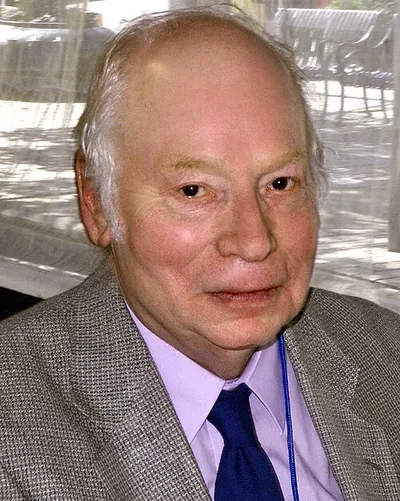 Steven Weinberg1933–2021 · Physics
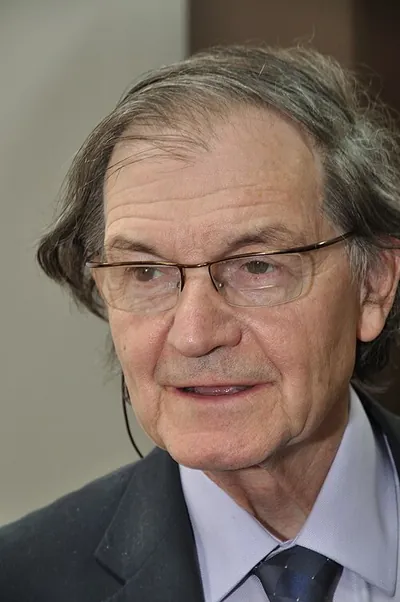 Roger Penrose1931 · Physics
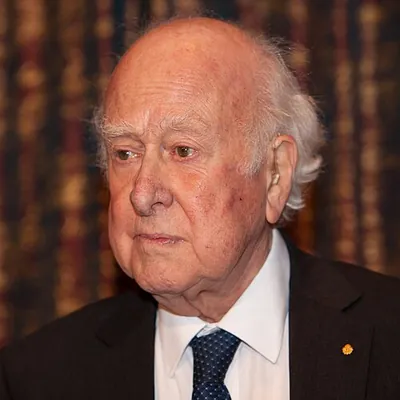 Peter Higgs1929–2024 · Physics
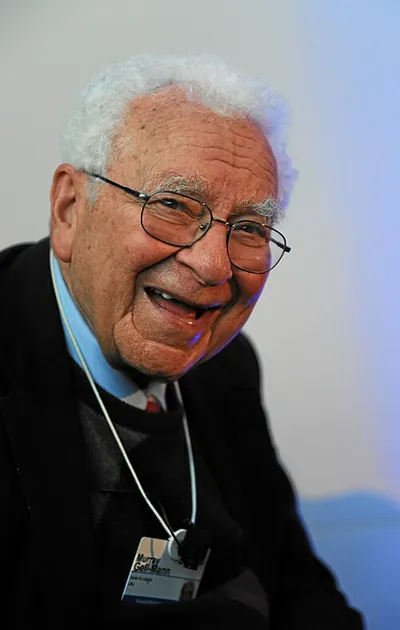 Murray Gell-Mann1929–2019 · Physics
