
Nicolaus Otto
German engineer who developed the four-stroke, compressed-charge engine that became the basis of later internal combustion engines · 1832–1891
- Born
- June 10, 1832
- Died
- January 26, 1891
- Country
- Kingdom of Prussia, Duchy of Nassau
- Section
- Energy
Biography
Nicolaus August Otto (Cologne, 1832 – Cologne, 1891) was a German engineer whose four-stroke engine with compressed fuel mixture became the model for nearly all internal combustion engines that followed. He lived in the second half of the nineteenth century, when the steam engine dominated industry and smaller, more practical power sources were being sought. His importance lies in shaping the engine that later powered cars, trucks, ships and aircraft.
He is usually recorded as born in 1832, the youngest of six children. Some accounts place his birth in Holzhausen an der Haide, in Hesse, while others place it in Cologne, where he lived and died. His father died in the year of his birth. He attended school in Langenschwalbach until 1848 without completing his studies, though he was noted for his good work. His real interest lay in science and technology, but he ended up training as a business apprentice in a small trading firm. He never received a solid technical education, a point often raised when people discuss his early work.
After his apprenticeship he moved to Frankfurt, where he sold colonial goods such as coffee, tea, rice and sugar. He later worked for several firms in western Germany, including that of Carl Mertens. These commercial years gave him contacts and some money, but they did not pull him away from machines.
The turning point came in late 1860, when he and his brother heard about a gas engine that Jean Joseph Étienne Lenoir had built in Paris. A gas engine works by igniting a mixture of illuminating gas and air inside a cylinder so that the expansion pushes a piston. The brothers built a copy of Lenoir's engine and in January 1861 applied for a patent on a version running on liquid fuel, but the Prussian Ministry of Commerce rejected it. Otto was also aware of the idea of compressing the fuel mixture before lighting it, which gives more power from the same charge. In 1861 he tried to build an engine on that principle, but it ran for only a few minutes before breaking. His brother gave up on the idea, and Otto looked for help elsewhere.
Between 1862 and 1863 he worked with the Cologne mechanic Michael J. Zons to improve the prototype. Funds were running low, so he went back to work for Mertens to keep his engine project alive. Early in 1864 he looked for investors and found Eugen Langen, son of a sugar industrialist. On 31 March 1864 the two formed a partnership in Cologne under the name NA Otto & Cie. It was the world's first company devoted entirely to the design and production of internal combustion engines.
The Otto and Langen engine of 1864 was a free-piston atmospheric design. Gas exploded to create a partial vacuum below the piston, and atmospheric pressure then pushed the piston down to deliver useful work. It used less than half the gas of the Lenoir and Hugon engines and was a commercial success. Its design, however, reached a technical dead end: it gave little power and needed a great deal of headroom. Even so, the company was producing 634 engines a year by 1875.
Otto then returned to the four-stroke cycle, which he had abandoned in 1862. A four-stroke cycle consists of intake of the mixture, compression, ignition and power, and exhaust. With help from Franz Rings and Herman Schumm, two engineers brought into the firm by Gottlieb Daimler, he finally produced a four-stroke engine that compressed its charge inside the cylinder. It was the first commercially successful engine to use in-cylinder compression, and it is the engine to which the term Otto cycle refers. The Rings-Schumm engine appeared in autumn 1876 and sold well from the start. The company had moved to larger premises in Deutz, near Cologne, in 1872.
His relationship with Daimler ended in dispute. Daimler wanted to build small engines for vehicles, which Otto showed no interest in, and he left the firm taking Wilhelm Maybach with him. Daimler did not want to pay royalties to Otto for the principle, so a lawyer searched for a way out and found an 1862 patent granted to the French engineer Alphonse Beau de Rochas for the four-stroke concept. That earlier patent cost Otto one of his own and let Daimler sell engines in Germany without paying royalties. Neither Otto nor Daimler had known of the Rochas patent, and there is no evidence that Rochas ever built an engine.
Otto married Anna Gossi, and the couple had seven recorded children. His son Gustav Otto became an aircraft builder and co-founded BMW with Karl Rapp in 1917. Otto received several honours: a gold medal at the Paris World Exhibition of 1867 for his atmospheric engine, and an honorary doctorate from the University of Würzburg in 1882. Production was also substantial, with more than 50,000 engines sold in the years that followed, many of them for machine works. Otto sold his engines only as stationary units, and vehicle engines came later through other manufacturers.
In 1884 Otto invented electric ignition, a system that lights the mixture with a timed spark, and his patent was made public that same year. Over time, the phrase Otto engine came to describe engines that draw in a fuel mixture, compress it and ignite it by a special device. The German engineers' association VDI recorded that definition in DIN standard 1940, and in 1936 its leadership pushed for the term to replace looser names such as explosion motor. His legacy is still present, because most petrol engines continue to rely on the cycle he refined. He died in his native city in 1891, and his home has become a museum.
Main contributions
- 1864Founding of NA Otto & Cie and the first free-piston atmospheric engine: the first company devoted solely to internal combustion engines, with a design that used the vacuum created by a gas explosion.
- 1867Gold medal at the Paris World Exhibition for his gas engine, an early recognition of his work.
- 1876Four-stroke compressed-charge engine: it compresses the fuel mixture inside the cylinder before ignition and gave its name to the Otto cycle.
- 1884Electric ignition: a system that lights the mixture with a spark at the right moment in the cycle.
- 1936DIN standard 1940, which defines the Otto engine as an internal combustion engine in which a compressed mixture is ignited by a timed spark.
Trivia and anecdotes
A patent that cost him
An 1862 patent granted to the Frenchman Beau de Rochas for the four-stroke cycle was used to take one of Otto's own patents away. Neither he nor Daimler had known of that document.
A first attempt that lasted minutes
His first four-stroke engine, built in 1861, ran for only a few minutes before it broke, and the failure pushed him to look for help outside his family.
Related discoveries and inventions
- 1876Internal combustion engineA machine that produces motion by burning fuel inside its own cylinder, unlike the steam engine, which heats water in a separate vessel.
Their contemporaries
While Nicolaus Otto was alive (1832–1891)…
Alive at the same time
Discovered or invented in those years
- 1846NeptuneThe eighth and most distant planet of the Solar System, an ice giant found through mathematical prediction before any direct sighting.
- 1859EvolutionThe process by which the heritable traits of living populations change over generations, explaining the diversity of life from common ancestors.
- 1869Periodic tableAn arrangement of the chemical elements into rows (periods) and columns (groups), ordered by atomic number, that reveals recurring chemical behaviour and lets scientists predict properties.
- 1869Deoxyribonucleic acidA double-stranded molecule that carries the genetic instructions of nearly all living things and many viruses.
- 1876TelephoneA device that carries the human voice over distance by turning sound into electrical signals and back into sound at the other end of the line.
- 1884CarA road vehicle with four wheels and its own engine, mainly built to carry people.
 Ludvig Nobel1831–1888 · Energy
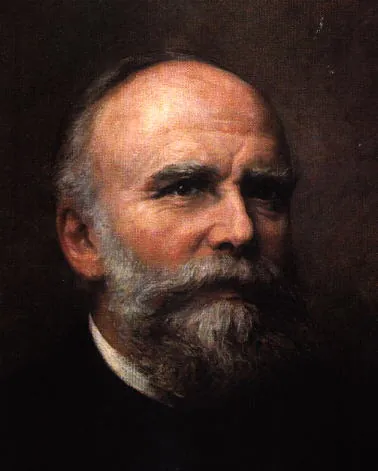 Eugen Langen1833–1895 · Energy
 Gaston Planté1834–1889 · Energy
 George Brayton1830–1892 · Energy
 Charles Tellier1828–1913 · Energy
 Zénobe Gramme1826–1901 · Energy
