
Amina Helmi
Argentine astronomer and professor at the University of Groningen, specialist in the history of the Milky Way · 1970
- Born
- October 6, 1970
- Country
- Argentina, Kingdom of the Netherlands
- Section
- Astronomy and space
Biography
Amina Helmi is an Argentine astronomer who works in the Netherlands, where she teaches at the University of Groningen. Her research seeks to reconstruct how our galaxy, the Milky Way, was assembled, using the stars we can observe today as clues. Her work helps explain that galaxies do not form all at once; they grow by absorbing smaller ones over billions of years.
She studied astronomy at the National University of La Plata in Argentina. She then moved to Leiden University in the Netherlands, where she earned her PhD in 2000 with a thesis on the formation of the galactic halo, the diffuse region surrounding a galaxy's disc. Her supervisors were Tim de Zeeuw and Simon White, both prominent figures in European astrophysics at the time.
Before securing a permanent post, Helmi worked as a postdoctoral researcher at the University of La Plata, the Max Planck Institute for Astrophysics in Germany and Utrecht University. She has been a faculty member at the University of Groningen since 2003 and a full professor since 2014.
Her method is to study the position, velocity, age and chemical makeup of stars. Stars carry traces of the conditions in which they formed, so reading them helps scientists reconstruct the galaxy's past. This field is known as galactic archaeology. Helmi also studies the nature of dark matter, a substance that neither emits nor absorbs light and is detected only through its gravitational effects. She combines computer simulations with observations, especially data from the Gaia space telescope.
In 2018, her team used Gaia data to identify remnants of an ancient galaxy, named Gaia-Enceladus, which merged with the Milky Way roughly 10 billion years ago. According to the study, the remains of this galaxy make up much of the inner stellar halo of our galaxy, and the merger may have helped shape the thick disc, a population of older, more widely spread stars than the thin disc where the Sun lies. The discovery strengthened the view that large galactic collisions played a decisive role in the Milky Way's history.
Her work has earned many honours: the Christiaan Huygens Prize in 2004, the Pastoor Schmeits Prize in 2010, the Spinoza Prize in 2019, the Brouwer Award of the American Astronomical Society in 2021 and the Kavli Prize in Astrophysics in 2026, shared with Vasily Belokurov and Rodrigo Ibata. She has been a member of the Royal Netherlands Academy of Arts and Sciences since 2017 and was named a Knight of the Order of the Netherlands Lion in 2021. A stream of stars in the Milky Way bears her name.
Her legacy lies in making galactic archaeology a central tool for reading the history of our galaxy, and in showing with concrete evidence that the Milky Way was built partly from other galaxies it absorbed.
Main contributions
- 2000PhD thesis on the formation of the galactic halo, defended at Leiden University.
- 2018Identification of the remnants of Gaia-Enceladus, an ancient galaxy absorbed by the Milky Way, using data from the Gaia telescope.
- 2019A stellar stream of the Milky Way that bears her name, known as the Helmi stream.
- 2026Kavli Prize in Astrophysics, shared with Vasily Belokurov and Rodrigo Ibata, for their studies on the formation of the Milky Way.
Teachers and students
Studied under:
Taught:
Trivia and anecdotes
A stream named after her
The Helmi stream, a group of stars in the Milky Way, carries her name in recognition of her work on the origin of the galaxy's stars.
Royal recognition
In 2021 she was named a Knight of the Order of the Netherlands Lion, one of the honorary distinctions of the Netherlands.
Their contemporaries
While Amina Helmi was alive (1970–)…
Alive at the same time
Discovered or invented in those years
- 1971EmailA network service that lets users send and receive digital messages through addressed mailboxes, much like postal mail but electronic.
- 1973Mobile phoneA handheld wireless phone that lets people make and receive calls while moving across a cellular network area.
- 1975Global warmingThe long-term rise in Earth's average surface temperature, driven mainly by greenhouse gases released through human activity.
- 1989World Wide WebA system of linked documents and resources, connected by hyperlinks and accessed over the Internet with web browsers.
- 1990Web browserA program that lets people access the web by fetching a page's files from a server and displaying them on screen as an interactive page.
- 1991HTMLThe markup language used to structure web page content so that a browser can display it.
 Didier Queloz1966 · Astronomy and space
 Saul Perlmutter1959 · Astronomy and space
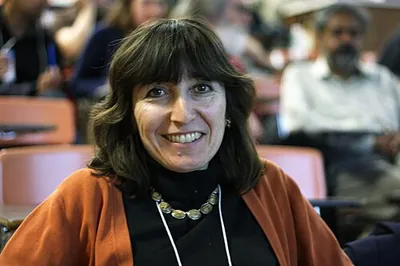 Wendy Freedman1957 · Astronomy and space
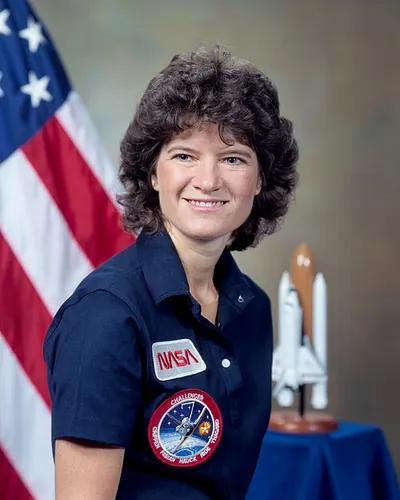 Sally Ride1951–2012 · Astronomy and space
 Russell A. Hulse1950 · Astronomy and space
 Michel Mayor1942 · Astronomy and space
