
Andrei Sakharov
Soviet nuclear physicist who helped develop the Soviet hydrogen bomb, later a dissident and human rights campaigner, Nobel Peace Prize laureate in 1975 · 1921–1989
- Born
- May 21, 1921
- Died
- December 14, 1989
- Country
- Soviet Union, Russian Socialist Federative Soviet Republic
- Section
- Physics
- Awards
- Abel Prize
Extended biography
Childhood and training
Andrei Dmitrievich Sakharov was born in Moscow on 21 May 1921 into a family where science and social conscience went hand in hand. His father, Dmitri Ivanovich, was a physics professor and an amateur pianist. His mother, Yekaterina Sofiano, came from a family with Greek roots. His paternal grandfather had been a lawyer in the Russian Empire who championed social justice and opposed capital punishment, and that humanitarian outlook shaped the boy far more than any religious teaching.
The household was not religious. Sakharov later recalled that, around the age of thirteen, he stopped believing in God. Yet he never fully abandoned the sense that the universe was governed by some guiding principle that physical laws could not explain. This combination of strict rational method and a strong moral sense became a constant thread in his life.
He studied physics at Moscow State University from 1938. The war forced the university to evacuate, and he completed his degree in Ashgabat, in what is now Turkmenistan, in 1941. Afterwards he moved to Ulyanovsk, where he worked at a munitions plant. There he devised a method for detecting flaws in armour-piercing shells, an early sign of the practical problem-solving that would define his career.
In 1943 he married Klavdia Vikhireva, and the couple had two daughters and a son. Their marriage lasted until her death in 1969. In 1945 he returned to Moscow to join the theoretical department of the Lebedev Physical Institute, known as FIAN, and in 1947 he defended a doctoral thesis on nuclear transmutation, the process by which one atomic nucleus is converted into another.
From the laboratory to the hydrogen bomb
After the war, Sakharov turned to cosmic rays, high-energy particles that arrive from space and strike the atmosphere, and to their effects on living things. In mid-1948 he joined the Soviet atomic bomb project under Igor Kurchatov. The first Soviet nuclear device was tested on 29 August 1949, ending the American monopoly on such weapons.
The next goal was a thermonuclear bomb, which releases energy by fusing light nuclei, such as those of hydrogen, instead of splitting heavy ones like uranium. In 1948 Sakharov's group proposed a layered design that alternated uranium with fusion fuel. The team nicknamed it the sloika, after a layered cake. It worked, but its explosive yield was modest, and it was not the design that would matter most.
After moving to Sarov in 1950, Sakharov played a central role in building a megaton-range hydrogen bomb. The design that succeeded is known in Russia as Sakharov's Third Idea and in the West as the Teller-Ulam design. Its key insight was that X-rays from a first, fission explosion could be channelled to compress the fusion fuel symmetrically before it ignited. The first Soviet test of this type took place in August 1953, and a version was tested as RDS-37 in 1955.
The most extreme result was the Tsar Bomba, tested in October 1961 with a yield of about fifty megatons, the most powerful nuclear device ever detonated. During these years Sakharov received high state honours, including Hero of Socialist Labour and the Stalin Prize. In this period he was, above all, an engineer-physicist solving concrete problems set by the state, and he later admired the scientific ability of his American counterparts while disagreeing with their politics.
Plasma, magnetic fields and the cosmos
Sakharov's work was not confined to weapons. In 1950 he proposed, with Igor Tamm, a way to confine plasma, a gas so hot that its atoms have lost their electrons, using magnetic fields shaped like a torus, or doughnut. The aim was controlled thermonuclear fusion, a way of producing energy without explosions. This line of thinking led to the tokamak, a design that remains the basis of much of today's experimental fusion research.
In 1951 he invented magnetocumulative generators, known as MK generators. The principle was to use chemical explosives to squeeze a magnetic field to extreme strength. The first, radial model produced a pulsed field of 25 megagauss, or 2,500 teslas. A helical version generated currents of around a thousand million amperes in 1953.
He also tested a "plasma cannon" driven by these generators. A small aluminium ring was vaporised by enormous induced currents and formed a stable, self-contained ring of plasma that was accelerated to roughly 100 kilometres per second. He later suggested replacing the copper coil with a large superconducting solenoid and even using underground nuclear blasts to focus energy toward a target, in a manner similar to shaped charges. His claim that such a setup could focus 10 to the 23rd protons per second onto a square millimetre has never been confirmed by any known experiment, and it should be read as untested theory.
After 1965 he returned to fundamental physics, working on particle physics and cosmology. He tried to explain why the universe contains far more matter than antimatter, a puzzle known as the baryon asymmetry. He set out conditions that a universe must satisfy to develop such an imbalance, which are still called Sakharov's conditions. He also explored cyclic models of the universe and proposed induced gravity as an alternative to quantum gravity, an idea that has not been experimentally confirmed.
From weapons work to activism
By the late 1950s Sakharov had begun to weigh the consequences of his work more heavily. He feared a thermonuclear war and the radioactive fallout from atmospheric tests. During the 1960s he campaigned against nuclear proliferation and the testing of weapons in the air, and his influence helped lead to the 1963 Partial Test Ban Treaty, signed in Moscow.
In 1964 he took a public stand that had political consequences. The Soviet Academy of Sciences proposed Nikolai Nuzhdin, a follower of Trofim Lysenko, for full membership. Lysenko's rejection of genetics had been enforced under Stalin. Sakharov spoke out against the nomination and held Nuzhdin responsible for the persecution of many genuine scientists. Nuzhdin was not elected, but the affair led Khrushchev to order the KGB to gather compromising material on Sakharov.
The decisive turn came in 1967, when anti-ballistic missile systems became a central issue between the United States and the Soviet Union. In a secret letter dated 21 July 1967, Sakharov urged the leadership to accept an American proposal for a mutual renunciation of such systems, arguing that a new arms race would make nuclear war more likely. He also asked to publish his manuscript in the press. The request was refused, and the letter was ignored.
In May 1968 he completed an essay titled Reflections on Progress, Peaceful Coexistence and Intellectual Freedom. It circulated in secret copies and was published abroad. In punishment, he was barred from any military research and stripped of his honours. He returned to FIAN to work on theoretical physics, but he did not stay silent. In 1970 he helped found the Committee on Human Rights in the USSR with Valery Chalidze and Andrei Tverdokhlebov.
Nobel Prize and persecution
Through the 1970s his activism grew and so did the pressure on him. He wrote appeals on behalf of hundreds of prisoners, attended closed trials, and received foreign journalists in his Moscow flat. In 1972 he married the human rights campaigner Yelena Bonner, who became a close partner in his struggle and his most visible spokesperson. Soviet newspapers ran campaigns against him, and the writer Aleksandr Solzhenitsyn publicly defended him.
In 1973 he was nominated for the Nobel Peace Prize, which he received in 1975. The Nobel Committee called him a spokesman for the conscience of mankind and praised his argument that the inviolable rights of people offer the only safe basis for lasting international cooperation. The authorities did not let him travel to Oslo, so Bonner read his speech at the ceremony.
The lecture, titled Peace, Progress, Human Rights, argued that these three goals depend on one another. Peace without rights is fragile, and progress without freedom is hollow. It was not only a warning about nuclear weapons. Sakharov also listed hunger, pollution, the exhaustion of resources, overpopulation and the dehumanising effects of modern life, and he defended scientific inquiry and dissent.
His political thought led him to treat human rights as the foundation of all politics. He wrote that the principle that what is not forbidden is allowed should be understood literally, a challenge to the unwritten ideological rules of the Communist Party. Accounts from the period say that the KGB chief Yuri Andropov once described him as an enemy, but the exact wording comes from secondhand reports and should be treated with caution.
Internal exile and final years
On 22 January 1980, after public protests against the Soviet military intervention in Afghanistan, Sakharov was arrested and sent without a trial into exile in Gorky, now Nizhny Novgorod. The city was closed to foreigners. He lived there under police surveillance, with repeated searches of his flat, and for long periods he had no telephone. That same year he was stripped of his Soviet honours, though he later declined to have them restored.
In 1984 Bonner was detained, and Sakharov began a hunger strike to win her permission to travel abroad for heart surgery. He was hospitalised, force-fed and isolated for four months. He staged another hunger strike in 1985 with the same aim. Eventually his wife was allowed to go to the United States for treatment. This period is well documented, partly through his letters and memoirs.
The situation changed under Mikhail Gorbachev, who had launched the policies of perestroika and glasnost. On 19 December 1986 Gorbachev telephoned Sakharov to say that he and his wife could return to Moscow. Back in the capital, he helped to start the first legal independent political organisations. In March 1989 he was elected as an independent deputy to the new Congress of People's Deputies of the USSR and co-led the democratic opposition within it.
In December 1988 he travelled to Armenia and Azerbaijan on a fact-finding mission about the Nagorno-Karabakh dispute. His remarks reflected the deep emotional and territorial dimensions of the conflict. His health, however, was fragile. On 14 December 1989, shortly after nine in the evening, he went to his study to rest before preparing a speech for the following day. His wife found him dead on the floor. According to the notes of a pathologist present at the autopsy, the most likely cause was an arrhythmia linked to an enlarged heart muscle, and he was 68. He is buried in the Vostryakovskoye Cemetery in Moscow.
Legacy
Sakharov left a double legacy. He was one of the architects of Soviet thermonuclear weapons, and his technical ideas are still studied by physicists. He also became the symbol of a scientist who refused to place his knowledge at the service of unlimited destruction. Few figures combine these two roles so clearly.
His contributions to plasma physics and controlled fusion live on in tokamak research, while his cosmological ideas about the imbalance between matter and antimatter remain an active field of study. Some of his more speculative proposals, such as induced gravity or connected universes, are not widely accepted and should be seen as open theoretical work rather than established results.
In human rights, his name has become a reference point. Since 1988 the European Parliament has awarded the Sakharov Prize for Freedom of Thought, and since 2006 the American Physical Society has given a prize in his name to scientists who uphold human rights. Streets, squares and museums bear his name in many cities, from Nizhny Novgorod and Jerusalem to Brussels and Los Angeles.
His papers, first gathered at Brandeis University in 1993 and later moved to Harvard, have helped historians understand his life and those of other dissidents. His story shows the tension between science placed at the service of power and the personal responsibility of those who practise it, a question that remains relevant today.
Quotes
“Fascism lasted twelve years in Germany. Stalinism lasted twice as long in the Soviet Union. There are many common features but also certain differences.”
“In the old China, the systems of examinations for official positions led to mental stagnation and to the canonizing of the reactionary aspects of Confucianism. It is highly undesirable to have anything like that in a modern society.”
“The division of mankind threatens it with destruction.”
“Intellectual freedom is essential to human society — freedom to obtain and distribute information, freedom for open-minded and unfearing debate, and freedom from pressure by officialdom and prejudices.”
“All-out nuclear war would mean the destruction of contemporary civilization, throw man back centuries, cause the deaths of hundreds of millions or billions of people, and, with a certain degree of probability, would cause man to be destroyed as a biological species.”
Main contributions
- 1949The first Soviet atomic device, tested on 29 August 1949 as part of the atomic bomb project he joined.
- 1950Proposal, with Igor Tamm, to confine plasma in a torus-shaped magnetic field, the basis of the tokamak design.
- 1951Magneto-cumulative (MK) generators, which compressed magnetic fields with explosives and produced a field of 25 megagauss.
- 1953The first Soviet fusion device, tested on 12 August 1953; it laid the groundwork for the Soviet hydrogen bomb.
- 1963The Partial Test Ban Treaty, signed in Moscow, to which he contributed through his campaigning.
- 1975Nobel Peace Prize for his defence of human rights and international cooperation.
Teachers and students
Trivia and anecdotes
A wartime munitions invention
During the war, in Ulyanovsk, he devised a method for detecting flaws in armour-piercing shells.
A mural on the Berlin Wall
In 1990 the artist Dmitri Vrubel painted «Thank You, Andrei Sakharov» on a section of the Berlin Wall, now in the East Side Gallery.
A phone call that ended his exile
After years without a telephone in Gorky, Gorbachev had one installed in his flat so he could personally tell him he could return to Moscow.
Related discoveries and inventions
- 1951TokamakA tokamak is a machine that uses a powerful magnetic field to confine plasma in a doughnut-shaped ring, aiming to achieve controlled nuclear fusion.
- 1953Joe 4The first Soviet test of a boosted fission weapon, a design that combined fission and fusion, detonated in 1953.
Their contemporaries
While Andrei Sakharov was alive (1921–1989)…
Alive at the same time
Discovered or invented in those years
- 1925TelevisionA system that sends moving pictures and sound over distance and shows them on a receiver, the television set.
- 1925Quantum mechanicsPhysical theory describing how matter and light behave at atomic and subatomic scales, where energy is exchanged in minimal packets and results are expressed as probabilities.
- 1931Big BangA cosmological model describing how the universe expanded from an early state of extreme density and temperature, about 13.8 billion years ago.
- 1945ComputerA programmable machine that takes in data, processes it by following stored instructions, and produces results, able to switch tasks simply by running different software.
- 1969InternetA global network of interconnected computer networks that communicate using the TCP/IP protocol suite.
- 1989World Wide WebA system of linked documents and resources, connected by hyperlinks and accessed over the Internet with web browsers.
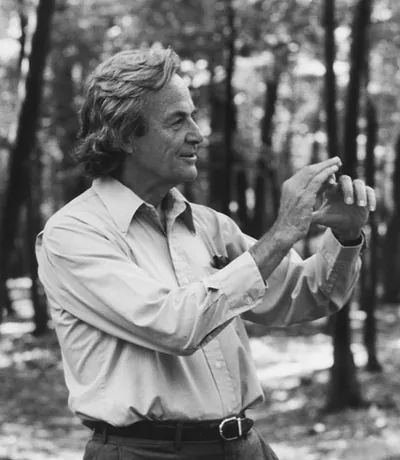 Richard Feynman1918–1988 · Physics
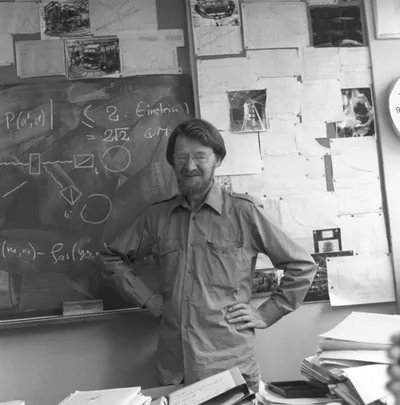 John Stewart Bell1928–1990 · Physics
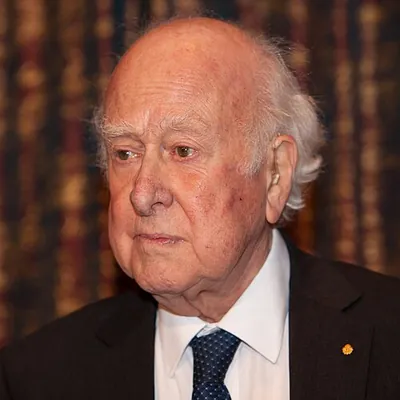 Peter Higgs1929–2024 · Physics
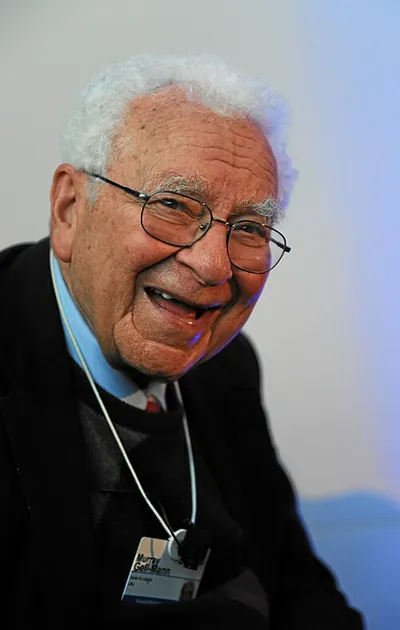 Murray Gell-Mann1929–2019 · Physics
 Roger Penrose1931 · Physics
 Steven Weinberg1933–2021 · Physics
