
Anna J. Harrison
American organic chemist, professor at Mount Holyoke College and first female president of the American Chemical Society · 1912–1998
- Born
- December 23, 1912
- Died
- August 8, 1998
- Country
- United States
- Section
- Chemistry
Biography
Anna Jane Harrison (Benton City, Missouri, 1912 – Holyoke, Massachusetts, 1998) was an American organic chemist who spent nearly forty years teaching at Mount Holyoke College. She worked in the decades after the Second World War, a period of rapid growth for American science, and she matters for two reasons: she trained generations of students, and she was a vocal advocate for women in science, becoming the first woman to lead the American Chemical Society.
She grew up on a farm. Her father died when she was seven, and her mother took over running the land and raising Anna and her brother. Her interest in science began at high school in Mexico, Missouri. She studied at the University of Missouri, earning a bachelor's degree in chemistry in 1933, a bachelor's in education in 1935, a master's in chemistry in 1937, and a doctorate in physical chemistry in 1940. Her doctoral work dealt with reactions involving sodium ketyls, highly reactive chemical intermediates.
Before settling into university research, Harrison taught at very different levels. While working on her master's, she taught at a one-room rural school in Audrain County, the same kind of school she had attended as a girl. From 1940 to 1945 she taught chemistry at H. Sophie Newcomb Memorial College, the women's college linked to Tulane University. During the Second World War she stepped away from teaching to carry out confidential research at the University of Missouri. In 1944 she studied toxic smoke for several bodies, among them the National Defense Research Committee and the Corning Glass Works. Her findings helped lead to field kits that could detect smoke for the United States Army, and this work earned her the Frank Forrest Award from the American Ceramic Society.
In 1945 she joined the chemistry department at Mount Holyoke College as an assistant professor, to work alongside the researcher Emma P. Carr. She became a full professor in 1950 and chaired the department from 1960 to 1966. Her research concerned the structure of organic compounds and how they interact with light, especially in the ultraviolet and far ultraviolet ranges, wavelengths the human eye cannot see. She received a grant from the Petroleum Research Fund Advisory Board of the American Chemical Society to study the absorption spectra and photodecomposition products of selected organic compounds.
Harrison was also highly active in scientific institutions. She served on the National Science Board from 1972 to 1978 and worked with many organizations, including the National Academy of Sciences, the National Science Foundation and the American Association for the Advancement of Science. She travelled on behalf of these bodies to India, Antarctica, Japan, Spain and Thailand. In 1978 she became the first female president of the American Chemical Society, and in 1983 she led the American Association for the Advancement of Science. She retired in 1979 and then taught at the U.S. Naval Academy in Annapolis. She wrote for journals such as the Journal of the American Chemical Society and Chemical & Engineering News, and in 1989 she co-wrote, with her Mount Holyoke colleague Edwin S. Weaver, the textbook Chemistry: A Search to Understand.
Her legacy lies mainly in teaching and in her campaign for equal opportunity. She consistently pushed for more public funding for science education and for the inclusion of women in science. She received twenty honorary degrees. She died in 1998, aged eighty-five, from a stroke.
Main contributions
- 1940Doctoral thesis on reactions involving sodium ketyls, highly reactive chemical intermediates, at the University of Missouri.
- 1944Research on toxic smoke that helped create smoke-detecting field kits for the United States Army.
- 1978First female president of the American Chemical Society.
- 1989Textbook Chemistry: A Search to Understand, co-written with Edwin S. Weaver.
Trivia and anecdotes
A one-room school
While studying for her master's, Harrison taught at the same one-room rural school in Audrain County that she had attended as a child.
An unusual path after retirement
When she retired in 1979 she did not leave teaching, instead teaching at the U.S. Naval Academy in Annapolis.
Their contemporaries
While Anna J. Harrison was alive (1912–1998)…
Alive at the same time
Discovered or invented in those years
- 1916Black holeA region of space where gravity is so strong that nothing, not even light, can escape once it crosses a certain boundary.
- 1925TelevisionA system that sends moving pictures and sound over distance and shows them on a receiver, the television set.
- 1925Quantum mechanicsPhysical theory describing how matter and light behave at atomic and subatomic scales, where energy is exchanged in minimal packets and results are expressed as probabilities.
- 1931Big BangA cosmological model describing how the universe expanded from an early state of extreme density and temperature, about 13.8 billion years ago.
- 1945ComputerA programmable machine that takes in data, processes it by following stored instructions, and produces results, able to switch tasks simply by running different software.
- 1969InternetA global network of interconnected computer networks that communicate using the TCP/IP protocol suite.
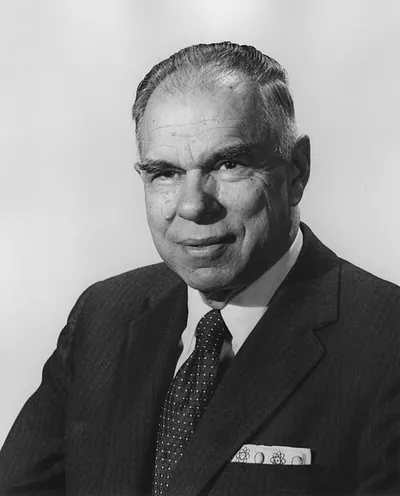 Glenn Theodore Seaborg1912–1999 · Chemistry
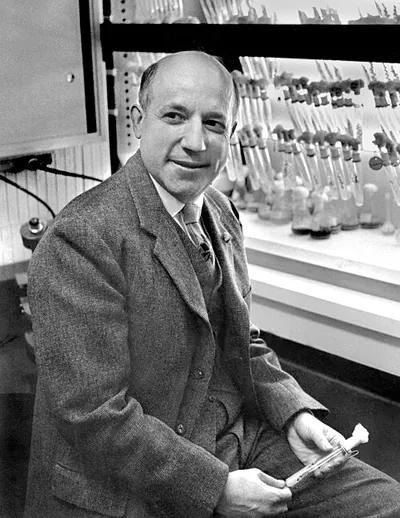 Melvin Calvin1911–1997 · Chemistry
 Dorothy Hodgkin1910–1994 · Chemistry
 Paul Flory1910–1985 · Chemistry
 Willard Libby1908–1980 · Chemistry
 Robert Burns Woodward1917–1979 · Chemistry