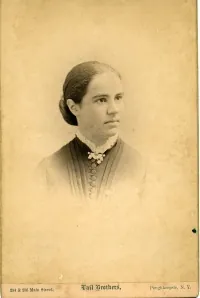
Antonia Maury
American astronomer who created a system for classifying stars by their spectra · 1866–1952
- Born
- March 21, 1866
- Died
- January 8, 1952
- Country
- United States
- Section
- Astronomy and space
Biography
Antonia Maury (1866-1952) was an American astronomer whose system for classifying stars by their spectra helped lay the foundations of modern astrophysics. She worked at a time when astronomers were beginning to learn what stars are made of by studying the light they give off, and her contribution is remembered mainly because it anticipated a tool that is still in use. For decades her name stayed in the background, overshadowed by the men who led the Harvard College Observatory.
She was born in Cold Spring, New York, on 21 March 1866, into a family deeply involved in science. Her grandfather, John William Draper, was a pioneer of both astronomy and photography, and her uncle Henry Draper and aunt Mary Anna Draper supported observatories and funded research. Her younger sister, Carlotta Maury, became a geologist and paleontologist. Antonia grew up surrounded by telescopes and scientific conversation.
She studied at Vassar College, graduating in 1887 with honours in physics, astronomy and philosophy. There she was taught by Maria Mitchell, one of the most respected astronomers in the country. That same year she joined the Harvard College Observatory as one of the so-called Harvard Computers, a group of highly skilled women who processed astronomical data for pay far below what men earned.
Her first major success came soon after. Astronomers studied stars with spectroscopy, which splits starlight into a rainbow crossed by dark lines, each linked to particular chemical elements. Maury noticed that some lines in the spectrum of Mizar split and merged in a regular rhythm, which showed that it was really two stars orbiting one another. In 1889 she found a second such pair, Beta Aurigae, and worked out its orbital period. However, the announcement was made by Edward Charles Pickering, the observatory's director, and for years her part was acknowledged only in a passing line.
The disagreement with Pickering centred on how spectra should be classified. In Maury's view the system used at the observatory was too simple. She designed a more detailed one that took into account a star's temperature and the width, sharpness and strength of its spectral lines. In 1897 she published an analysis of around 4,800 stellar photographs and a close study of 681 bright northern stars. It was the first observatory publication to carry a woman's name in its title. Even so, Pickering and others refused to adopt her system, and Maury left the observatory in 1896 after a period of teaching. She kept her friendship with Pickering, who asked her more than once to come back.
Her scheme found a life beyond Harvard. Around 1908 the Danish astronomer Ejnar Hertzsprung studied it and used it to separate bright red giants from faint dwarf stars. That distinction led to the Hertzsprung-Russell diagram, a basic tool of astrophysics. Hertzsprung judged her work more complete than that of Annie Jump Cannon, a colleague and friend of Maury. In 1922 the International Astronomical Union revised its classification, drawing on the work of Maury and Hertzsprung. Some historians, including Dorrit Hoffleit, argue that the delay in adopting her ideas slowed progress in stellar morphology by about thirty years.
In 1918 she returned to Harvard as an adjunct professor, this time receiving public credit for her work under her own name, and she remained there until her retirement in 1948. In 1933 she published a summary of many years of spectroscopic study of Beta Lyrae, another binary star. In 1943 she received the Annie Jump Cannon Award from the American Astronomical Society, and the Henry Draper Catalogue was revised to incorporate her ideas. After retiring she devoted herself to birdwatching and nature conservation, and for a time she worked as curator of the John William Draper House in Hastings-on-Hudson.
Her legacy is twofold. Her classification scheme shaped later systems, such as the one developed by Morgan and Keenan, which is still in use. Her reputation has also been rediscovered in recent decades as an example of the women scientists who worked in the shadow of their institutions. The lunar crater Maury bears her name, shared with her cousin, the naval officer Matthew Fontaine Maury.
Main contributions
- 1887Calculation of the orbit of Mizar, the first spectroscopic binary identified, by detecting the periodic splitting of its spectral lines.
- 1889Discovery of Beta Aurigae, a second spectroscopic binary, and calculation of its orbital period.
- 1897Catalogue of spectra of bright northern stars, using a classification system more detailed than the one used at Harvard.
- 1908Use of her classifications by Ejnar Hertzsprung to distinguish giants from dwarfs, the basis of the Hertzsprung-Russell diagram.
- 1922Revision of stellar classification by the International Astronomical Union, inspired by her work and Hertzsprung's.
- 1933Synthesis of the binary star Beta Lyrae, the result of years of spectroscopic analysis.
Trivia and anecdotes
A crater shared by two cousins
The lunar crater Maury was originally named after her cousin, the naval commander Matthew Fontaine Maury, and later extended to her, so the two share the same lunar feature.
Work published under another name
Her discovery of Mizar was announced under Pickering's name, and the paper mentioned her only in a single line, as the niece of a doctor.
Their contemporaries
While Antonia Maury was alive (1866–1952)…
Alive at the same time
Discovered or invented in those years
- 1869Periodic tableAn arrangement of the chemical elements into rows (periods) and columns (groups), ordered by atomic number, that reveals recurring chemical behaviour and lets scientists predict properties.
- 1876TelephoneA device that carries the human voice over distance by turning sound into electrical signals and back into sound at the other end of the line.
- 1884CarA road vehicle with four wheels and its own engine, mainly built to carry people.
- 1903AirplaneA fixed-wing aircraft, heavier than air, powered by engines or rockets, that stays aloft because its wings generate lift.
- 1925TelevisionA system that sends moving pictures and sound over distance and shows them on a receiver, the television set.
- 1945ComputerA programmable machine that takes in data, processes it by following stored instructions, and produces results, able to switch tasks simply by running different software.
 Henrietta Swan Leavitt1868–1921 · Astronomy and space
 Annie Jump Cannon1863–1941 · Astronomy and space
 Karl Schwarzschild1873–1916 · Astronomy and space
 Ejnar Hertzsprung1873–1967 · Astronomy and space
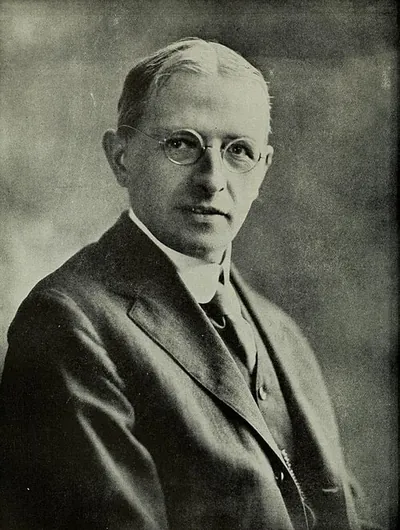 Henry Norris Russell1877–1957 · Astronomy and space
 Milutin Milanković1879–1958 · Astronomy and space
