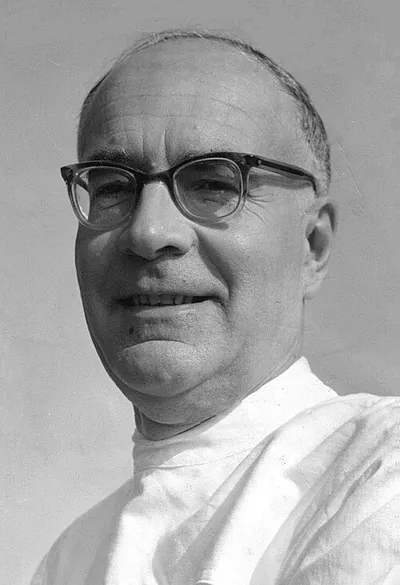
August Uno Lamm
Swedish electrical engineer and inventor, a pioneer of high-voltage direct current power transmission · 1904–1989
- Born
- May 22, 1904
- Died
- June 1, 1989
- Country
- Sweden
- Section
- Energy
Biography
Uno Lamm (Gothenburg, 1904 - Burlingame, California, 1989) was a Swedish electrical engineer and inventor. He is often considered the father of high-voltage direct current transmission, known as HVDC, a method of carrying electricity over long distances with fewer losses than conventional alternating current. His work unfolded in the first half of the twentieth century, when electrical grids were expanding and cities needed power from ever more distant plants.
He was born in Gothenburg, on Sweden's west coast, to a family that would shape his early path. He studied at the Royal Institute of Technology in Stockholm, where he earned his master's degree in 1927. After a short spell of compulsory military service, he joined ASEA, Sweden's largest electrical company, first through its training programme. In 1929 he was put in charge of a project to develop a high-power mercury arc valve.
A valve, in this context, is a device that lets current pass in one direction and controls its flow. The valves of the time handled only about 2,500 volts, which was not enough to move large amounts of power across hundreds of kilometres. Lamm spent years trying to build components that could withstand far higher voltages. In 1943 he received his doctorate with a thesis on the transductor, a pre-saturated direct current magnetic reactor, studying part-time while he kept working on the valve.
The results of that long effort came with the Gotland project. ASEA won the contract in 1950, and the system was completed in 1955 as the first modern commercial HVDC system. That same year Lamm became head of the company's project to develop Sweden's first commercial nuclear reactors, a sign of how broad his responsibilities had grown inside the firm.
At the start of the 1960s ASEA chose him to work with General Electric on the Pacific DC Intertie. The aim was to combine alternating and direct current networks so that electricity could flow from hydroelectric plants in the Pacific Northwest to consumers in southern California. By the end of 1964 he had settled there. From 1967 to 1988 he served as a director at large of the IEEE, the Institute of Electrical and Electronics Engineers, which gave him an influential voice in his profession.
Lamm was also a prolific writer. Over his career he obtained 150 patents and published about 80 technical papers. He also wrote for Swedish newspapers and magazines on social questions, often in criticism of his country's government. He was described as a firm anti-Communist who admired some features of the American economy.
During the Second World War he was required to travel to Nazi Germany on ASEA business. His superiors criticised his anti-Nazi stance, in particular his refusal to give the Nazi salute at patent hearings. In his personal life he married twice and had four children. He died in Burlingame, California, in 1989, aged 85.
His legacy is twofold. HVDC technology is today used to move power over long distances and to link grids, and in 1980 the IEEE created the Uno Lamm award in his honour. He also received many recognitions during his lifetime, including the Lamme Medal in 1965 and the Howard N. Potts Medal in 1981.
Main contributions
- 1929Leads the development of a high-power mercury arc valve, a key part for handling higher voltages.
- 1943Doctoral thesis on the transductor, a pre-saturated direct current magnetic reactor.
- 1955Gotland project: the first modern commercial high-voltage direct current (HVDC) transmission system.
- 1961Pacific DC Intertie project with General Electric, combining alternating and direct current networks in the western United States.
- Holds around 150 patents accumulated over his career.
Trivia and anecdotes
A name with a history
At a lecture in the United States, Lamm described his device and remarked that the same principle could be applied to resistors, making a transistor. That name was later given to the solid-state amplifier, although the direct link between the two should be treated with caution.
A refusal to salute
During the war, his refusal to give the Nazi salute at patent hearings drew criticism from his superiors at ASEA.
Their contemporaries
While August Uno Lamm was alive (1904–1989)…
Alive at the same time
Discovered or invented in those years
- 1916Black holeA region of space where gravity is so strong that nothing, not even light, can escape once it crosses a certain boundary.
- 1925TelevisionA system that sends moving pictures and sound over distance and shows them on a receiver, the television set.
- 1925Quantum mechanicsPhysical theory describing how matter and light behave at atomic and subatomic scales, where energy is exchanged in minimal packets and results are expressed as probabilities.
- 1931Big BangA cosmological model describing how the universe expanded from an early state of extreme density and temperature, about 13.8 billion years ago.
- 1945ComputerA programmable machine that takes in data, processes it by following stored instructions, and produces results, able to switch tasks simply by running different software.
- 1969InternetA global network of interconnected computer networks that communicate using the TCP/IP protocol suite.
 Igor Kurchatov1903–1960 · Energy
 Felix Wankel1902–1988 · Energy
 Walter Zinn1906–2000 · Energy
 John R. Dunning1907–1975 · Energy
 Mária Telkes1900–1995 · Energy
 Nikolay Dollezhal1899–2000 · Energy