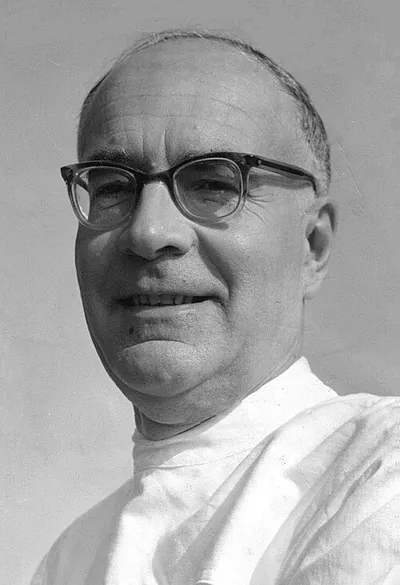
Boris Stechkin
Soviet engineer and inventor who specialised in heat engines and aircraft engines · 1891–1969
- Born
- August 5, 1891
- Died
- April 2, 1969
- Country
- Soviet Union, Russian Empire
- Section
- Energy
- Awards
- Abel Prize
Biography
Boris Sergeyevich Stechkin (1891-1969) was a Russian and Soviet scientist, engineer and inventor whose work centred on heat engines, machines that turn the energy released by burning fuel into mechanical work. He is remembered above all for his role in designing aircraft engines in the Soviet Union, a field that mattered greatly for both civil and military aviation in the twentieth century.
Stechkin was born in 1891 in the Russian Empire. He trained as an engineer at a time when aviation was still in its earliest years, and his technical education led him to work on high-powered machinery. His interest in the theory behind heat engines led him to develop his own account of how these systems operate, with the aim of applying it to real engine design.
During the 1910s he took part in pioneering aeronautical projects. He helped develop the Ilya Muromets, designed by Igor Sikorsky in 1913, regarded as the first four-engined aircraft and a large bomber. He also contributed to the Tsar Tank, built by Lebedenko in 1916 and 1917, which is often cited as the largest armoured vehicle ever made. Both projects show his early involvement with unusually large machines.
After the revolution, his work became part of the Soviet aviation industry, where he contributed to the design and improvement of many aircraft engines. During the Second World War and the years that followed, his achievements earned several state prizes, including a Stalin Prize, Second Class, in 1946 for creating a new type of aircraft engine and substantially improving an existing one. In 1957 he received the Lenin Prize for his part in creating the Tu-104, one of the world's first jet airliners for passengers.
In 1961 he was awarded the title Hero of Socialist Labour, the highest civilian honour in the USSR. He died in Moscow in April 1969.
His legacy lies mainly in the theory of heat engines and in the generation of engineers who worked on the propulsion systems he helped shape, whose influence on Soviet aviation lasted for several decades.
Main contributions
- 1913Ilya Muromets: co-developed the first four-engined aircraft and bomber, designed by Igor Sikorsky.
- 1917Tsar Tank: contributed to this armoured vehicle built by Lebedenko between 1916 and 1917, regarded as the largest in history.
- 1946A new type of aircraft engine and a major improvement to an existing one, earning a Stalin Prize, Second Class.
- 1957Tu-104: his role in creating this aircraft, for which he received the Lenin Prize.
Teachers and students
Trivia and anecdotes
Two Orders of Lenin
He received two Orders of Lenin, in 1947 and 1961, along with several military and civilian decorations.
Their contemporaries
While Boris Stechkin was alive (1891–1969)…
Alive at the same time
Discovered or invented in those years
- 1903AirplaneA fixed-wing aircraft, heavier than air, powered by engines or rockets, that stays aloft because its wings generate lift.
- 1925TelevisionA system that sends moving pictures and sound over distance and shows them on a receiver, the television set.
- 1925Quantum mechanicsPhysical theory describing how matter and light behave at atomic and subatomic scales, where energy is exchanged in minimal packets and results are expressed as probabilities.
- 1931Big BangA cosmological model describing how the universe expanded from an early state of extreme density and temperature, about 13.8 billion years ago.
- 1945ComputerA programmable machine that takes in data, processes it by following stored instructions, and produces results, able to switch tasks simply by running different software.
- 1969InternetA global network of interconnected computer networks that communicate using the TCP/IP protocol suite.
 Albert Betz1885–1968 · Energy
 Harry Ricardo1885–1974 · Energy
 Nikolay Dollezhal1899–2000 · Energy
 Mária Telkes1900–1995 · Energy
 Felix Wankel1902–1988 · Energy
 Igor Kurchatov1903–1960 · Energy